


‘Hating Bangladesh’ is a Key Theme in Indian Election Campaign
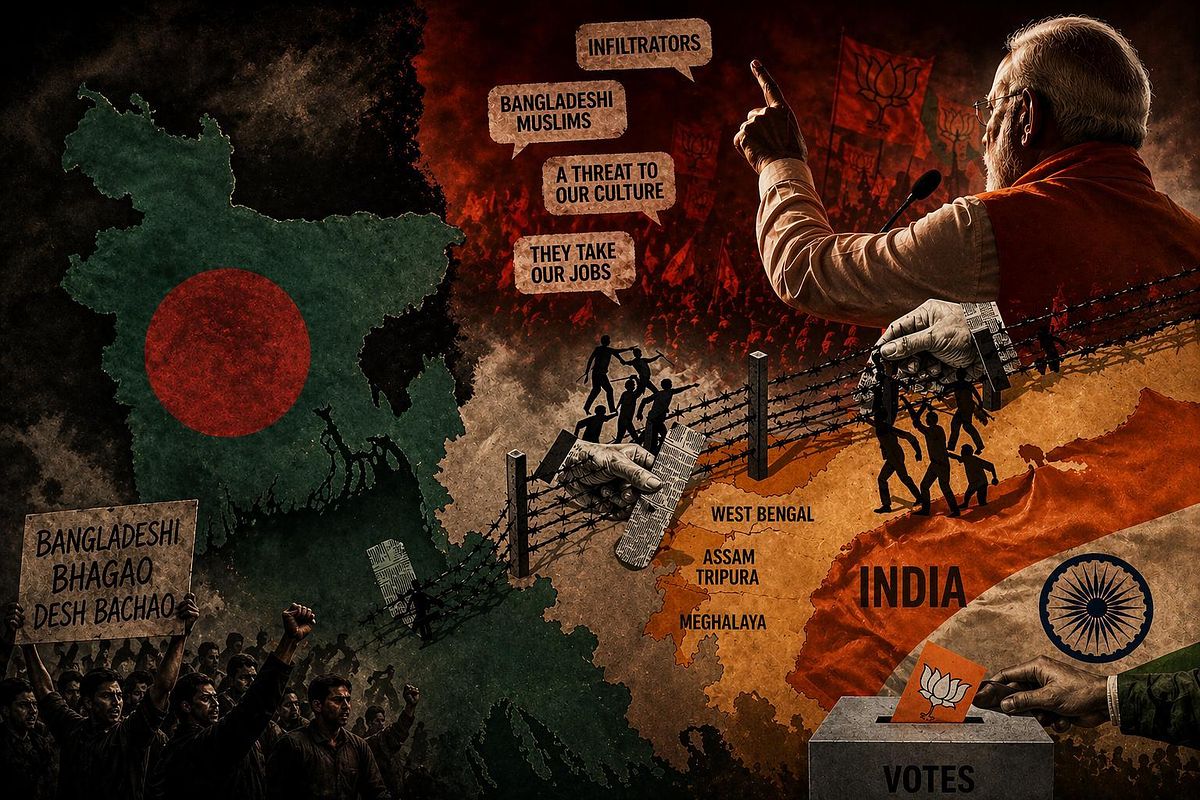

Bangladesh has become a recurring theme in election campaigning by India’s ruling Bharatiya Janata Party (BJP) in states that border the country. In speeches, campaign videos and party messaging, senior BJP leaders have linked Bangladesh to illegal migration, border insecurity, demographic change and alleged voter fraud.
The rhetoric has been most visible in West Bengal ahead of the state’s two-phase assembly election on April 23 and April 29. But similar messaging has also appeared in Assam, Bihar and parts of northeastern India.
The BJP has been weaponizing the issue of undocumented migration from Bangladesh for years, particularly in Assam. What has changed is the scale of the campaign and the way it now overlaps with voter-roll revisions, border security promises and AI-generated online propaganda.
The election campaign turned hateful towards ‘Bangladesh’, an identity that has been increasingly becoming ‘derogatory’ and turning into a weapon of vilification of minorities in India.
This development comes at a time when relations between Dhaka and New Delhi have strained since the fall of Sheikh Hasina in August 2024.
Anti-Bangladesh Rhetoric During Polls
For decades, the BJP and other Hindu nationalist groups have labelled sections of Muslim communities, especially those speaking Bengali, in border regions as “outsiders” or “foreigners”, often accusing them of being undocumented immigrants from Bangladesh. In Assam, the state government created special tribunals to hear citizenship cases, while hundreds were sent to detention centres across the state.
In West Bengal politics, as an Atlantic Council columnist has noted, Bangladesh now functions “less as a foreign policy concern than a domestic political proxy through which citizenship, demography, and belonging are contested”.
The same line has been repeated by senior BJP leaders during the campaign.
BJP national president Nitin Nabin accused West Bengal’s ruling Trinamool Congress (TMC) of failing to develop the state while allowing undocumented migrants to settle there.
“Over the past 15 years, the people of Bengal haven't developed at all; instead, Bangladeshi infiltrators have certainly come here and settled down. Now their names will be Delete, Deport, and Depart.”
In another statement, he said Bengal’s land had been handed over to Bangladeshi infiltrators while local people were forced to migrate in search of work.
Jagat Prakash Nadda, India’s health minister and a senior BJP leader, said the TMC was trying to turn Bengal into Bangladesh and promised that a BJP government would remove infiltrators.
Prime Minister Narendra Modi used similar language at a rally in Purba Bardhaman district on April 11.
“The infiltrators should start packing their bags; it is time to leave. Those who have helped the infiltrators will not be spared.”
Home Minister Amit Shah told a rally on April 21 that alleged infiltrators should prepare to go to Bangladesh after the vote count.
In another statement shared by the party, Shah said the election was about freeing Bengal from infiltrators.
At a rally in Chandipur, Shah also promised that if the BJP came to power, the border with Bangladesh in West Bengal would be sealed with barbed fencing within 45 days. He accused the TMC of deliberately keeping the border open.
West Bengal is Leading the Hate Campaign
West Bengal, bordering Bangladesh is one of India’s most important electoral battlegrounds where anti Bangladesh sentiment has been widely curated in the campaign.
The BJP has never governed West Bengal. Since 2011, the state has been ruled by the Trinamool Congress (TMC) led by Mamata Banerjee. For the BJP, winning Bengal would mark one of its biggest political breakthroughs in eastern India.
Suvendu Adhikari, one of the BJP’s most prominent leaders in the state, has repeatedly tied the election to Bangladesh and the issue of alleged infiltration.
At a rally on March 30, Adhikari said West Bengal must not be allowed to become Bangladesh and that infiltrators would not be allowed to control the state.
On April 4, he warned Hindu voters that a wrong decision in the election would turn Bengal into “Greater Bangladesh”.
In another televised appearance, Adhikari said BJP flags were visible in Hindu villages but not in Muslim villages, while those residents still received government benefits.
The same line has also been echoed outside Bengal. In Bihar, BJP state president Sanjay Saraogi said Bangladeshi infiltrators had become a national issue rather than only an election issue.
In Meghalaya, BJP leader Anil Antony described infiltration from Bangladesh as a major national concern and defended voter-roll revision exercises.
On April 21, Union Home Minister Amit Shah said: “Today, I am telling the infiltrators that the counting is on the 4th, and on the 5th, the BJP government will be formed... Get ready to go to Bangladesh quickly. Now, under the leadership of Modi ji, the journey from fear to trust will begin in Bengal.”
In another post shared by the BJP’s official X handle, Shah said: “This election is not about making someone a legislator or a BJP worker the Chief Minister; rather, it is an election to free the whole of Bengal from infiltrators.”
On the same day, Shah promised that the international border between West Bengal and Bangladesh would be sealed with barbed fencing within 45 days if the BJP came to power in the state.
Addressing a rally in Chandipur, he accused the TMC of deliberately keeping the border open to allow infiltrators to enter West Bengal.
“Freeing West Bengal of the illegal infiltrators is our priority. Neither the current Chief Minister nor her nephew will ever allow that. Those who are responsible for allowing illegal infiltrators to enter West Bengal will never drive them away from the state. They have deliberately kept the international borders with Bangladesh unfenced and open,” Shah alleged.
Anil Antony, the BJP leader in charge of Meghalaya, also expressed serious concern over illegal infiltration, particularly from Bangladesh, calling it a major national issue.
Speaking to the media, Antony said both Prime Minister Narendra Modi and Amit Shah had repeatedly raised the issue and introduced measures to curb illegal entry, including border fencing.
He said the BJP was committed to decisively tackling infiltration from Bangladesh.
On the Special Intensive Revision (SIR), Antony said the exercise is constitutionally mandated and not a new initiative, noting that it had been conducted in previous years as well. He added that the SIR aims to streamline electoral rolls by removing duplicate entries, updating details of relocated voters, and ensuring that only eligible citizens are able to cast their votes.
BJP Deploys AI Videos to Stoke Anti-Muslim Hate
Assam has been one of the main testing grounds for this political messaging.
A now-deleted AI-generated video posted by BJP Assam showed Chief Minister Himanta Biswa Sarma appearing to fire at images of Muslim men under the words “No Mercy”.
The video mixed real footage of Sarma handling a rifle with AI-generated scenes of two Muslim men being targeted under the words “No Mercy”. It also showed Sarma dressed as a cowboy pointing a pistol, alongside text such as “Foreigner free Assam”.
Local media identified one of the men shown in the video as a member of parliament from the opposition Indian National Congress party. The video was shared ahead of Assam’s assembly election, where Muslims make up about one-third of the population.
Sarma later defended the video and said the issue was not the imagery itself, but that it had failed to include the word “Bangladeshi”.
“The video was fine. Just one word was needed to be added. They had to put the word ‘Bangladeshi’,” he said at an event in Guwahati on March 12.
He added that the shooting shown in the video was symbolic and said a revised version would be reposted later.
Researchers at Bellingcat said the Assam video was part of a wider pattern.
The group analysed 499 visual social media posts shared on Facebook, Instagram and X by official BJP accounts in Assam and West Bengal. It found that 194 posts appeared to meet the United Nations definition of hate speech — meaning speech targeting people based on religion, ethnicity or national origin. Thirty-one of those posts contained obvious AI-generated imagery.
The study examined 202 posts from BJP Assam and 297 from BJP West Bengal. It also reviewed posts from opposition parties during the same period: 194 from Congress in Assam and 357 from the Trinamool Congress (TMC) in West Bengal.
While all major parties appeared to use AI-generated visuals in some posts, Bellingcat said hateful messaging was concentrated in BJP content.
In Assam, researchers identified 28 BJP posts using AI-generated imagery. Twenty-four of them contained hateful messaging. By contrast, 41 Congress posts appeared to use AI-generated imagery, but none met the hate-speech threshold.
In West Bengal, Bellingcat found 14 BJP posts with clear signs of AI generation, seven of them hateful. It also found 15 TMC posts using AI visuals, but none that qualified as hate speech.
The largest category of hateful messaging targeted Bangladeshi or Bengali-origin Muslims. These posts often referred to them as “infiltrators” or “foreigners”. Researchers counted 66 such BJP posts in December alone, eight of which used obvious AI-generated imagery.
One video showed AI-generated protests against “illegal infiltration” in Assam and warned viewers to “wake up” or the state would “turn into Bangladesh”.
Another mixed real footage from past violence in Assam with AI-generated images of Muslim men. A song in the background accused them of taking over “Assamese land” while showing non-Muslim Assamese people crying.
In September, BJP Assam posted another AI-generated video titled “Assam without BJP”. It portrayed the state as being taken over by Muslims, whom it described as illegal immigrants.
The video showed Muslims occupying airports, tea estates, heritage sites and the stadium in Guwahati. Women were depicted wearing hijabs or burqas, while men wore skullcaps, tunics and lungis.
Captions claimed this future was the “dream” of opposition leader Gaurav Gogoi and suggested links between his Congress party and Pakistan by showing Rahul Gandhi beside a Pakistani flag.
The video also falsely claimed that Muslims would rise to 90 percent of Assam’s population. Muslims currently make up 34.22 percent of Assam’s 10.7 million people.
The BJP Assam account has repeatedly used coded and derogatory language. It referred to Muslims as “Kanglus”, a slur used for people from Bangladesh, and called Congress MP Gaurav Gogoi the “messiah of miyah”.
“Miyah” is commonly used as an honorific for Muslim men in South Asia. In Assam, the term has increasingly been used in a derogatory way against Muslims with roots in eastern Bengal, now Bangladesh.
The account also shared AI-generated content showing Gogoi wearing a skullcap and speaking on the phone with Pakistan army chief Asim Munir.
One widely criticised video posted on September 16 by BJP Assam showed Muslim men and women occupying landmarks across the state, including Guwahati Airport, the Accoland amusement park, Rang Ghar and the city stadium.
It began with an elderly Muslim man cutting meat under the caption “Beef Legalisation”. It then showed Rahul Gandhi and Gaurav Gogoi with a Pakistani flag and the caption “Pakistan Link Pirty”. Another segment showed tea gardens populated only by Muslim tourists.
The video later depicted migrants entering Assam freely and Hindus losing land to Muslims, before ending with the message: “Choose Your Vote Carefully.”
The video drew criticism from Asaduddin Owaisi, who accused the BJP of treating the presence of Muslims in India as a problem.
“BJP Assam has posted a disgusting AI video that shows a Muslim-majority Assam if there was no BJP,” he said. “They are not fear-mongering just for votes, this is the repulsive Hindutva ideology in true form.”
The wider political context is also significant.
India Hate Lab, a project of the Washington-based Center for the Study of Organized Hate, recorded 1,318 hate speech events in India in 2025 — an average of more than three each day. It said 98 percent targeted Muslims, with Muslims explicitly named in 1,156 cases.
Human Rights Watch said in a report published in August 2024 that Prime Minister Narendra Modi and several BJP leaders “frequently used hate speech against Muslims and other minorities, inciting discrimination, hostility, and violence” during the 2024 general election campaign.
The report also noted that Modi had once been denied a US visa over his links to the 2002 anti-Muslim violence in Gujarat, where more than 1,000 people, mostly Muslims, were killed.
The Center for the Study of Organized Hate said in a 2025 report on AI-generated imagery and Islamophobia that such visuals strengthen the association between Muslim identity and illegality.
“AI-generated images on these themes reinforce associations between Muslim identity and illegality, reinforcing xenophobic and Islamophobic stereotypes,” the report said.