RAB Impersonation and an Attempted Abduction: How Did Suman Mia’s Name Enter the Case?
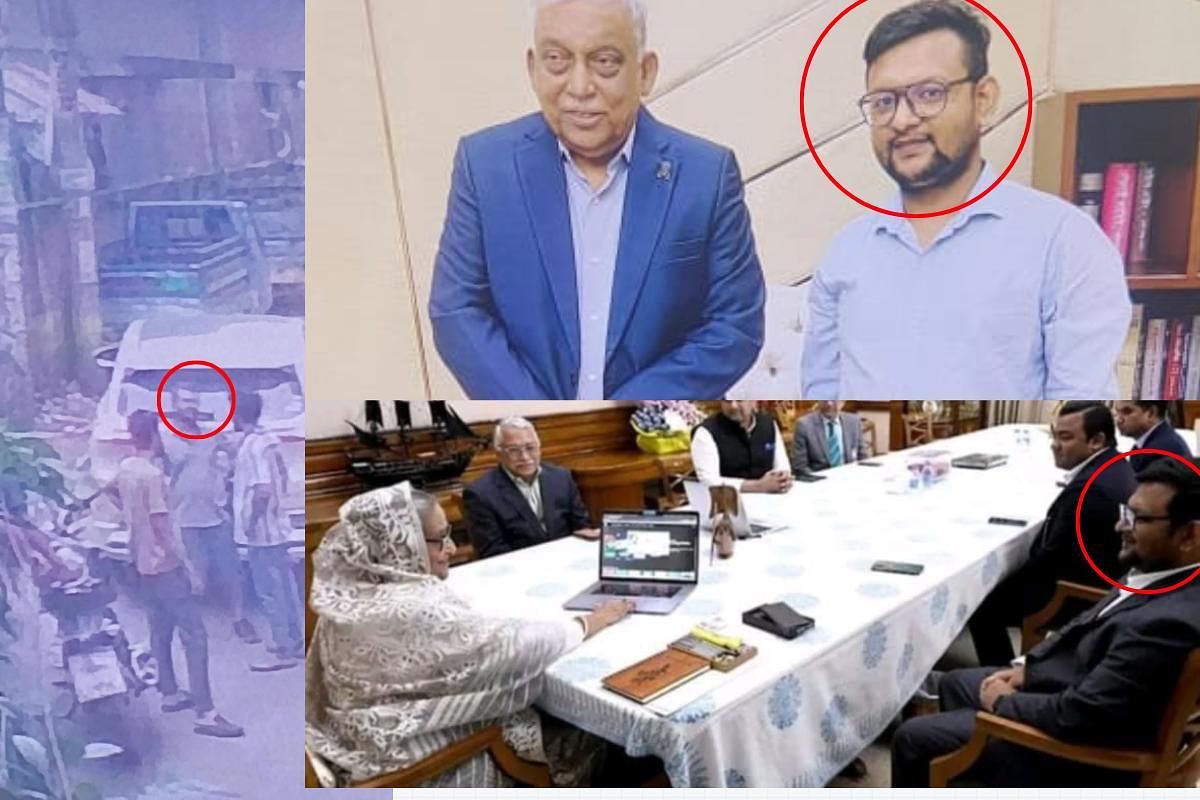
At 5:57 a.m. on Sept. 6, a white Toyota Harrier with no license plates stopped outside a building in Koltabazar, in Old Dhaka. A women’s residential mess occupied the seventh floor.
Security camera footage shows a man in a T-shirt and three-quarter-length pants getting out of the vehicle. He lit a cigarette after taking one from another man beside a motorcycle. Three more men in civilian clothes soon joined them.
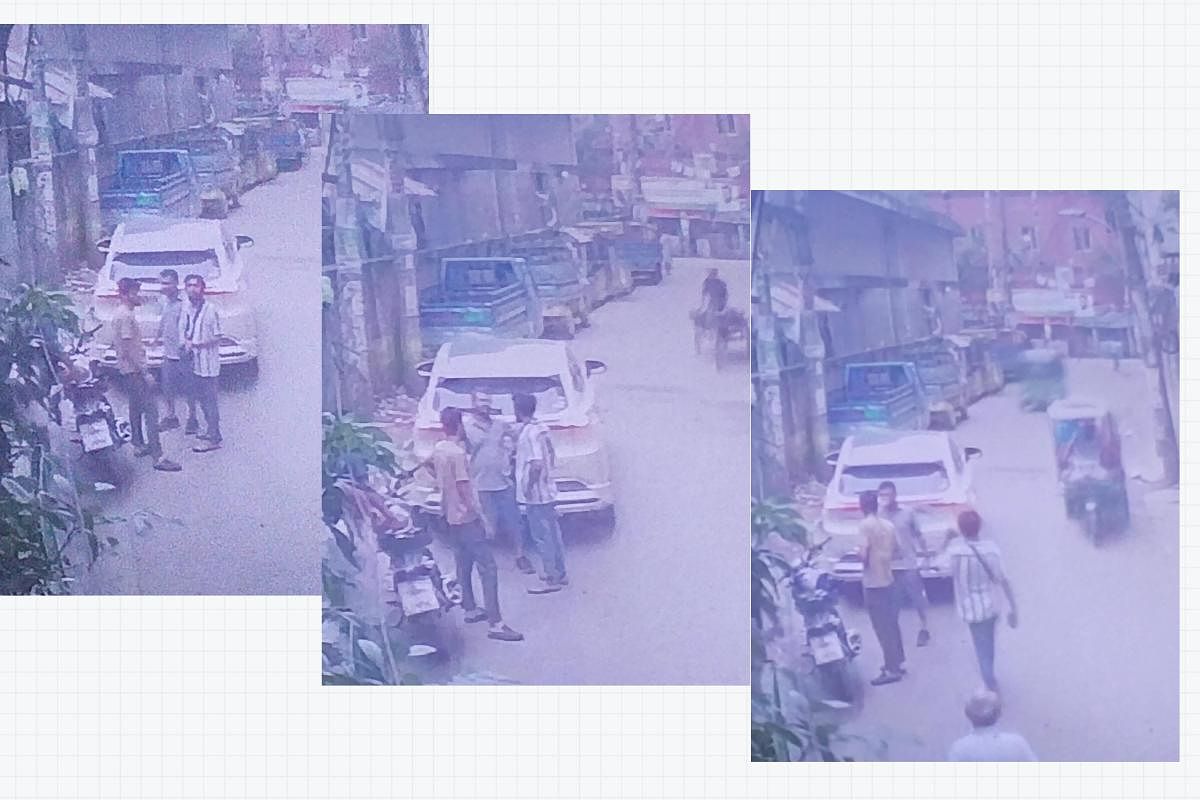
Momtaz Ara Barsha, a former student in Jagannath University’s Department of Theatre from the 2015–16 academic year, lived in the mess with several other women. Footage from another camera shows some of the men who had been standing near the motorcycle knocking on the door of their rented apartment.
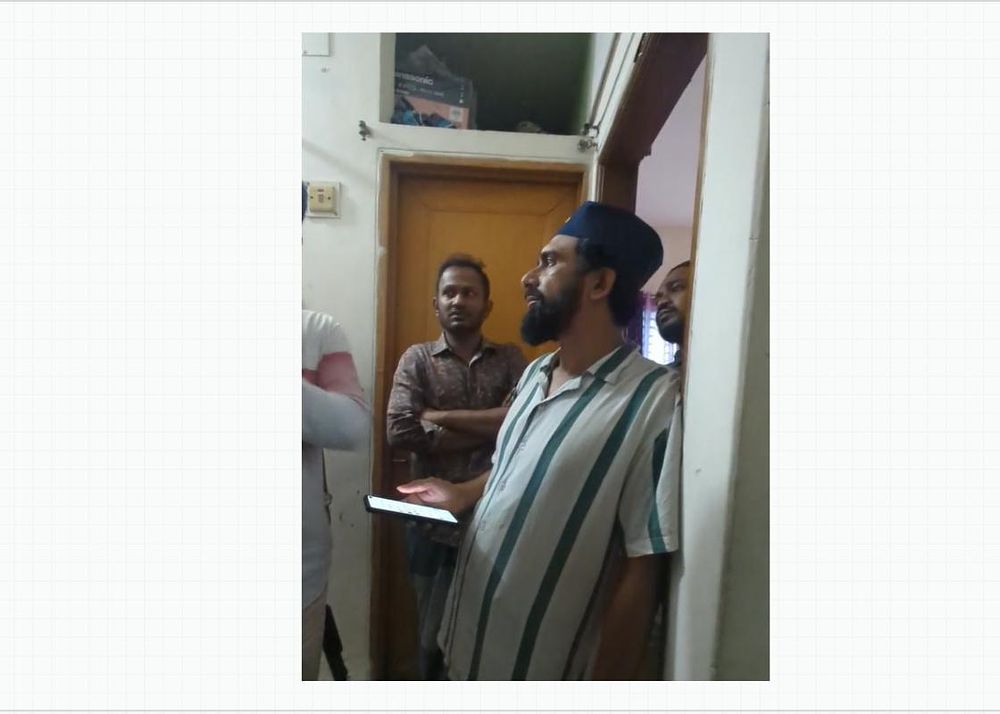
The women inside asked who they were. At first, the visitors would not identify themselves. They then said they were members of the Rapid Action Battalion, or RAB, and told the women to open the door.
When the women refused, the men tried to force it open, according to residents of the mess. The women called the national emergency service, 999. By then, neighbors from nearby apartments had gathered. The women eventually opened the door after the men continued to press them.
Three men in civilian clothes entered and searched the apartment. They then tried to take Barsha with them. She and the other residents asked to see a search or arrest warrant, but the men produced neither, the residents said.
A team from Sutrapur police station arrived. Around the same time, three RAB-2 vehicles bearing RAB markings pulled up outside. Uniformed officers went to the seventh floor and said Barsha was named in a theft case filed with Cantonment police station and would be taken away.
A team from Jagannath University’s proctorial office also reached the building, accompanied by Mostafizur Rahman, the university student union’s secretary for social service and student welfare, and Tarek Bin Atik, the university’s transport administrator.
Mr. Atik told The Dissent that the men in civilian clothes initially said they had come to the building by mistake. Later, they said they had come to apprehend a suspect in a theft case.
At one point, he said, Barsha was put into a vehicle. University officials intervened. Amid objections from the officials and students, the men left without her. According to those present, the men in civilian clothes had shown neither arrest warrants nor identification.
“The team had come from RAB-2,” Mohammad Matiur Rahman, the officer in charge of Sutrapur police station, told The Dissent that day. “They had gone there concerning a suspect in a case filed with Cantonment police station.”
Barsha says the man in three-quarter-length pants who arrived in the Toyota Harrier was her younger sister’s former husband, Suman Ahmed, also known as Suman Mia. Her sister, Sharmin Akter Shraboni, also identified the man to The Dissent as her former husband and said the white vehicle belonged to him.
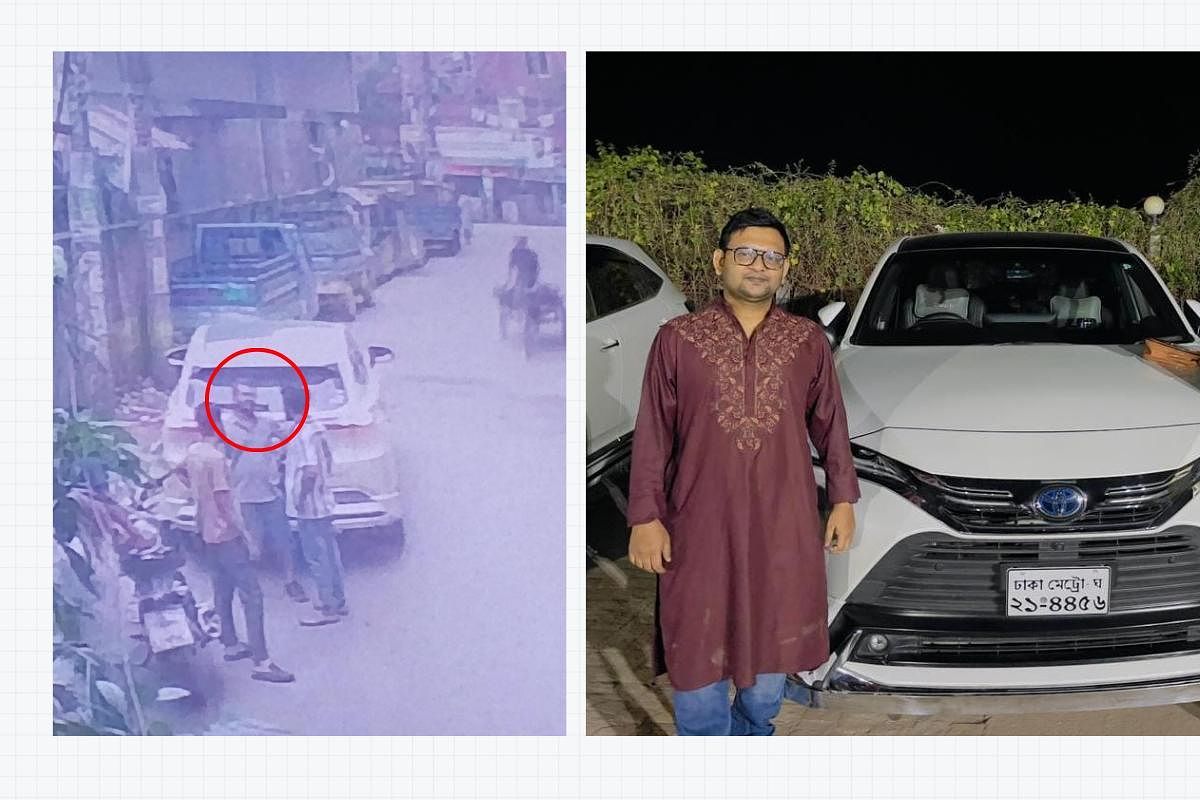
Barsha alleges that Mr. Suman used his connections and influence with RAB to try to take her away because of a family dispute stemming from his marriage to her sister.
Who Is the “Influential” Suman Mia?
Barsha describes Mr. Suman as an information technology specialist who has worked for years with RAB, the police and the Directorate General of Forces Intelligence, or DGFI.
She alleges that before the 2024 uprising, he developed a “Mujib” app that brought him close to the ousted prime minister, Sheikh Hasina, and the Awami League. Even after the Awami League government fell, she says, he retained ties to law enforcement agencies and government bodies.
According to Barsha, her sister divorced Mr. Suman on April 11 following repeated allegations of extramarital relationships. He opposed the divorce, she says, and began threatening the family afterward.
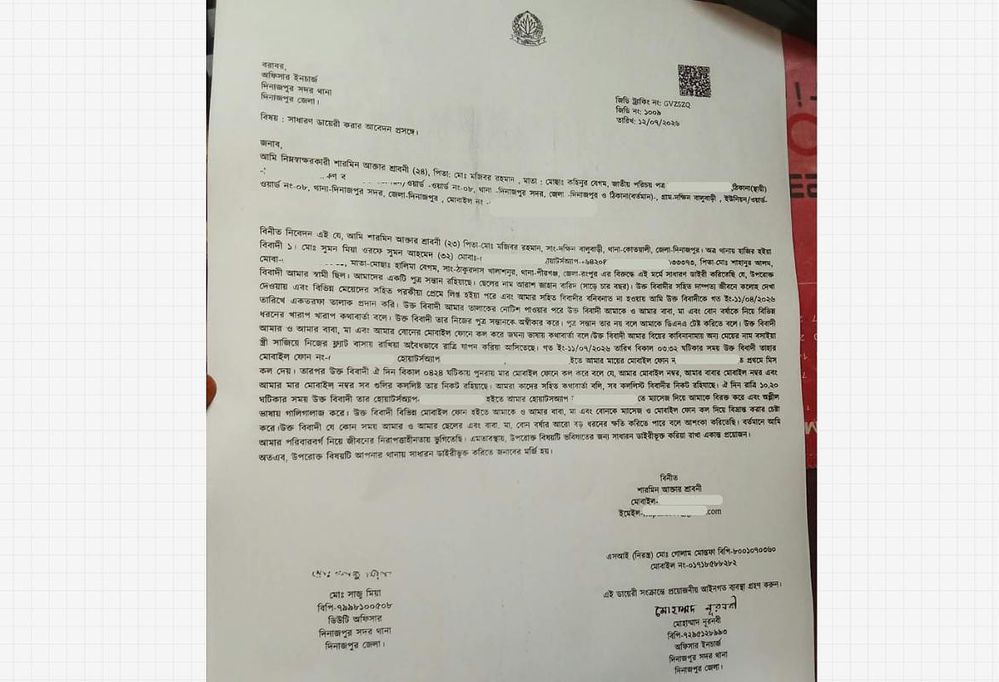
On July 12, Shraboni filed a general diary with Dinajpur Sadar police station reporting threats from her former husband. On July 19, she filed a case against him under a law concerning violence against women and children. Barsha says the threats continued.
She alleges that Mr. Suman threatened to “finish off” family members one by one, to deal with them “within a week,” and to frame them by planting contraband, using a phrase involving “gold.”
Then, on Aug. 12, Barsha’s name appeared in the complaint in a theft case filed with Cantonment police station in Dhaka. She believes Mr. Suman orchestrated RAB’s attempt to take her away.
“They didn’t stop at putting my name in a false case and trying to take me away,” she told The Dissent. “One defamatory propaganda report after another is being published about me in different media outlets. My private photos are being sent to various people to defame me. My family and I are mentally devastated.”
Suman’s Rise During the Awami League Years
Mohammad Suman Mia, 32, was born in Pirganj, Rangpur, and presents himself as an information technology entrepreneur. His former wife and former sister-in-law say his technology work helped him build relationships with law enforcement officers, intelligence agencies and influential figures in the Awami League government.
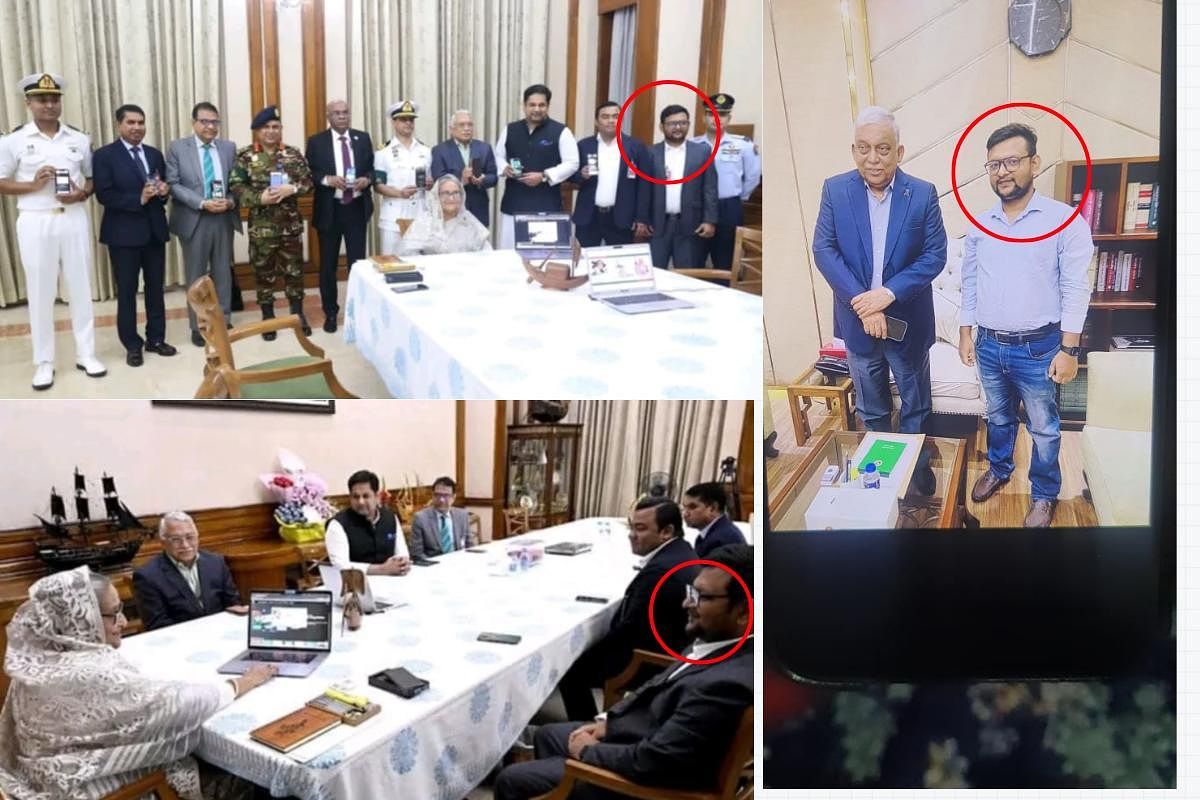
Mr. Suman is the chief executive of Durbar Tech. In February 2024, Durbar Technologies Limited and Mr. Suman created a “Bangabandhu” app about the life of Sheikh Mujibur Rahman. Ms. Hasina, then prime minister, later inaugurated it. Mr. Suman was photographed standing beside her. Photographs also show him with Asaduzzaman Khan Kamal, the home minister at the time.
Mr. Suman and Shraboni were married from 2017 until April this year. Shraboni was 15 when they married. They have a 4-year-old son.
“More than 80 million taka was invested in the app made for the government,” Shraboni told The Dissent. “He took no money from Sheikh Hasina; he made it as a gift. After that, his access to and influence with important people in the government grew.”
“He is very skilled in I.T. and hacking,” she added. “He used to solve online problems, including issues with the Facebook pages of well-known people and models. That work brought him into contact with many influential people.”
Shraboni alleges that managing social media accounts and pages, gathering information and providing technical assistance also helped Mr. Suman develop relationships with law enforcement officers. Eventually, she says, he began working as an “informant” for RAB, the police and DGFI.
“Suman worked as an informant for RAB, the police and DGFI,” Barsha said. “He also did I.T.-related work for them — sometimes finding information, sometimes fixing problems with online accounts or pages. That is how he became close to them.”
She further alleges that during the Awami League years he provided information about opposition political activists and helped authorities apprehend them.
The family says Mr. Suman used both his political and administrative connections and his technical skills to exert influence in his personal life. They say he claimed he could obtain people’s private information, phone numbers, locations and online account details.
“Even after we changed our numbers, he found the new ones,” Barsha said. “He could learn whom we were contacting and where we were. Because he works in I.T. and knows people in law enforcement, we were always afraid.”
Shraboni likewise alleges that Mr. Suman obtained the family’s new contact details after they changed phone numbers and moved. The Dissent could not establish whether he obtained that information through hacking, personal contacts or some other means.
The family has also questioned his finances. Shraboni says his technology company is effectively closed and has no visible substantial business activity, yet he owns a house and a car worth more than 15 million taka.
“How much does the C.E.O. of an ordinary company earn?” she said. “His company is closed now, and there isn’t much work. Yet his house and car are worth more than 15 million taka. Where that money came from needs to be investigated.”
The Dissent could not independently verify these allegations, particularly those concerning Mr. Suman’s assets, income, company or investments.
Barsha and Shraboni say he maintained his law enforcement contacts after the Awami League government fell in the 2024 uprising. They allege that he drew on those relationships to influence RAB amid the family dispute.
“Even after the government fell, he had contacts in RAB and the police,” Barsha said. “He knew whom to ask to get things done. After my sister filed the case, he used that influence to try to implicate me in a theft case.”
Mr. Suman denied the allegations to The Dissent.
“I have no connection with RAB,” he said. “If I had that much money, everyone would know what it was and where it was. They can’t establish it just by saying so.”
Barsha Named in a Theft Case Involving a RAB Officer
On Aug. 12, amid the dispute between Mr. Suman and his former wife’s family, Hasan Muhammad Muhtarim, a senior assistant superintendent of police serving with RAB-2, filed a theft case with Cantonment police station.
According to the complaint, 1.4 million taka and 10 bhori of gold were stolen from the officer’s home. He named his driver, Mohammad Russell, and Russell’s wife, Machura Begum, as suspects. Both have since been arrested. The complaint says the money had been kept at the home for work on the residence.
The complaint describes Russell telling the officer’s wife that Machura had been possessed by a jinn, or spirit. The supposed spirit, Russell allegedly said, knew many details about her family; following its instructions would advance her career and protect the family from danger.
The complaint identifies Mr. Muhtarim as a police officer. His wife is a senior assistant secretary. It alleges that Russell and Machura used the story about the jinn to obtain money and gold jewelry from her. It also accuses them of giving her a sedative before stealing cash and jewelry.
According to the complaint, the couple sold the stolen gold to Barsha.
Barsha says she does not know either of them and has never bought anything from them.
“I don’t know either of these people,” she told The Dissent. “I have neither the means nor any reason to buy 10 bhori of gold. I support myself by tutoring three students. Even the phone I use was bought on installments. Investigate where and when I supposedly bought gold.”
She alleges that Mr. Suman used his influence to get her name added to the case.
Asked about the operation at Barsha’s apartment, Noymul Hasan, the director of RAB-2 and an additional deputy inspector general of police, told The Dissent: “RAB went there to apprehend a suspect named in the complaint in a case. At the time, pressure was put on RAB not to arrest the suspect.”
Asked whether Mr. Suman had influenced the inclusion of Barsha’s name in the complaint, Mr. Hasan responded: “Who is Suman? I don’t know Suman. There is no one by that name in RAB-2.”
Asked why Mr. Suman would have been present at the operation if he had no role in the theft case, Mr. Hasan said: “For operations of this kind, a person familiar with the matter is taken along as an informant.”
Mohammad Rakibul Hasan, the officer in charge of Cantonment police station, told Banglanews24 that RAB had conducted the operation while investigating an allegation that Barsha bought stolen gold jewelry. He said cash and gold jewelry worth about 3.9 million taka had been stolen from the assistant superintendent’s home. Although two suspects had been arrested, no stolen property had been recovered from them, he said, and the police had requested RAB’s assistance.
“Barsha’s name was mentioned in the complaint in connection with the alleged purchase of stolen gold jewelry,” Mr. Hasan said. “RAB may have gone there on information suggesting that questioning her could yield information or evidence about the stolen property.”
Asked what evidence led him to name Barsha in his complaint, Mr. Muhtarim, who filed the theft case, said: “Her name was included based on information from a trusted source.”
A Mysterious Message on Barsha’s Phone
Police arrested Russell and Machura on Aug. 28. That same day, Barsha received a series of suspicious messages from an unfamiliar number. The Dissent viewed the messages on her phone.
One read: “Sister, I’m in a lot of trouble. Amin bhai hasn’t paid for the goods. Did you send everything to Dinajpur to Amin bhai? You aren’t answering my calls or messages. The police are looking for me.”
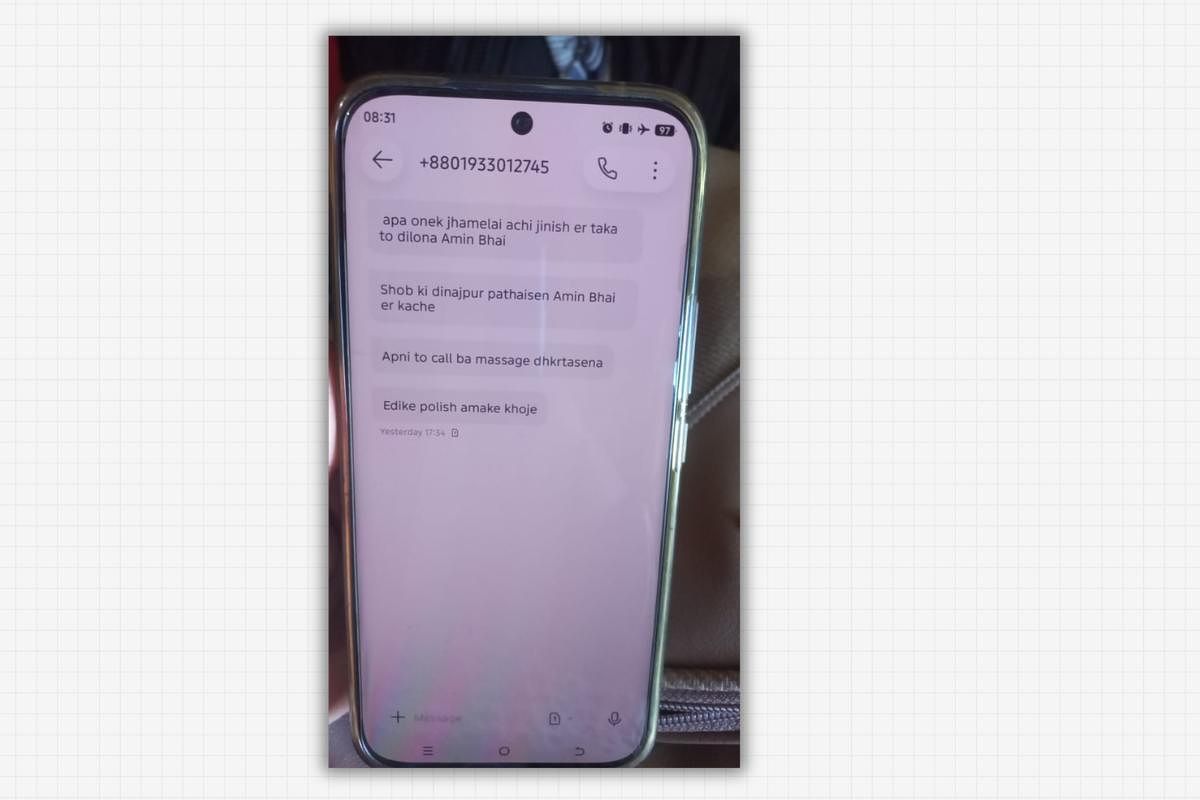
Barsha and Shraboni believe the messages were meant to create the impression that Barsha had taken part in an illicit transaction or received stolen goods.
Alarmed, Barsha sent her sister a screenshot. The Dissent verified their WhatsApp conversation about the message from last month. Shraboni then went to Dinajpur police station, showed the screenshot to the investigating officer and told him of her concern.
“I told Sub-Inspector Mizanur Rahman that the messages did not look right to me,” Shraboni said. “They were written as though my sister was involved with stolen goods. The S.I. said that because we had already filed a general diary and a case, I shouldn’t worry.”
Mr. Rahman confirmed the exchange to The Dissent. “Shraboni showed me the messages at the time and told me of her concern,” he said. “I am aware of the matter.”
On Sept. 6, RAB personnel tried to take Barsha from the Koltabazar apartment.
“There is a connection between RAB’s attempt to take me away and that unidentified person’s messages,” Barsha told The Dissent. “After RAB came to my home on Sept. 6, I learned of a theft case through a lawyer. The text message was sent to me at 5:34 p.m. on Aug. 28.”
The family believes that an earlier threat to frame them by “planting gold” is connected to Barsha being named in the theft case. Barsha alleges that Mr. Suman used his contacts and influence to implicate her because of the family dispute.
Their suspicions deepened, they say, because they identified Mr. Suman outside Barsha’s building early on the day of the operation. Both sisters say he is the man seen in security footage arriving in a white Toyota Harrier without license plates.
“The person who threatened to deal with us within a week and frame us with gold was outside my home early that morning,” Barsha said. “Then RAB came to take me away in a theft case. You cannot look at these events separately.”
The Dissent asked Mr. Suman whether he had gone to Barsha’s building on the morning of Sept. 6. He did not answer yes or no.
“In any case involving a suspect, whom would the complainant choose?” he said. “Someone familiar, of course.”
Asked whether he could serve as a source in a case involving a family with whom he was in conflict, he said: “If there is a conflict with me, the authorities would understand that I am the perfect person. I would be the best at locating [her]. But I am not interested in these things. I don’t even know what case has or hasn’t been filed.”
Asked again whether he had gone to Barsha’s home on Sept. 6, he said: “I am not involved in any of this. I’m not going there. I’m not concerned with them.”
Asked about allegations that he had threatened Barsha and Shraboni from different numbers, Mr. Suman said: “They are the ones who threaten me. They call from different numbers and use abusive language.”
Reports That Portrayed Barsha Negatively
The Sept. 6 attempt to take Barsha away was covered prominently by The Dissent and several other outlets. Barsha says, however, that some reports portrayed her negatively and included false information.
On Sept. 9, Nagorik Television published a report headlined, “That JnU Student Is a Leader of the Banned Chhatra League; Controversy Over the Disbanded RAB!”
The report did not describe the attempt by men in civilian clothes to take Barsha away at about 6 a.m. Instead, it claimed that RAB and other law enforcement personnel had gone to arrest her on Sept. 6 but had to release her in the face of a “mob.”
It also called Barsha a member of a “gold-smuggling group” and referred to allegations against her from her time at university. Nagorik Television presented no evidence that she belonged to such a group.
The outlet wrote that its investigation had found no clear basis for the claims reported by media immediately after the incident that someone had tried to arrest or forcibly disappear Barsha because of a family feud. Instead, it said, allegations had emerged that she had used Jagannath University students’ concerns about her safety to evade the Cantonment police case and stir controversy around RAB.
“Nagorik TV wrote false things despite the presence of my former brother-in-law, Suman Mia, during the attempt to arrest me and despite the related evidence,” Barsha told The Dissent.
“I did nothing that could be described as using tricks to escape a case,” she said.
Nagorik Television quoted someone it identified as Barsha’s roommate as saying Barsha earned only 7,000 taka a month from tutoring but occupied two beds by herself at a cost of 6,500 taka. The report also said she had never given her roommates her phone number or correct identity, spent much of the day talking to people on the phone, and led an unusually expensive lifestyle.
Barsha’s roommate disputed the account. “No one lives in our room apart from Barsha apa and me,” she told The Dissent. “Nagorik TV did not speak to me.”
The report also claimed that Barsha had told the building’s caretaker to say he did not know her and that she did not live there if anyone asked.
Barsha acknowledged giving him such an instruction but said the report omitted the reason. Documents concerning her sister’s divorce were being sent to Barsha’s address, she said, and Mr. Suman had begun threatening her family.
“I told the caretaker that my sister had divorced, that we felt unsafe, and that if someone asked about me, he should say I had moved out or that he knew nothing,” she said. She said she could show the divorce documents bearing her address.
“The report also questioned my lifestyle,” she added. “I live very simply. Even the phone I use now was bought on installments, and I can prove it. If I were involved in gold smuggling, why would I need to buy a phone on installments?”
Nagorik Television’s report cited an unnamed “concerned citizen” and an unnamed “legal expert” who criticized damage to RAB’s reputation. It did not give their identities. The outlet did not include comments from Barsha or anyone in her family.
On Sept. 10, Kalbela published a report headlined, “A ‘Jinn King’ Behind That JnU Student; Barsha Long Involved in a Stolen-Gold Sales Ring.” The report accused Barsha of helping sell stolen gold but presented no evidence for the allegation and did not include her response.
Human rights activist Rezaur Rahman Lenin told The Dissent that a RAB team could carry out an operation if it had been authorized, but he saw no indication of authorization in this case. There were no arrest-warrant documents, he said. In his view, Mr. Suman’s attempt to have Barsha taken away appeared connected to the case filed against him under the law concerning violence against women and children.
“Trying to take her away in civilian clothes and without an arrest warrant undoubtedly bears the signature of the RAB we saw during Sheikh Hasina’s rule,” he said.
Allegations of Threats After the Divorce
Barsha and Shraboni say the Sept. 6 incident is tied to a long-running family dispute involving Shraboni’s former husband, allegations that he had relationships with other women, their divorce and the case filed against him.
Shraboni told The Dissent that she and Mr. Suman were married for nearly eight years and had a child together. Several years into the marriage, she said, they grew apart. She alleges that he kept her and their child for long periods at her father’s home in Dinajpur while he lived in Dhaka and did not want her to live with him there.
Barsha gave a similar account. She says Mr. Suman repeatedly found reasons to send Shraboni back to Dinajpur when she wanted to stay with him in Dhaka. On one occasion, Barsha alleges, he beat Shraboni after she went to Dhaka and sent her back to her father’s home.
“My sister kept saying he wouldn’t bring her to Dhaka,” Barsha said. “When she stayed at her father’s home with the child, people in the village talked. I suggested that she rent a place. Even when she later went to Dhaka, Suman did not stay with her. Once, when my sister went to Dhaka, he beat her and sent her back.”
Shraboni alleges that while she was in Dinajpur, Mr. Suman had relationships with several women in Dhaka. She later learned, she says, that he had brought women to his home while she was away.
Mr. Suman visited his in-laws in Dinajpur on Dec. 14 for their child’s birthday and returned to Dhaka on Dec. 16. Some time afterward, a woman named Riana contacted Shraboni on Messenger, saying she urgently needed to discuss Mr. Suman.
According to Shraboni, the woman said by phone that she and Mr. Suman had been in a relationship for about two and a half years and had lived together. She said he had misled her about his marriage at the beginning of the relationship.
“The woman told me Suman had led her to believe there was no relationship between us,” Shraboni said. “He said I had a physical condition and that he contacted me only for medical reasons. At first, he hid our child from her, too.”
Shraboni says the woman initially said she withdrew from the relationship when she learned about the child, but later admitted she had known earlier.
After speaking with the woman, Shraboni confronted Mr. Suman. She says he acknowledged the relationship during a phone call and that she has a recording and messages from their conversations.
“I asked him what I had done wrong,” she said. “After eight years of marriage and a child, why had he done this? He admitted it then.”
Shraboni says she still tried to preserve the marriage. She discussed the matter in the presence of several of Mr. Suman’s colleagues and acquaintances, and says he acknowledged that he had made a “mistake.”
“I asked him to admit his mistake in front of everyone and call the woman to say there would be no more contact after that day,” Shraboni said. “But I couldn’t get him to say those words.”
She alleges that the relationship continued. On an Eid holiday, she saw a photograph on social media of Mr. Suman going to a movie with the woman. The woman later contacted Barsha, Shraboni says, and told her that Mr. Suman was living with another woman in Uttara.
Shraboni alleges that he had been living for more than six months in a sublet apartment with a woman named Brishti. The family spoke with the property owner, she says.
“The first woman told my sister that Suman was living with another woman in Uttara,” Shraboni said. “We also spoke with the property owner. We have photographs of Suman with that woman and other information.”
Shraboni provided The Dissent with several photographs showing Mr. Suman spending time with the two women.
After learning of the allegations, Barsha asked acquaintances about the women’s identities and whereabouts and spoke directly with several people. Shraboni believes her sister’s involvement became a major source of Mr. Suman’s anger.
“I didn’t know my way around Dhaka or much beyond home,” she said. “My sister asked people she knew and found information about the women. Suman understood that I couldn’t have done all that on my own. That is when he began to resent her.”
Shraboni says she decided to end the marriage after similar allegations surfaced repeatedly.
“I told Suman that someone could make a mistake once,” she said. “But when the same thing happens again and again, you can no longer call it a mistake. It becomes an offense. He told me, ‘I’ll do whatever I want. You can’t say anything.’”
The decision to divorce him was hers, Shraboni says, but Mr. Suman believed Barsha had persuaded her. “I divorced him of my own accord,” she said. “But he thought my sister had made me do it. He also resented her for finding information about the women.”
According to Barsha, Mr. Suman also made insulting remarks about Shraboni’s body before the divorce. She says her sister became so distressed that she attempted suicide. Barsha then helped her with the divorce process out of concern for her safety.
Two days after the divorce, Shraboni says, Mr. Suman arrived without warning at her father’s home in Dinajpur at about 2:30 a.m. and repeatedly rang the doorbell.
“I was very frightened and called my sister,” Shraboni said. “A neighbor called down from a balcony and told him to stop ringing the bell so late and come back in the morning. But he wouldn’t listen.”
Barsha then sent Mr. Suman a voice message telling him to leave and warning that their father would call the police otherwise. He left, Shraboni said.
Afterward, Shraboni’s father called Mr. Suman to ask why he had come in the middle of the night. According to Shraboni, Mr. Suman told him he could make it difficult for the family to remain in Dinajpur if he wished.
“My father asked him, ‘Had you come to kill my daughter? You’re divorced. If you want to see the child, you can come during the day,’” Shraboni said. “He told my father, ‘If I want, it will be hard for your family to stay in Dinajpur.’”
Shraboni also alleges that after the divorce, Mr. Suman questioned whether the child was his and said he wanted a DNA test. She considered it a serious attack on her character.
“I couldn’t bear an accusation like that,” she said. “First I filed a general diary. Then I had no choice but to file a case.”
Shraboni says the threats intensified after she filed the case. Calls and messages came from various domestic and international numbers rather than Mr. Suman’s familiar number, she says. In many instances, the messages were deleted after they were sent.
“After the case, he sent a message saying, ‘If you take one step, I’ll take five. You haven’t seen what I’m capable of yet,’” she said. “He told my father he could destroy our entire family if he wanted.”
Shraboni alleges that one of the women involved with Mr. Suman also called and threatened the family.
“She told me, ‘Just wait and see what happens to you. Within a week, you’ll see what happens to you and your sister,’” Shraboni said. “How could she say that to us if Suman hadn’t emboldened her?”
Shraboni says Mr. Suman later sent a message threatening to deal with family members “one by one” by “filling them with gold.”
“He wrote, ‘Within a week I’ll fill you with gold one by one. Your parents, your sister and you — I’ll fill you with gold one by one,’” she said. “I have a screenshot of that message.”
The family understood the phrase as a threat to frame them by planting stolen gold or some other illegal item.
Shraboni also alleges that in another message, Mr. Suman said the case against him would go nowhere even if he paid a judge one million taka, and that he would sue the family for defamation.
“He said that if he threw one million taka at the judge, nothing would happen to him in the case,” she said. “He said our case could do nothing to him and that he would file a defamation case against us instead.”
She further alleges that Mr. Suman pressured her father into giving him money at the time of their marriage and afterward. A bank transaction record would show a payment of 200,000 taka from her father to Mr. Suman, she says.
“My father has a modest job,” Shraboni said. “He gave 200,000 taka under pressure, hoping his daughter’s marriage would go well. In the end, my marriage did not last, and my child has been deprived of a father’s affection.”
According to the sisters, Mr. Suman’s anger after the case was directed largely at Barsha. He repeatedly told Shraboni that Barsha was “going too far” and needed to be stopped.
“He kept telling my sister, ‘Your sister is going too far. Who is backing her? You couldn’t do all this yourself. Tell your sister to stop, or she’ll see what happens,’” Barsha said.