

Fake Copyright Claims: How Meta is Undermining Press Freedom and Free Expression

After 17 years, BNP Acting Chairman Tarique Rahman returned to Bangladesh on December 25, 2025. The following day, front pages of Bangladeshi newspapers were decorated with colorful images of Tarique’s home coming. However, two newspapers published an image generated using artificial intelligence, and presented it as a “genuine photograph” in their reports. To point out the discrepancy, digital investigative media outlet– The Dissent– ran a fact-check story and shared a photo-card on its Facebook page comparing the image with the real photographs.
Shortly afterward, Facebook removed the photo-card, stating that The Dissent had violated Meta’s “copyright policy.”
In reality, however, The Dissent did not violate Meta’s copyright rules. Comparative visual illustration used in fact-checking reports does not violate Facebook’s policies. Facebook itself employs third-party fact-checkers to identify misinformation on its platform, and using portions of images or videos containing false information for comparative illustration is a fundamental component of the fact-checking process.
Between the last week of December and the first week of January, Facebook removed images used in seven fact-checking and investigative reports by The Dissent, citing “copyright violations.” While review requests were available for the first three copyright claims, no review option appeared in Facebook’s notifications for subsequent claims. Facebook did not respond to any of the first three review requests submitted by The Dissent.
Regarding the first removed image, Meta stated that a user named Sadman Jahin Hamim, using the email address [email protected], had claimed ownership of the copyright. The second image was reported by Titas Chakma, using the email address [email protected]. From the third claim onward, Facebook provided no information about which account or email submitted the copyright claims.
After this series of copyright claims, Facebook has warned—through notifications—that The Dissent’s page is now at risk of being removed. Also, several admins of the page was restricted from posting on the page.
Such incidents have not been limited to The Dissent’s Facebook page alone. Similar actions have affected the official Facebook page of Bangladesh’s interim government’s Chief Adviser, as well as the pages of several online activists. Over the past 15 days, The Dissent has collected evidence of at least 25 such ‘copyright’ claims.
Personal Selfies Caught Up in Copyright Claims!
On January 4, The Dissent editor Qadaruddin Shishir received a copyright claim notification on his personal Facebook profile. The notification stated that a photo he had posted on December 31 had been removed.
The stated reason was: “The post may contain something that infringes someone else’s copyright.”
The image in question was a selfie taken at 2:03 p.m. on December 31 while traveling on the Dhaka Metro from Uttara to Motijheel, captured on Shishir’s personal mobile phone. The image contains metadata, and several other photos from the same location remain on his device.
As a result, there is no possibility that anyone other than Shishir owns the copyright to the image. The caption accompanying the post was also written by Shishir himself, describing an incident involving him and his companions that day. Therefore, neither the image nor the text could belong to anyone else.
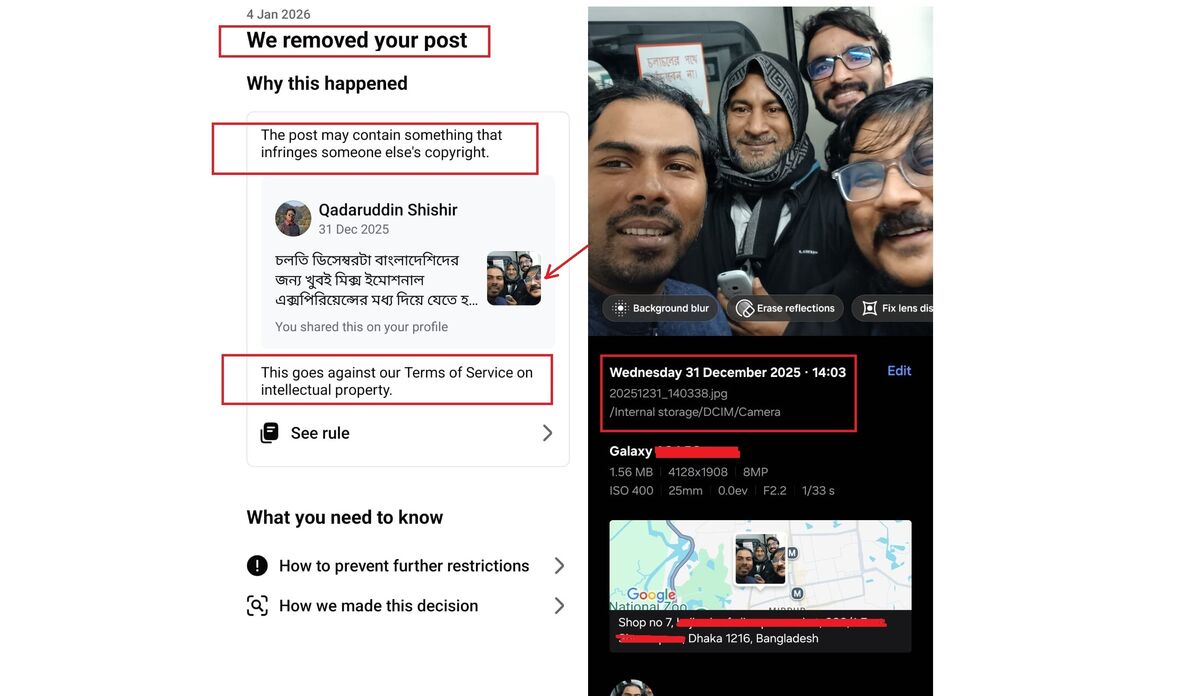
Copyright was claimed on own selfie of The Dissent's editor Qadaruddin Shishir
Despite this, Facebook removed the post on the suspicion that “someone else may have copyright rights.” Although a review request was submitted immediately, no response was received from the platform even after two days.
In this manner, Meta is removing content from its rightful owners’ pages or profiles without verification when others falsely claim ownership through copyright strikes.
For business pages, such fake copyright claims are harming monetization and triggering a range of restrictions on pages and profiles.
Coordinated Attacks Through Fake Copyright Claims?
On December 12, Osman Hadi—a prominent young Bangladeshi political figure and a leader during the July 2024 mass uprising— was shot by assailants. He later died in Singapore on December 18.
After Osman Hadi was shot, the official Facebook page of Bangladesh’s interim government’s Chief Adviser posted a video of Hadi reciting poetry. Several days later, Meta removed the post.
The Chief Adviser’s press team told The Dissent that the post had been removed due to a copyright claim. Subsequently, the Chief Adviser’s profile picture was also removed from the same page.
Both posts were later restored following review appeals.
Former Bangladeshi military officer Mohammad Mustafizur Rahman claims that at least 17 of his posts have been subjected to fake copyright claims over the past several months. The first such claim occurred on June 13, with two more filed on December 22 and 23. He shared screenshots of three of these claims with The Dissent.
In one instance, a post was reported by a page named “Jamuna Television,” but the attached email address was [email protected], which is not Jamuna Television’s official email.
This indicates that the copyright strike was filed from a fake page impersonating Jamuna Television. Two additional strikes were filed by pages named “France 24” and “Sheikh Hasina Official.”
Expatriate Bangladeshi journalist Abdur Rob Bhutto also posted a screenshot on Facebook claiming that one of his posts had been removed following a copyright report.
Many others have recently posted similar claims, stating that they are being targeted by fake copyright strikes.
For example, the Facebook page “Hey Bro Club” posted: “Over the past 2–3 days, some groups have been issuing fake copyright strikes to remove my videos for sharing posts about Hadi bhai (Osman Hadi). Already 6–7 videos have been taken down. My page could be suspended at any moment. I’m sharing screenshots of the copyright claims in the comments.”
Similarly, another Facebook page titled “Abu Saeed, Mugdha. The War Is Not Over” posted: “Activists are under attack! IDs are being disabled! Reach is being reduced to zero! Baseless copyright claims are being filed!”
Earlier, a post from “The Red July News,” a page covering the July mass uprising, was removed through a fake copyright report.
Former military officer Colonel Md. Mustafizur Rahman told The Dissent that fake copyright claims led to the removal of at least 17 of his posts, eventually resulting in the disabling of his (previous) Facebook page with 130,000 followers.
He said, “Based on my long experience working in military intelligence, I used to share information to keep the public informed. That effort has been disrupted.” He also expressed concern that he could face further fake copyright claims in the future.
Political activist Arafat Shaishab told The Dissent that he shared a photo of Tarique Rahman on his profile, which was removed following a copyright claim. The complainant's name shown was “Dr. Zubaida Rahman,” Tarique Rahman’s wife. However, the email address used for the claim belonged to an individual named Shubho Das, indicating false identity.
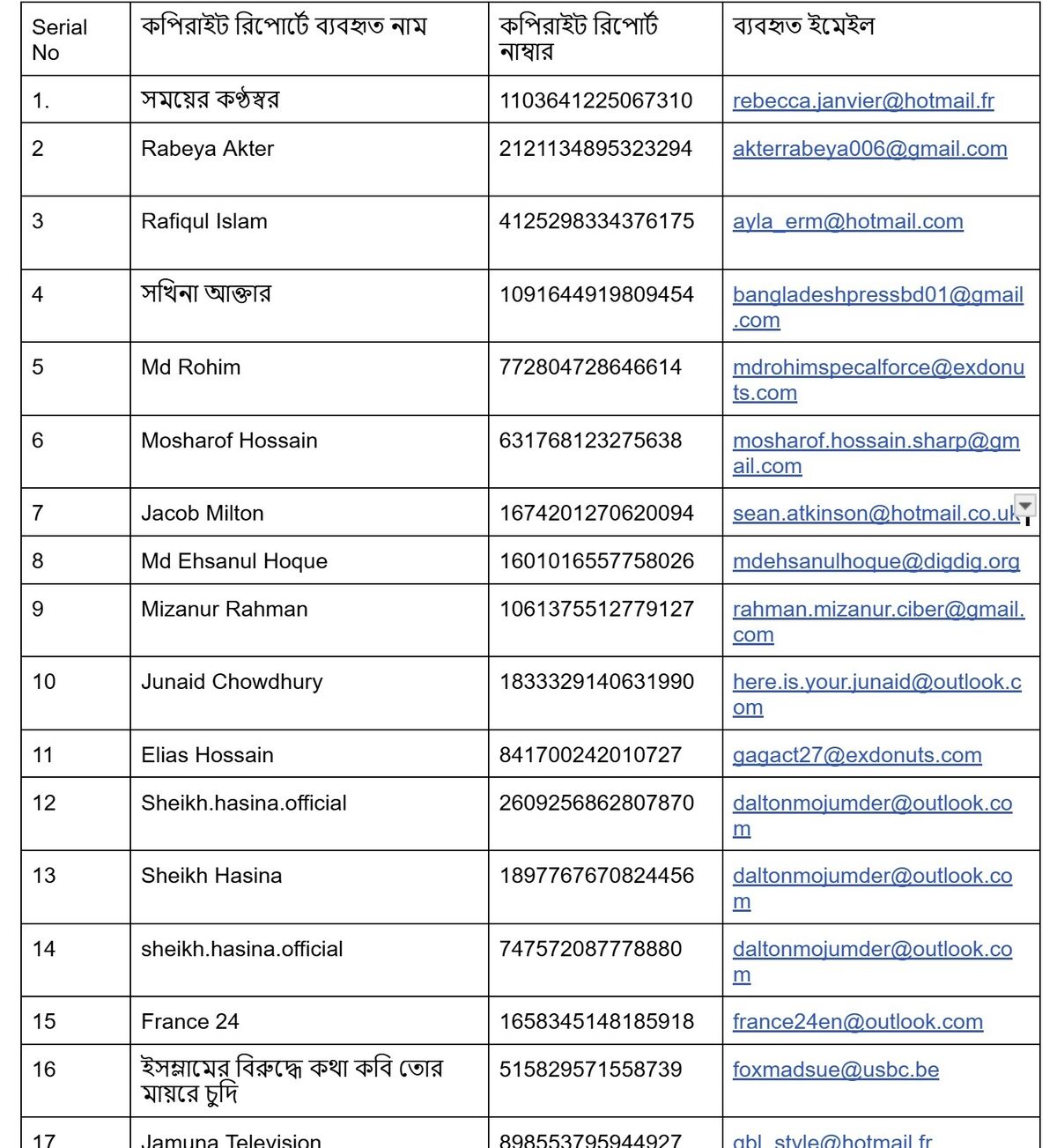
The Facebook IDs and emails used in several fake copyright claims that was reviewed by The Dissent
As a result of the false report, Shaishab said his account was placed under long-term restrictions, drastically reducing its reach. He added, “Facebook shut off my monetization. They never paid me anything, but for others, this can be a serious problem.”
Who is Behind These Fake Copyright Claims?
It remains unclear who is responsible for the fake copyright claims described above.
However, in the past, several cyber groups in Bangladesh have been accused of using fake copyright claims and similar tactics to remove posts or make pages disappear.
More recently multiple Facebook pages—including “Crack Platoon-Bangladesh Cyberforce” and “Ryan Draper”— have recently claimed in several posts that they removed various pages and accounts.
In a December 25 post, “Crack Platoon-Bangladesh Cyberforce”— which identifies itself as “soldiers of the fallen Bangladeshi autocrat Sheikh Hasina”— claimed: “The secret Shibir page PUSAB, operated under the name of a private university to implement Jamaat–Shibir agendas, has been content-disabled.”
Screenshots attached to the post show Facebook’s copyright claim form.
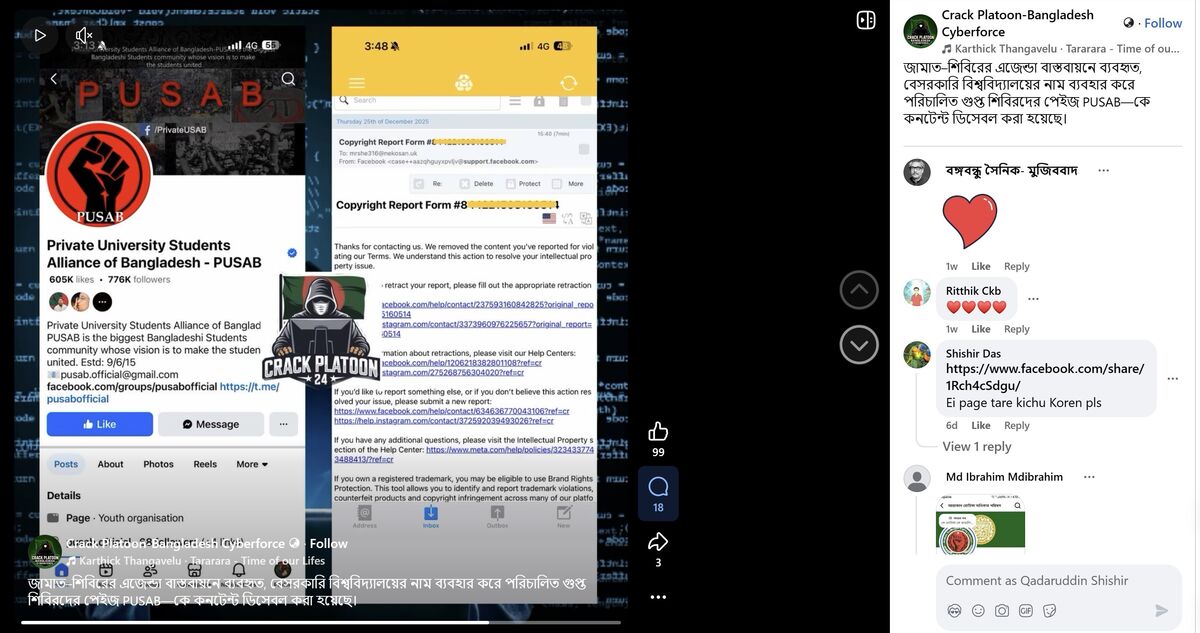
The page frequently boasts about removing Facebook profiles and pages. Examples can be seen here, here, here, and here.
On the same day, a post from an account named Ryan Draper—described as a “social media analyst” for Crack Platoon— claimed that at least 10 copyright strikes were issued against the PUSAB page.
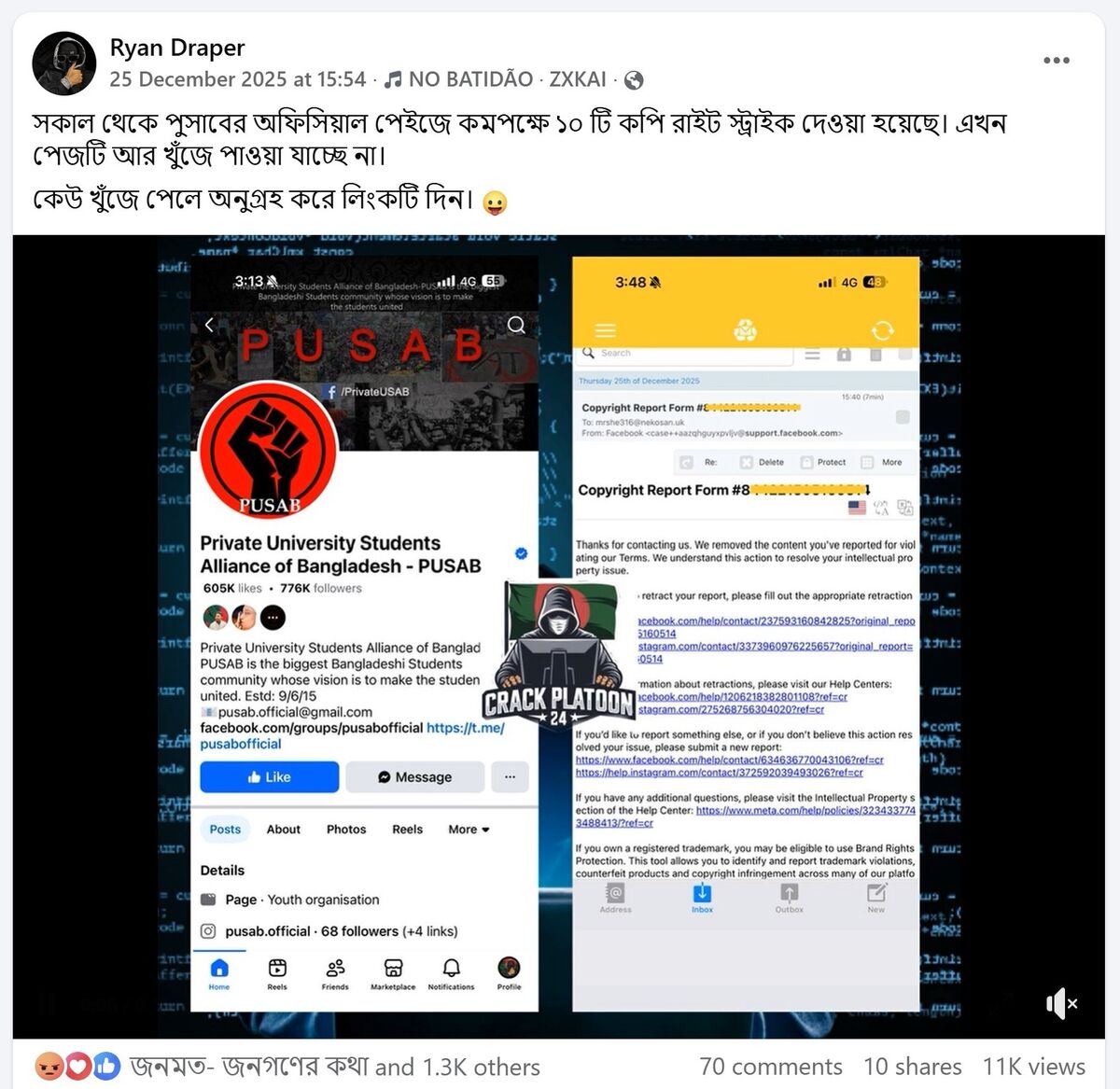
Ryan Draper’s profile contains multiple posts claiming credit for removing Facebook pages and accounts through copyright strikes. See here, here, here, here and here.
The same day, a Facebook account named “Qawmi Cyber Expert Team” posted that four posts were removed from Indian journalist Mayukh Ranjan Ghosh’s verified Facebook account through copyright claims.
This page regularly posts boasting the removal of Facebook profiles and pages. See here, here and here.
Another page, “Dark Cyber Gang – DCG,” posted on December 26 that a post had been taken down from Mufti Imran Bashir’s YouTube channel using copyright claims.
This page also claims to have removed various pages. Examples are here, here and here.
How Are These Takedowns Being Carried Out?
To understand how such removals occur, The Dissent spoke with Omar Faruk, a social media campaign expert and founder of Yati Digital.
“Large cyber groups use fake documents and submit appeals in specific ways,” Faruk said. “Removing posts or photos usually takes one to three days. Videos can take more than a month—sometimes longer.”
“This is not something an individual can do alone,” he added. “These operations involve large groups and significant financial transactions. International experts are involved who can bypass Facebook’s algorithms.”
Human rights activists say the misuse of copyright claims to remove content— including that of reputable media outlets— is undermining independent journalism and freedom of expression.
Manisha Biswas, a legal specialist at the Bangladesh Legal Aid and Services Trust (BLAST), said: “The misuse of copyright law on intermediary platforms is obstructing freedom of expression online. Offenders are using these tools to silence critics. Reforms to content removal and strike systems are urgently needed.”
She added that both parties should be given an opportunity to be heard before content is removed.
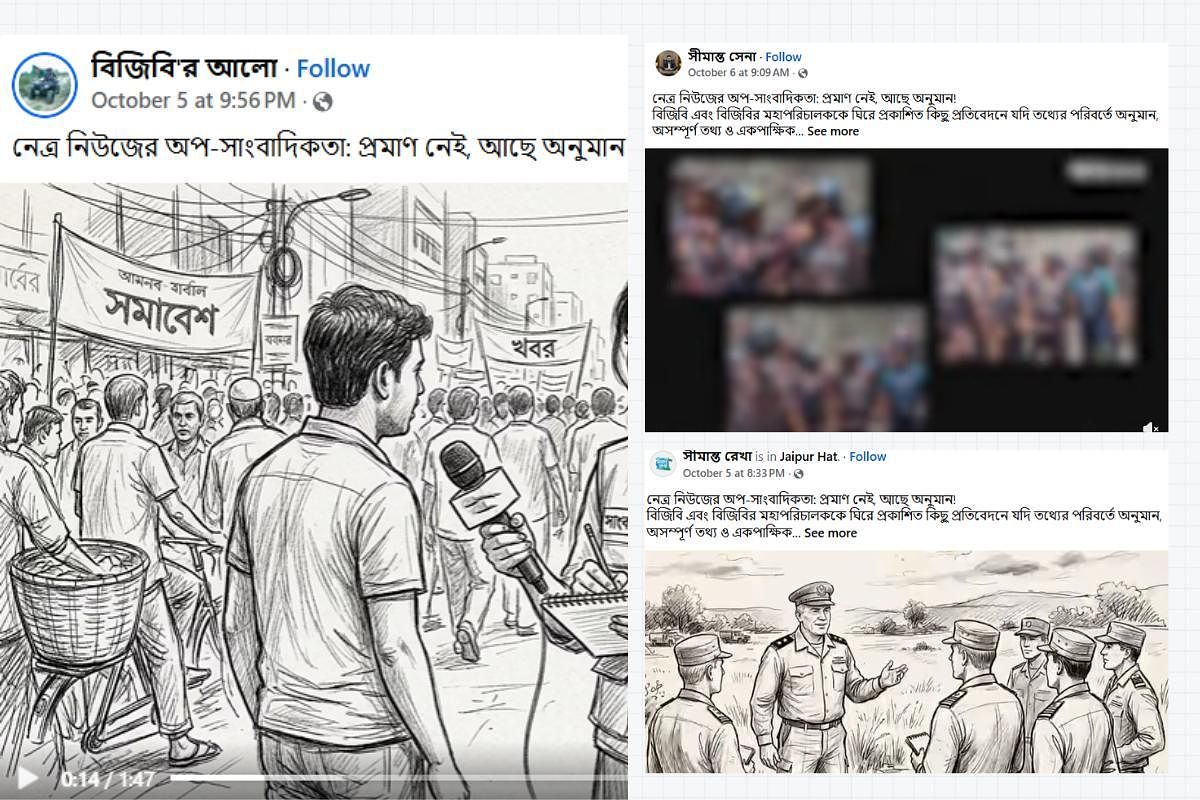
This is not the first time fake copyright claims have been used in Bangladesh. A previous investigation by Sweden-based Netra News found that actors affiliated with the former Bangladeshi government (of Sheikh Hasina) used fake copyright complaints to shut down the websites and YouTube channels of dissenting journalists by creating fake websites, impersonating identities, and backdating content.
Outside Bangladesh, cybercriminals have similarly abused copyright strike systems to extort money from Instagram influencers by threatening account shutdowns.