


DGHS ‘Negligence’ Leads to Spread of Incorrect Information in Media

A sharp surge in measles infections across Bangladesh has triggered widespread concern, as the highly contagious disease continues to claim the lives of children. The rising death toll has created public anxiety, with media reports suggesting that between at least 38 and as many as 100 children may have died so far, although no precise official figure has been confirmed.
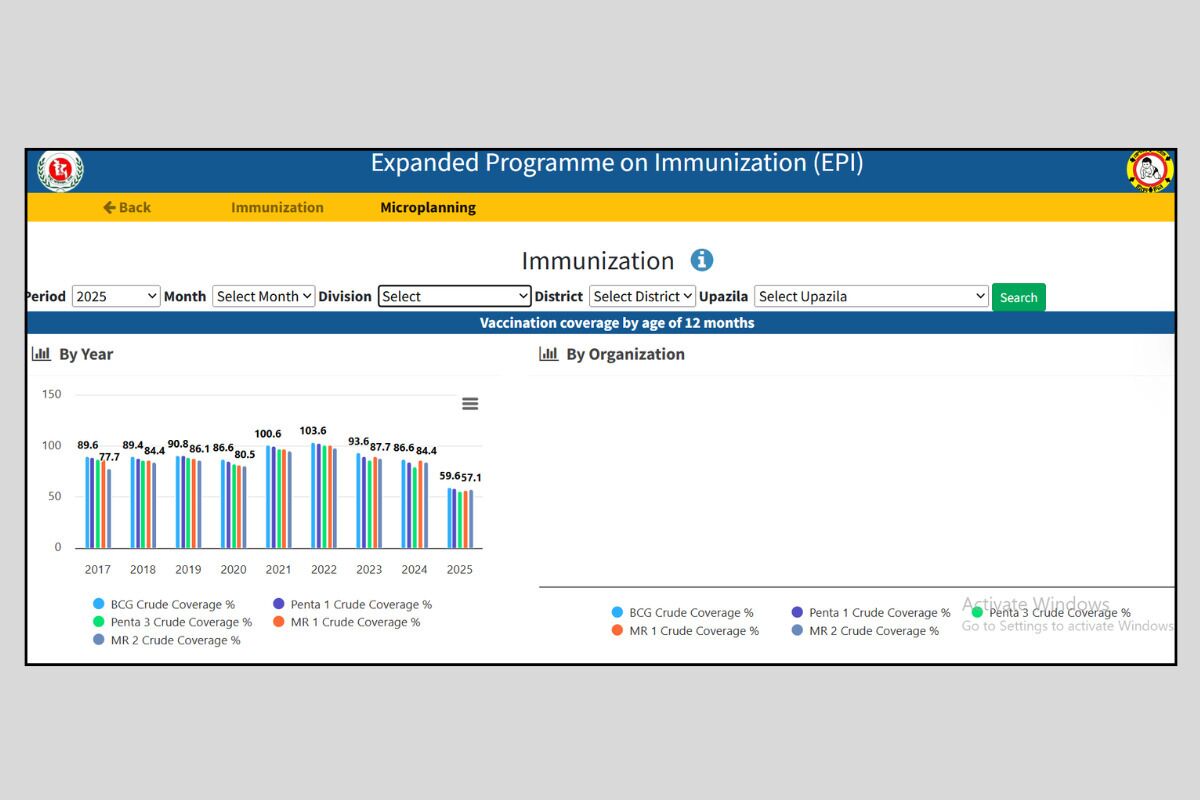
Amid the ongoing outbreak, confusion has deepened due to the circulation of inaccurate information in the media regarding vaccination coverage in 2025. Most local media outlets relied on data published on the Directorate General of Health Services (DGHS) website under the government’s Expanded Programme on Immunization (EPI). The dataset included vaccination coverage for 12-month-old children from 2017 to 2025, covering measles and other vaccines.
According to that data, measles-rubella (MR-1) vaccine coverage in 2025 stood at approximately 57.5 percent, while MR-2 coverage was reported at 57.7 percent.
Based on this information, several leading media outlets including Prothom Alo, Kaler Kantho, Bangladesh Pratidin, Banglanews24, Kalbela, and Khoborer Kagoj published reports citing the figures.
However, officials have since acknowledged that the data was neither updated nor accurate. Dr. Mohammad Shahriar Sazzad, Deputy Director of the EPI at DGHS, told The Dissent, “This information is not correct. It appears that the data remained there because it had not been updated.”
Confusion Triggered by Minister’s Remarks
The confusion surrounding measles vaccination intensified following remarks by Health Minister Sardar Sakhawat Hossain Bakul on March 29 at the Bangladesh-China Friendship Conference Center during the inauguration of an international pharmaceutical expo.
Responding to journalists, the minister said, “Measles cases have increased significantly. The vaccine was administered eight years ago, but no government has given it since then. We have allocated Tk 604 crore, and the purchase committee has approved it. We will procure vaccines soon and begin the campaign.”
His comments quickly fueled public confusion about the status of measles vaccination in the country.
Soon after, a screenshot from the DGHS website went viral on social media, showing MR-1 coverage at 57.5 percent and MR-2 at 57.7 percent for 2025.
Reacting to the minister’s statement, UNICEF EPI Specialist Sarwar Alam Sanku wrote on Facebook that ‘‘the claim about no measles vaccination over the past eight years was completely incorrect. It is unfair to make such claims about Bangladesh’s globally recognized EPI programme, Over the past nine years, nearly 35 million children have been vaccinated according to government administrative reports. Coverage has consistently been around 95 percent. During the 2020–2021 measles-rubella campaign alone, around 35 million children received at least one dose, with coverage close to 100 percent.”
Similarly, physician and researcher Dr. Md. Marufur Rahman noted in a Facebook post on March 31 that earlier reports citing low vaccination coverage were based on incomplete data.
“I also initially reported that vaccination coverage was below 60 percent based on the EPI dashboard. However, this was incomplete data—and the responsibility for that lies with the authorities. Nowhere on the dashboard was it mentioned that the data was incomplete,” he wrote.
He added that, according to the central MIS database, measles vaccination coverage last year was approximately 93 percent for the first dose and 91 percent for the second dose—around 6 percent lower than the previous year.
Attempts to reach both Sarwar Alam Sanku and Dr. Rahman for further comment were unsuccessful.
However, EPI Deputy Director Dr. Sazzad confirmed the accuracy of these figures. “MR-1 coverage is about 92 percent, and MR-2 is around 90 percent. This is not public data – only those with access to our MIS system can view it,” he said.
An official from the World Health Organization’s Bangladesh office, working in the surveillance and immunization division, also confirmed the figures but requested anonymity. “The data is correct, but it is nationally protected and not intended for public use,” the official said.
Why the Published Data Was Misleading
According to standard immunization schedules, children receive the first measles dose at nine months and the second dose at 15 months.
However, the data published on the DGHS website only reflected vaccination coverage among 12-month-old children. As such, it should not have included MR-2 data, which applies to children aged 15 months or older. This discrepancy further underscores why the published figures were misleading.
Outdated Data Removed from Website
Following inquiries from The Dissent, the outdated data was removed from the DGHS website.
Dr. Sazzad confirmed that the data had been taken down due to a lack of updates. “After you raised the issue, I asked the MIS team to hide the data and make it visible again only after updating it,” he said.
He acknowledged that the failure to update the data amounted to “negligence,” though he clarified that responsibility lay with the MIS unit.
“Our role is to administer vaccines. The technical and digital display of data is handled by the MIS,” he added.