

How some media outlets made a planned attack seem “acceptable”
On Friday (April 10), an attack took place in front of the National Museum in Shahbagh, Dhaka, where several individuals were assaulted. According to a report by Dhaka Tribune, “On Friday evening in Shahbagh, several individuals were beaten and women were harassed by a group calling itself the ‘Azadi Movement.’ The victims were targeted after being labeled ‘homosexual.’ The attack occurred around 8 p.m. near the gate of the National Museum. Footage that later circulated on social media showed a disorderly crowd physically assaulting several people.”
The Dhaka Tribune report further noted that the victims said they had been attacked without provocation. They also alleged that female members of their group were sexually harassed during the incident.
In an interview with the media, one victim, Kazi Tahsin Agaz, said that a group of about 20 people had been marching through Shahbagh chanting anti-homosexual slogans before the attack.
It was also reported that the ‘Azadi Movement’ had organized a gathering in Shahbagh before the incident. From that gathering, they demanded that the area be cleared of what they described as “homosexual activities.”
The Daily Star also published a report on the attack carried out in Shahbagh by the ‘Azadi Movement.’
A review of online materials shows that around noon on Friday (April 10), the group issued a press release announcing that they would assemble at Shahbagh’s Hadichattar at 7 p.m. to “drive out these anti-social and illegal elements.” The statement also invited journalists to attend the program.
A notice circulated on Facebook by one of the group’s activists read:“With due respect, you have already learned through various media that every Friday, groups of homosexual individuals are gathering at Shahbagh’s Hadichattar for unknown purposes. They are appearing near Dhaka University to fulfill some international agenda or as part of an international conspiracy to destroy the country’s social values. We, the Azadis, have already driven them out twice from Dhaka University. As a continuation, we will strategically expel these anti-social and illegal elements from Shahbagh Hadichattar. Your presence is essential in this patriotic effort.”
Later, around 8 p.m., members of the group marched into Shahbagh and were seen attacking several individuals. The entire incident was broadcast live on a Facebook page named Uttor Dokkhin. The footage showed a banner at the front of the procession bearing the words “Azadi Movement.”
In other words, the attack was carried out following a pre-announced program, with journalists explicitly invited to be present.
When Violence Is Reframed as Public Action
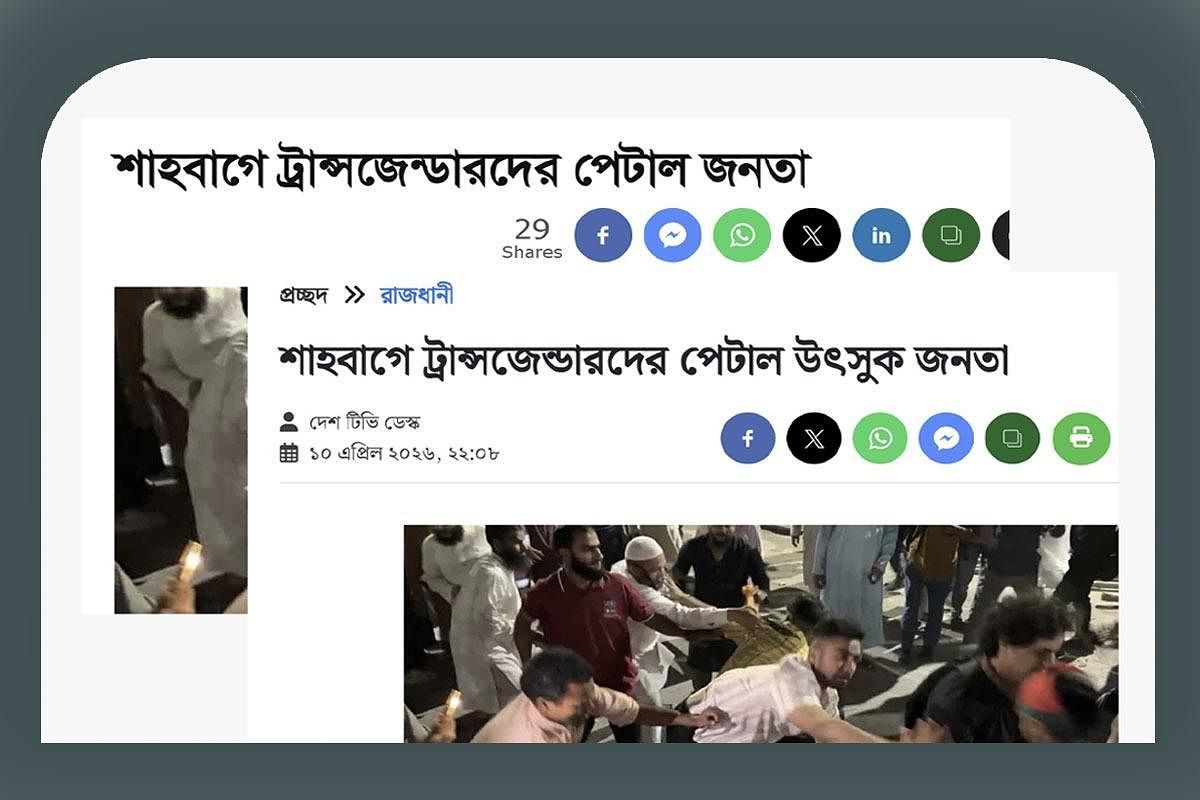
Despite indications that the attack was premeditated and organized under the banner of a specific group, several media outlets described it using terms such as “attack by curious onlookers,” “mob beating,” or “public thrashing.” These reports largely omitted the role of the organizing platform and the planned nature of the gathering, instead replacing the identity of the attackers with the more neutral or even positive term “public.” In doing so, they created an impression that lent a degree of acceptability to the violence.
The newspaper Kalbela ran the headline: “Transgender individuals beaten by the public in Shahbagh.” In the body of the report, it stated that “several transgender individuals were beaten by ordinary people in front of the National Museum in Shahbagh. Every Friday, transgender and homosexual individuals gather there, which often causes discomfort to passersby. When they gathered again today, ordinary people eventually attacked them.”
The captions used by Kalbela on YouTube and Facebook read: “Public delivers mob beating to transgender individuals in Shahbagh.”
Desh TV and Asia Post carried similar headlines: “Transgender individuals beaten by curious onlookers in Shahbagh.”
Ittefaq headlined its report: “Public chases away homosexuals after issuing a one-minute ultimatum,” while an online outlet named Barta Bazar used the headline: “Public beats transgender individuals in Shahbagh.”
BanglaNews24.com titled its report: “Transgender individuals assaulted following an argument in Shahbagh,” while ATN Bangla used the headline: “Beating on suspicion of homosexuality after a 10-minute ultimatum in Shahbagh.”
Who Are the ‘Azadi Movement’?
A press release posted on Facebook in the name of the ‘Azadi Movement’ identified a Dhaka University student, Muhammad Shahriar Alam, as the group’s spokesperson, and included a WhatsApp number.
When contacted, Shahriar said he was the convener of the Dhaka University unit of Bangladesh Khilafat Chhatra Majlis. He claimed that the group had formed the ‘Azadi Movement’ during the recent Ramadan.
Last year, an organization named Azadi Movement Bangladesh was formed by the hardline Islamic preacher Ataur Rahman Bikrampuri, who is currently in prison. Bikrampuri has faced allegations, including from Prothom Alo, The Daily Star, and Shahbagh police, of inciting mob violence. He has also drawn controversy for publicly calling for the killing of individuals accused of blasphemy.
When asked whether the ‘Azadi Movement’ represented by Shahriar Alam was a branch of the organization founded by Bikrampuri, Shahriar said he was not aware of such an organization. He declined to identify others involved in the movement. Shahriar Alam had previously contested the Dhaka University Central Students’ Union election as a candidate for social welfare secretary from a panel backed by Islami Andolon Bangladesh.