


How Prothom Alo’s Headlines Shaping the Narrative for Awami League
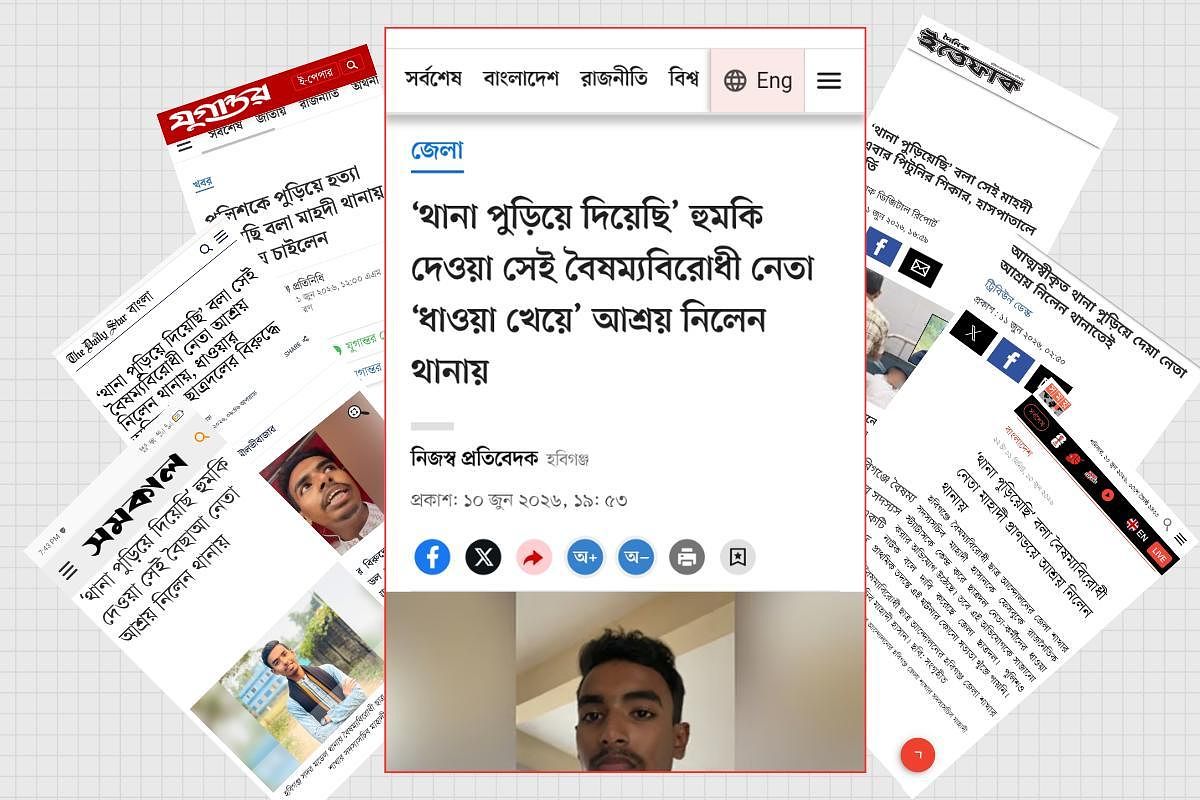

On the evening of June 10, the daily Prothom Alo published a report on its website titled, “‘We Burned Down the Police Station’: Anti-Discrimination Leader Who Made the Threat Seeks Shelter at Police Station After Being ‘Chased’” (‘We Burned Down the Police Station’: Anti-Discrimination Leader Who Made the Threat Seeks Shelter at Police Station After Being ‘Chased’).
An excellent headline. One of the elements sought in an event to make it newsworthy is oddity, a concept that is difficult to translate into Bengali. It can have various meanings. The central idea, however, is an event that contains some degree of abnormality, strangeness or incongruity—something that falls somewhat outside the boundaries of common sense or normality. A paradox, translated as “self-contradictory idea” or “self-contradictory truth”, falls under oddity as a news element. In other words, an event that contains a self-contradictory truth makes for good news.
Prothom Alo’s headline is excellent because it clearly brings out a paradox or self-contradictory truth in the behaviour of anti-discrimination leader Mahdi. The same person who, after August 5, once went to a police station and proudly told the officer-in-charge, “We burned down the police station”—a rhetorical claim rather than a reflection of reality—is now seeking shelter at a police station when he finds himself in danger. This creates a paradox and highlights the contradiction in Mahdi’s behaviour.
Prothom Alo’s headline has also successfully achieved something else. Through this framing, it has brought Mahdi’s past “misdeeds”—his threat to burn down a police station—to the forefront at a time when he himself has become a victim of being chased. The framing is likely to reduce the level of concern that might otherwise have arisen over his current victimhood. Instead, depending on the reader, this framing may even give many people a sense of satisfaction at Mahdi’s victimisation. In particular, it has created an occasion for celebration for those who stand at the opposite political or ideological pole from him.
As evidence that the headline has created a “celebratory” occasion for some, I am citing a comment posted below the photo card of the report on Prothom Alo’s Facebook page: “I enjoyed hearing that, poor fellow.”
That sense of “enjoyment” was not limited to this one commenter. Prothom Alo’s headline framing entertained thousands of Facebook users. The post received slightly more than 11,000 reactions, of which more than 7,700 were “Haha” reactions. Similar instances of “enjoyment” could also be found.
A question may arise here: Would Mahdi’s political opponents not have found his being attacked amusing even if the headline had been different? The answer is that, yes, many might still have found it amusing. But by highlighting the paradox in the headline, Prothom Alo made the incident more attention-grabbing and entertaining for Mahdi’s opponents. This, too, can be understood from the comments section of Prothom Alo’s Facebook post. I am citing comments from two readers. One wrote, “Thanks to Prothom Alo for an unmatched headline.” Another commented, “I was stunned after seeing the headline.”
In other words, the headline caught the attention of many people in its own right. And that is a success for a news outlet. Alternatively, it demonstrates the skill of the copy editor who wrote the headline.
Given that Prothom Alo’s headline framing turned the incident in which Mahdi was attacked into a source of humour for most readers—as indicated by the number of “Haha” reactions—or led many to regard his being attacked as something he “deserved” (as reflected in Facebook comments), is Prothom Alo responsible for this?
No, Prothom Alo is certainly not responsible. The reason is that the newspaper did not unfairly highlight the paradox. The paradox exists in Mahdi’s behaviour, and the news outlet simply identified it accurately and brought it into the headline. The readers’ negative reactions that followed are a by-product of an excellent headline; there is little more to say about it.
The Credit for the Headlines of 12 News Outlets Goes to Prothom Alo
Another puzzle needs to be solved here. Some may wonder why I am focusing on Prothom Alo’s headline when they saw headlines framed in the same way about Mahdi in many other news outlets that day.
The answer is that an online search for the phrase “We burned down the police station” shows that a headline beginning with those words appeared in at least 13 news outlets in Dhaka. Among them, Prothom Alo published the report first. In other words, after Prothom Alo used such a headline, the other news outlets published the story with identical or similar headlines.
It is clear that Prothom Alo deserves the credit for the framing of the headlines used by these 12 news outlets because several outlets, including Samakal and Ittefaq, effectively published significant portions of Prothom Alo’s report in copy-and-paste form.
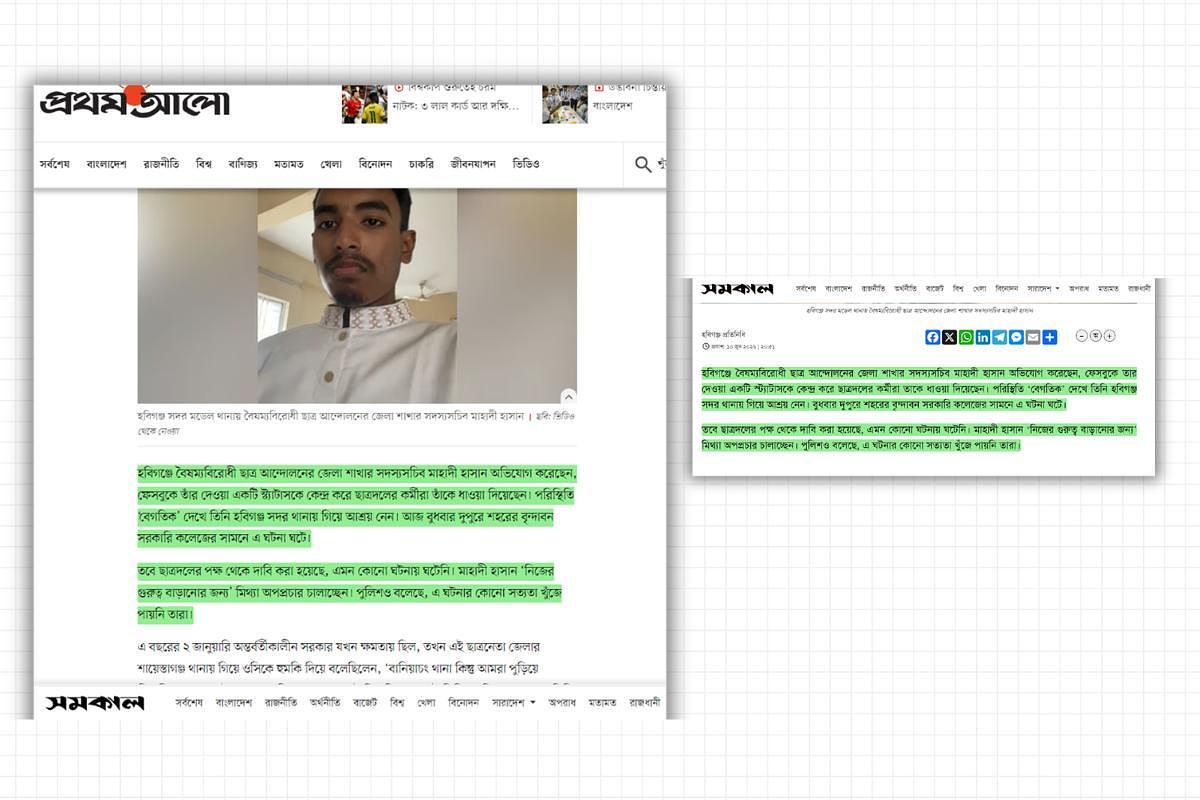
Look at the copied-and-pasted sections in Samakal’s report, published at 8:51 pm, which retained a headline almost identical to that of Prothom Alo’s report, published at 7:53 pm, in the screenshot below.
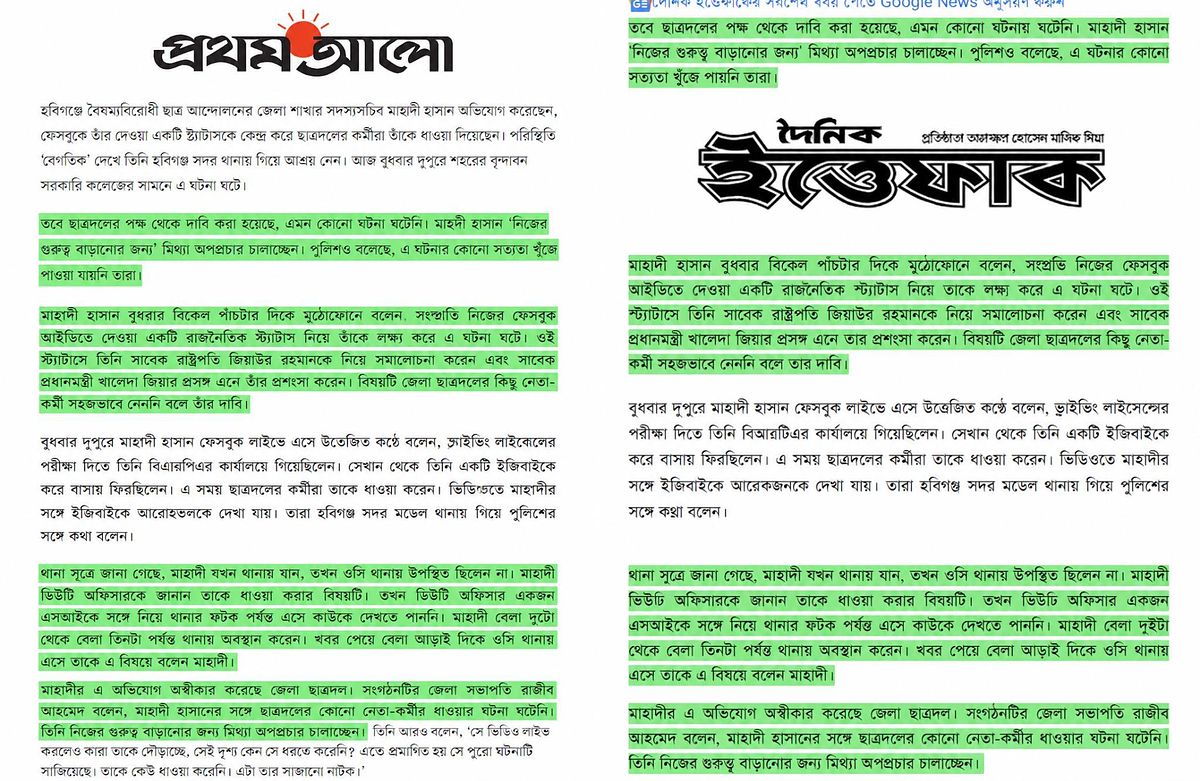
Evidence of copy-and-paste can also be found in Ittefaq’s report. See the comparative screenshot below.
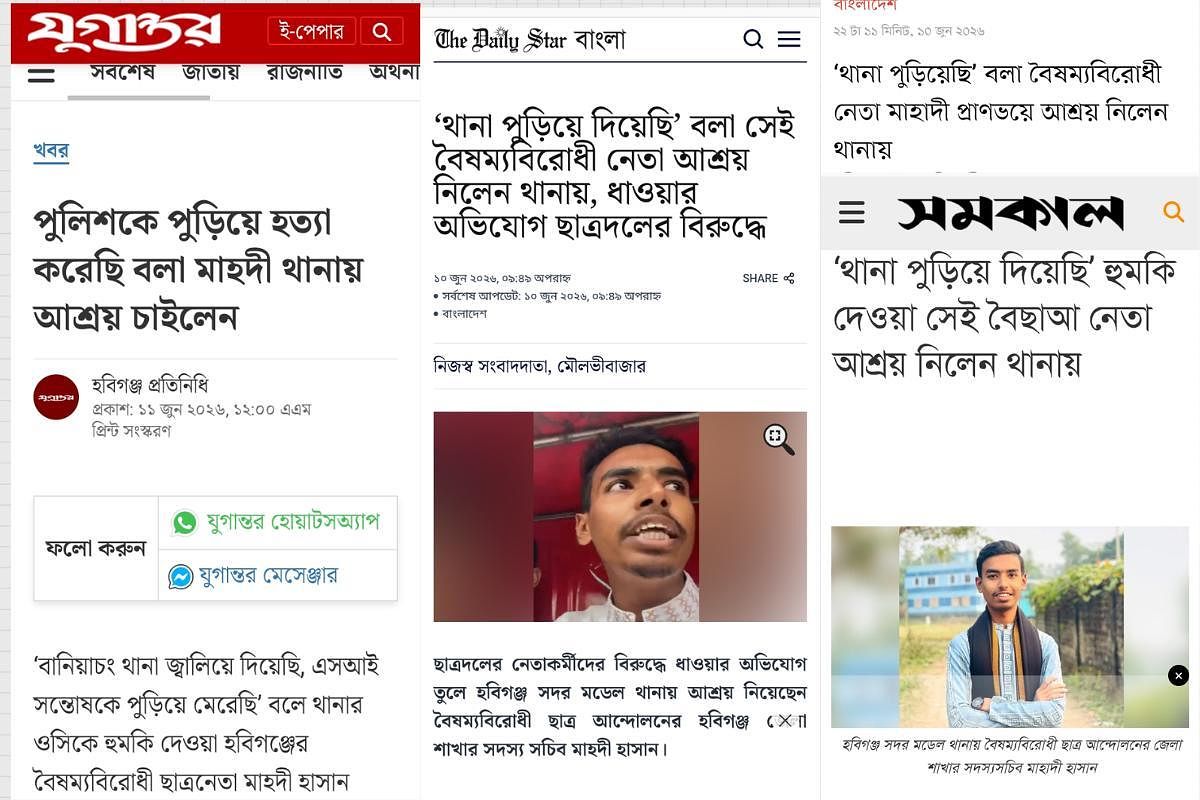
The problem in this case is that Samakal, Ittefaq and the other outlets that copied and pasted Prothom Alo’s headline or report, or drew inspiration from it, did not give Prothom Alo any credit.
I hope the puzzle has now been solved as to why this discussion began by focusing solely on Prothom Alo’s headline.
Media Outlet | Date and Time | Headline |
|---|---|---|
Prothom Alo | June 10: 19:53 (7:53 pm) | |
Priyo | June 10: 20:22 (8:22 pm) | |
Samakal | June 10: 20:51 (8:51 pm) | |
Rupali Bangladesh | June 10: 21:05 (9:05 pm) | Mahdi, who set fire to a police station, now seeks shelter at a police station |
The Daily Star | June 10: 21:49 (9:49 pm) | |
Ittefaq | June 10: 21:55 (9:55 pm) | |
Somoy TV | June 10: 22:11 (10:11 pm) | |
Banglavision | June 10: 23:03 (11:03 pm) | Mahdi, who said “we burned SI Santosh to death,” seeks shelter at a police station |
Amader Shomoy | June 10: Published at 11:42 pm | The leader who said “we burned down the police station” now seeks shelter at a police station |
Jugantor | June 11: 00:00 (12:00 am) | Mahdi, who said “we burned police officers to death,” seeks shelter at a police station |
Dhaka Tribune | June 11: 02:50 (2:50 am) | The self-proclaimed leader who burned down a police station seeks shelter at the same police station |
RisingBD | June 11: 09:21 (9:21 am) | Mahdi, who threatened to “burn down the police station,” seeks shelter at a police station |
Prothom Alo Is Following Certain Patterns, Rather Than Using Isolated Headlines
If Prothom Alo’s headline on the report about Mahdi is analysed in isolation, it demonstrates skill in headline writing. But a closer look at the report reveals another element: a photograph used in the article. Its caption reads, “On January 2, anti-discrimination student movement leader Mahdi Hasan went to Shayestaganj Police Station in Habiganj to secure the release of a detained person and threatened the officer-in-charge. Photo: Taken from video.”
In other words, the effort to highlight Mahdi’s past “misdeeds” at a time when he has become a victim is not limited to the “skill of headline writing”. A photograph showing him issuing a threat inside a police station has also been included in the report to further emphasise those “misdeeds”.
Was this the first time Prothom Alo had published a report about a person identified with the “pro-July” camp becoming a victim while linking or highlighting information about their past misdeeds? Or had it done so before?
Does Prothom Alo use similar framing for those who identify themselves as “anti-July”—those affiliated with the Awami League or its associate organisations? Does it link the current victimisation of an Awami League leader to past misdeeds in the headline?
These questions warrant closer examination.
With this in mind, I began searching Prothom Alo’s website to examine how it frames reports about people from both camps—those who identify themselves as “pro-July” and those who identify themselves as “anti-July”—when they are attacked in various ways.
The term “pro-July” is not used here in its broadest sense. In the broader political and organisational context, all significant political parties and organisations other than the Awami League and its associate organisations are commonly regarded as “pro-July”. However, since the central figure in the report under analysis, Mahdi Hasan, is a leader of the Anti-Discrimination Student Movement, this discussion specifically categorises individuals associated with political parties and organisations that emerged around the July uprising—such as the National Citizen Party, the Anti-Discrimination Student Movement and Inqilab Mancha—as “pro-July”. Reports concerning individuals affiliated with established political parties and organisations such as the BNP and Jamaat-e-Islami have been excluded.
On the other hand, this analysis defines the Awami League and its associate organisations as “anti-July”.
This article is not a research study. Consequently, no particularly rigorous methodology was followed in searching Prothom Alo’s website. Reports about individuals from the two camps defined above as “pro-July” and “anti-July” who have recently appeared in the news after being “attacked” in various ways were searched for selectively on Prothom Alo’s website. As a result, not all relevant reports may have been captured equally. Here, “attacked” refers to being subjected to physical attacks, criminal cases or imprisonment.
An analysis of the reports found through these searches suggests that Prothom Alo broadly follows several patterns in its coverage of people affiliated with the NCP and the Anti-Discrimination Student Movement who have been attacked, as well as those affiliated with the Awami League who have been attacked. These patterns are outlined below.
1. Highlighting Past Misdeeds Versus Ignoring Them
The headline “‘We Burned Down the Police Station’: Anti-Discrimination Leader Who Made the Threat Seeks Shelter at Police Station After Being ‘Chased’” highlights Mahdi’s past misdeeds. There are similar examples in reports about another “pro-July” figure who became a victim.
On March 26 this year, another Prothom Alo headline read, “House of Shaktish student leader ‘involved’ in assault over allegations against Chhatra League set on fire in his village”.
Here, when the student leader became a victim of an arson attack on his home allegedly carried out by the Awami League, the headline highlighted his past misdeeds.
However, when Awami League-affiliated individuals with allegations or evidence of publicly known misdeeds in the recent past became victims, or when their property was targeted after the mass uprising on August 5, those misdeeds were not highlighted in the headlines. Numerous examples of this can be found in Prothom Alo’s coverage.
For instance, on July 15, during the July 2024 movement, Awami League General Secretary and minister Obaidul Quader publicly threatened the protesters, saying, “Chhatra League is ready to respond to arrogance on campus”. The following day, Chhatra League carried out armed attacks on students at Dhaka University and other campuses, injuring many. On July 16, six protesters were killed in attacks by police, the Awami League and Chhatra League.
Several months later, on February 6, 2025, a Prothom Alo report carried the headline “Vandalism and arson at Obaidul Quader’s ancestral home in Noakhali”. If the newspaper had followed the same approach it used in the cases of Anti-Discrimination Student Movement leader Mahdi Hasan and Jubo Shakti leader Saifullah—bringing past allegations against them into the headline—the headline about Obaidul Quader should have read, “Vandalism and arson at the ancestral home of Obaidul Quader, who threatened July protesters”.
Similarly, the Prothom Alo headline published on April 15, 2025, “A room in the house of Chhatra League president Saddam Hossain set on fire in Panchagarh”, should instead have read: “A room in the house of Chhatra League president Saddam Hossain, who threatened July protesters, set on fire”.
This is because Saddam also threatened the protesters on July 16, 2024, saying: “Not a single incident will go unanswered”.
On August 5, the day of the mass uprising, Prothom Alo’s headline read, “UP chairman Selim Khan and his son Shanto Khan beaten to death in Chandpur”. Prothom Alo’s report stated that Selim Khan had fired at an angry crowd that day. Reports from various other media outlets also identified Selim as a notorious sand-mining mafia figure in the area. Had his misdeeds before and on the day of the uprising been highlighted in Prothom Alo’s headline, it should have read, “UP chairman Selim Khan, who fired at a crowd, and his son Shanto Khan beaten to death in Chandpur”.
Another Prothom Alo headline on August 5 read, “Attack, vandalism and arson at the homes of Shamim and Selim Osman”. According to a report by The Daily Star, before the homes of Shamim and Selim Osman were attacked in Narayanganj that day, Shamim Osman and his associates had fired at an angry crowd. Videos of the shooting were published by news outlets and circulated on social media.
In this case, Prothom Alo’s headline should have read, “Attack, vandalism and arson at the home of Shamim Osman, who fired at a crowd”. But that was not the headline the newspaper used.
Considerable effort was made to find a Prothom Alo report in which past misdeeds were highlighted in the headline of a story about an Awami League-affiliated individual being attacked in the present. But no such report emerged from the search. This may reflect the limitations of the author’s search, or it may mean that no such headline has appeared in the newspaper in recent times.
2. Ignoring the Accused’s Awami League Affiliation When a “Pro-July” Person or Institution Is Attacked
When a “pro-July” figure is allegedly attacked by someone affiliated with the Awami League, the accused’s political affiliation is often omitted from the headline. The political identity of the person attacked is also frequently not highlighted.
Two recent incidents reported by Prothom Alo illustrate this pattern. The headline of a June 10 report read, “Vandals set fire to July Martyrs’ Memorial in Netrokona late at night”. Reports by several other news outlets, as well as information in Prothom Alo’s own report, indicated that pro-Awami League slogans could be heard from those who set the fire. In this case, the perpetrators were described as “vandals”.
Prothom Alo also published a video report on the incident under the headline, “Fire at July Martyrs’ Memorial in Netrokona, video circulates”. The video was widely circulated enthusiastically by various pro-Awami League Facebook pages and profiles. However, Prothom Alo’s headline made those spreading the video less visible by using passive framing.
The same thing happened in another incident in Netrokona that day, when Awami League activists allegedly stripped a student of Jahangirnagar University, forced the student to make statements opposing the July movement, recorded those statements while the student was naked and uploaded the footage to Facebook. Prothom Alo used a passive headline for this incident: “Video of Jahangirnagar University student being harassed in Netrokona circulates”. The incident involving stripping, assault and the forced recording of statements was presented in the headline using the relatively mild term “harassed”.
The pattern is not limited to three headlines about two incidents in Netrokona. In many other recent cases involving attacks by Awami League members on “pro-July” figures, Prothom Alo has omitted the attackers’ political affiliation from its headlines. For example, after four people were killed in what was described as an armed and planned Awami League attack in Gopalganj on July 16, 2025, Prothom Alo’s headline read, “NCP leaders and activists surrounded and attacked after rally in Gopalganj, Section 144 imposed”. Another headline about the incident read, “Attack and clashes around NCP rally in Gopalganj, death toll rises to four”. The attackers’ Awami League affiliation was omitted from both headlines.
Another headline, published on January 21, 2025, read, “Two arrested for opening fire on students and members of the public in Chattogram”. Information in the report showed that the two individuals were actually activists of Jubo League and Chhatra League.
However, not all such reports omitted the political affiliation of Awami League members from the headlines. In some reports, their political identity was highlighted.
3. Concealing the Political Identity of Attacked Awami League Figures While Highlighting Positive Identities
The Awami League is a party whose leaders went into hiding following the mass uprising, and the party’s activities were subsequently banned. In present-day Bangladesh, affiliation with the Awami League or its associate organisations carries a negative connotation. In this context, when an Awami League-affiliated individual is attacked, Prothom Alo’s coverage often—but not always—conceals the person’s political identity, such as being an Awami League leader or a leader of one of its associate organisations, in the headline. Instead, it foregrounds a professional or other positive identity, such as a valiant freedom fighter, a prominent citizen or a professor.
Prothom Alo has repeatedly used headlines such as:
“Freedom fighter humiliated with a garland of shoes in Chauddagram, threatened with expulsion from the area”
“Former commander of freedom fighters’ association publicly harassed in Barguna, video goes viral”
“Those involved in humiliating a freedom fighter in Chauddagram identified, no one arrested”
“Statement by 30 prominent citizens expressing outrage over the humiliation of a freedom fighter in Cumilla”
“Jamaat expels two supporters over incident in which a valiant freedom fighter was humiliated with a garland of shoes”
In these headlines, priority has been given to the individuals’ identities as “freedom fighters”, “valiant freedom fighters” or “former commanders of the freedom fighters’ association”. The incidents have been presented to readers as cases involving the humiliation or harassment of a freedom fighter.
However, these individuals also had another important identity: they were leaders of the local Awami League. Other news outlets have published information about their political affiliations and past misdeeds.
For example, a report by the daily Kalbela about Kanu, an Awami League leader and freedom fighter from Chauddagram, carried the headline, “Awami League had once demanded Kanu’s execution”. Kanu was accused of shooting and killing a local Jubo League leader in 2016. He had faced eight cases, including murder charges, during the Awami League’s tenure. Some of the plaintiffs in those cases were leaders and activists from other factions of the Awami League.
The question here is not whether Kanu was a freedom fighter. Rather, the question is which identity a news outlet chooses to foreground in a headline when an individual has multiple identities, and which identity it pushes into the background.
In Prothom Alo’s headlines, the identity of attacked Awami League figures as freedom fighters has consistently been made more visible than their political affiliation.
Another Similar Incident
Prothom Alo published a report about a Dhaka University teacher who was assaulted after going to Dhanmondi 32 under the headline, “Dhaka University professor Jamal Uddin assaulted after visiting Dhanmondi 32”. Here, the individual’s identity as a “Dhaka University professor” was foregrounded.
However, when the same person was subsequently arrested, Prothom Alo’s headline read, “Awami League-backed Dhaka University teacher Jamal Uddin arrested”. In this case, his political position or affiliation was explicitly mentioned in the headline.
Placing the two headlines side by side shows that different identities of the same individual were prioritised in different contexts. When he was attacked, his academic identity as a “Dhaka University professor” was foregrounded. When law enforcement arrested him, his identity as an “Awami League-backed teacher” appeared in the headline.
4. Passive Framing of Cases Against Awami League Figures Without Mentioning the Alleged Crimes
In reports about the arrest of fugitive former Awami League ministers, MPs and leaders in murder and corruption cases following the mass uprising, Prothom Alo’s headlines generally omit the specific and serious allegations against them, such as murder or arms charges. Instead, they use only terms such as “arrested” or “remanded”. Even in reports about bail, Prothom Alo’s headlines often avoid specifying the offence in the case in which bail was granted.
Some examples of Prothom Alo headlines are:
“‘Notorious’ former Awami League MP Jannat Ara Henry arrested”
“Former Cox’s Bazar MP Abdur Rahman Bodi arrested”
“Former MP Kazi Monirul Islam arrested in Dhaka”
“Former shipping minister Shajahan Khan arrested”
“Former MP Haji Salim arrested”
“Artist and former MP Momtaz arrested”
“Former Sunamganj MP Muhibur Rahman arrested”
“Awami League leader Dublu Sarkar of Rajshahi arrested”
“Awami League leader Baharul of Koyra arrested in Dhaka”
Many of these headlines omit the identity “Awami League leader”. Instead, they highlight identities such as “former MP” or “artist”. The headlines also do not mention the allegations or offences behind the arrests. Readers may get the impression that the individuals were arrested “because they were MPs” or “because they were Awami League leaders”. The headlines do not mention the serious allegations against them, which may include murder, violence, crimes against humanity, corruption or other offences.
The same pattern can be seen in headlines about remand. Examples include:
“Former MP Kabirul Haque remanded for six days”
“Former minister Shajahan Khan remanded for four days”
“Former MP Shafiqul Islam remanded for two days in Jhenaidah”
“Former MP Shafiul Islam Mohiuddin remanded for three days”
“Two-day remand granted for former MP Latif”
Here, too, readers are informed that the individuals have been remanded, but the nature of the allegations behind the remand is, in most cases, left out of the headlines.
There are, of course, exceptions. Some headlines do mention the allegations behind the arrests of Awami League leaders. Examples include:
“Former Bogura MP Ragebul Ahsan sent to jail in two murder cases”
“Former MP Fazle Karim shown arrested in a case over the murder of a madrasa student”
“Former public administration minister Farhad Hossain remanded for five days in a murder case”
“Awami League leader arrested in Savar in murder and arms cases”
