

How Media Misrepresented the Issue of Consent in Second Marriages


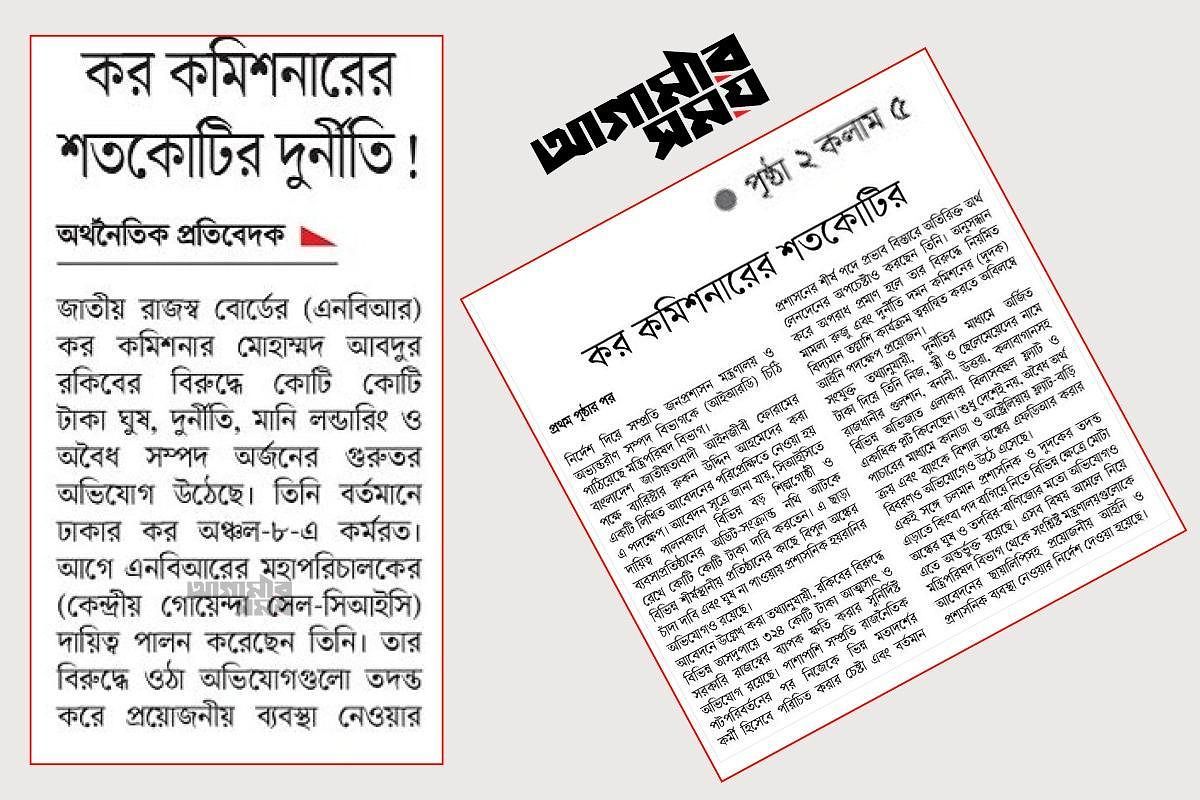
Reports published on Jan. 11 by several Bangladeshi media outlets, centered on a High Court verdict, claimed that the court had ruled that permission from a first wife would no longer be required for a second marriage. Through their headlines and accompanying reports, the issue was framed in a way that suggested the court had altered or relaxed existing legal obligations governing second marriages.
Such reports appeared in Dhaka Mail, Daily Janakantha, Channel i (online), NTV (online), as well as Khoborer Kagoj, BanglaVision, Ittefaq, and several other media outlets.
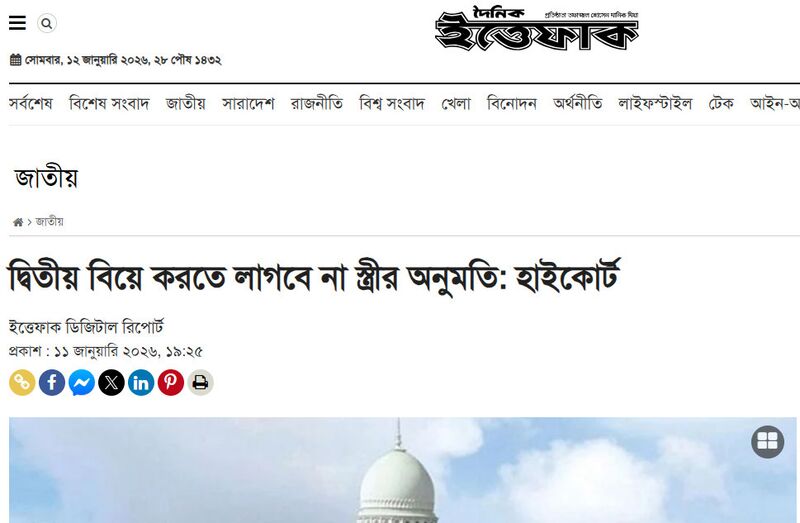
In the introduction to its report, Channel i Online wrote:
“Although a second marriage is permissible for men under Muslim law, in the context of Bangladesh it had been considered a serious offense and a violation of morality. But recently, a High Court verdict is changing this long-standing practice. From now on, a second marriage can be conducted without the wife’s permission—this is precisely the kind of verdict the High Court has delivered.”
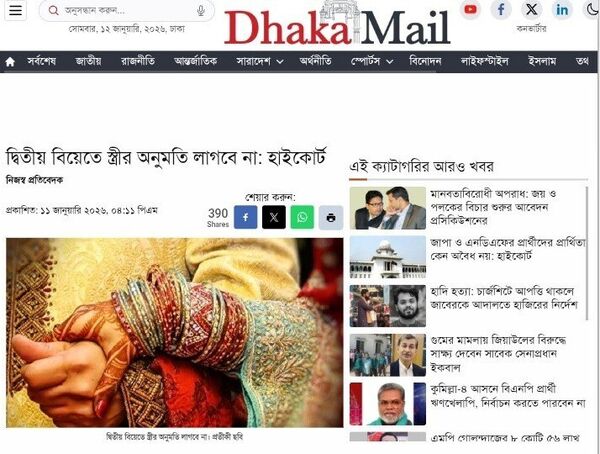
Nearly identical introductions were published by Daily Ittefaq, BanglaVision, Khoborer Kagoj, and Janakantha. In these reports, the introductions explicitly claimed that the law governing polygamy had been changed, that previously a second marriage could not take place without the first wife’s permission, and that the new verdict now allowed such marriages.
An analysis by The Dissent, however, found the claim that “permission from the wife is not required for a second marriage” to be incomplete and misleading. The High Court, it said, had neither amended existing law nor relaxed the legal framework regulating polygamy.
Instead, the case arose from a writ petition filed by Supreme Court lawyer Ishrat Hasan, who sought the annulment of the existing provisions on polygamy under the Muslim Family Laws Ordinance of 1961. The court dismissed the petition and left the previous provisions fully intact. Media reports, rather than clarifying this point, presented information that added to public confusion.
What the Law Says
Section 6(1) of the Muslim Family Laws Ordinance, 1961, states that no person, while an existing marriage is subsisting, may contract another marriage without the written permission of the Arbitration Council. Any marriage contracted without such permission shall not be registered under the Muslim Marriages and Divorces (Registration) Act of 1974.
Subsection (2) provides that an application for permission must be submitted to the chairman at the designated office with the prescribed fee. The application must state the reasons for the proposed marriage and indicate whether the consent of the existing wife or wives has been obtained.
Subsection (3) states that upon receiving the application, the chairman shall ask the applicant and each existing wife or wives to nominate one representative each. The Arbitration Council thus constituted may grant the application if it deems the proposed marriage necessary and just, subject to any conditions it considers reasonable.
Subsection (4) requires the Arbitration Council to record the reasons for its decision. Within a specified period, any party may apply for revision before the concerned assistant judge at the designated office upon payment of the prescribed fee. The decision of the assistant judge shall be final and may not be questioned in any court.
Subsection 6(5) outlines the consequences if a person contracts another marriage without the permission of the Arbitration Council. Under Section 5(a), the full amount of prompt and deferred dower payable to the existing wife or wives must be paid immediately. If payment is not made, the amount may be recovered as arrears of land revenue. Under Section 5(b), upon conviction, the offender may be punished with simple imprisonment for up to one year, a fine of up to 10,000 taka, or both.
Context of the Verdict
The verdict stemmed from a writ petition concerning polygamy that challenged the validity of Section 6 of the Muslim Family Laws Ordinance, 1961, and sought its annulment along with directives for a new policy banning polygamy. The petition was filed in the High Court in 2021 by Supreme Court lawyer Advocate Ishrat Hasan.
In the petition, Mr. Hasan argued that Section 6 effectively legitimizes polygamy, as the Arbitration Council established under the provision is predominantly male. He contended that this structure allows permission for polygamy to be granted broadly without ensuring justice and equal rights for existing wives, ultimately infringing upon women’s fundamental rights.
After hearings, a dual bench of the High Court—comprising Justice Fahmida Kader and Justice Syed Zahed Mansur—delivered its verdict on Aug. 20 last year in the case Ishrat Hasan vs. State. In a 24-page judgment dismissing the rule, the court held that the process for granting permission for polygamy under Section 6 of the Muslim Family Laws Ordinance is neither discriminatory nor arbitrary and does not violate the fundamental rights of either women or men.
The judgment further clarified that in cases of a second marriage, the determining factor is not the wife’s sole consent but the permission of the Arbitration Council, as the law does not identify the wife’s personal consent as the only condition. The court emphasized that this interpretation does not constitute a new provision but rather reflects the continuation of existing law.
According to Saikat Zaman, a lawyer at the Dhaka District and Sessions Judge Court, the framework for regulating polygamy in Bangladesh dates back to Section 494 of the Penal Code of 1860, which prescribed up to seven years’ imprisonment for a second marriage conducted without permission. With the introduction of the Muslim Family Laws Ordinance in 1961, the nature of punishment for men changed, and second marriages became subject to the approval of the Arbitration Council.
Mr. Zaman said the verdict had been presented as though the High Court had issued a new ruling, when in fact the requirement of Arbitration Council permission has long been in place. He argued that headlines written without a full reading of the judgment, or that isolate a single judicial observation, have fueled public confusion and distorted the ruling’s actual impact.
Confusion on Social Media
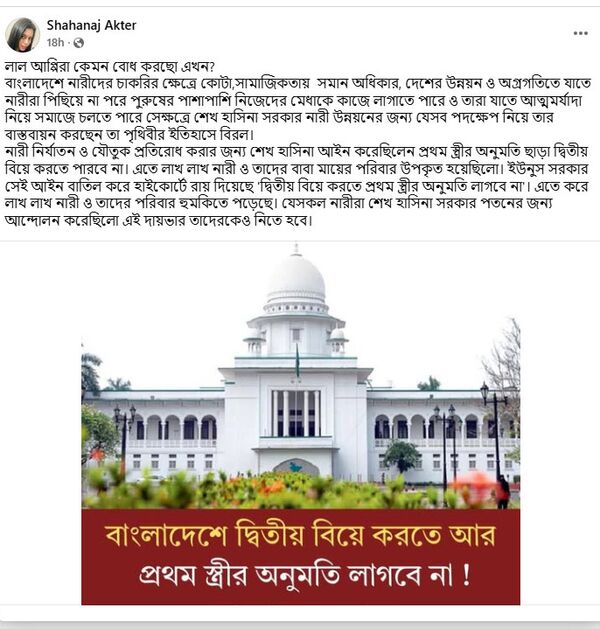
The confusion generated by the verdict was not confined to mainstream media. After the ruling, numerous posts circulated on Facebook pages and personal accounts claiming that “permission from the first wife is no longer required for a second marriage,” presenting it as a new decision or reform by the interim government led by Dr. Muhammad Yunus.
Many of these posts employed sarcastic and provocative language, including remarks such as, “How do you feel now, red sisters?” “Yunus uncle’s greatest reform of all time,” and “May this law be implemented quickly.”

Some posts also used the misleading headlines to target Islamic scholars, or “hujurs,” alleging that the High Court delivered the verdict under their pressure and that it reflected the influence of religious groups.
An account named Sushupto Pathok claimed that the High Court had issued the ruling—“permission from the wife is not required for a second marriage”—under pressure from Islamist scholars.
Another user, Abdul Wadud Molla Palash, wrote: “Here you go, hujur—now marry as much as you want; there are no more obstacles to marriage.”

A Facebook account named Biplobi Kontho-e Protibad shared a cartoon depicting two men in religious attire standing beside multiple female figures.
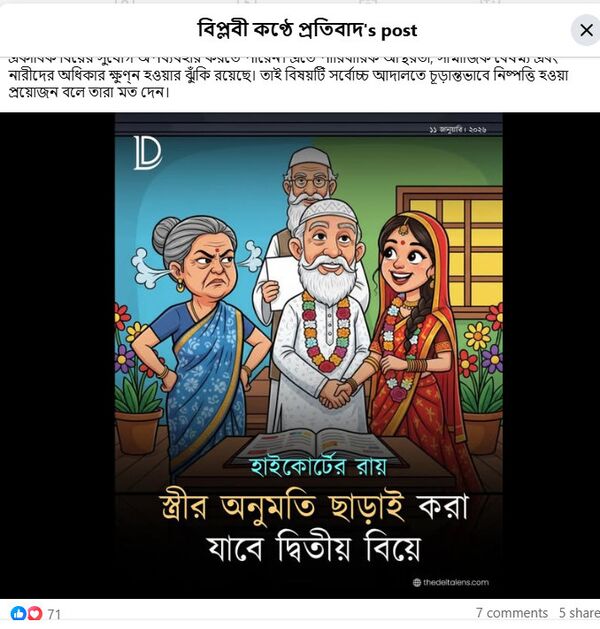
The caption read: “According to the High Court verdict, a second marriage can be conducted without the wife’s permission.”