

‘No Drugs Detected’: How Incomplete Reporting Created Confusion over the Rangpur Murders

Police recovered the bodies of Ganapati Chakraborty, a former teacher at Rangpur Zilla School, his wife and their two children from a house in the Machhuapara area of Rangpur city on the night of 22 August.
Police said the four were killed following a dispute after the suspects were prevented from taking yaba.
Two young men, Mugdha Das and Siddhartha Das, were arrested later that night.
Following their arrest, the suspects gave confessional statements before a court under Section 164 of Bangladesh’s Code of Criminal Procedure. Police said they admitted taking yaba before and after the killings.
Describing the incident at a news conference on 23 August, Rangpur Metropolitan Police Commissioner Mohammad Abdul Mabud said: “Mugdha Das and Siddhartha Das reached the roof of Ganapati Chakraborty’s house by crossing over from a neighbouring building.
“When Ganapati Chakraborty tried to stop them from taking yaba, they killed him first. They then killed his wife, daughter and son one after another.”
According to the police commissioner’s account, the two suspects took a shower in the bathroom of the house after the killings. They then sat at the dining table, ate dates and consumed the remaining yaba.
On Sunday afternoon, the eighth day after their arrest, the Detective Branch of Rangpur Metropolitan Police collected urine samples from Siddhartha Das and Mugdha Das for drug tests.
After receiving the medical report on Monday afternoon, Sanatan Chakraborty, deputy commissioner of the Detective Branch, told reporters that no drugs had been detected in the samples.
Evidence of drug use remains in urine for up to seven days, doctor says
Following the publication of the test results, doctors said urine samples generally need to be collected and tested within seven days to detect yaba or amphetamine use.
They said evidence of such drugs would usually no longer be detectable in urine after that period.
Professor Dr Rashedul Haque, a doctor in the biochemistry department at Rangpur Medical College Hospital, told The Dissent: “Amphetamine—a central nervous system stimulant found in yaba—does not remain in the blood or urine for a long time.
“It generally remains detectable in urine for five to seven days. After that, it can no longer be found.
“As the suspects had been in custody for more than seven days, they could not have taken drugs during that period. That is why the result was negative. This was the expected result, because amphetamine is not detected in urine after more than seven days.”
He added: “The samples should have been collected and tested immediately after their arrest.”
Detective Branch deputy commissioner Sanatan Chakraborty told The Dissent: “Drugs taken previously are generally not detected in a urine test conducted after such a long interval.
“A negative result therefore does not mean the suspects did not take drugs before or after the killings.”
He said hair samples would now be collected from the suspects for further testing.
Explanation missing from many media reports
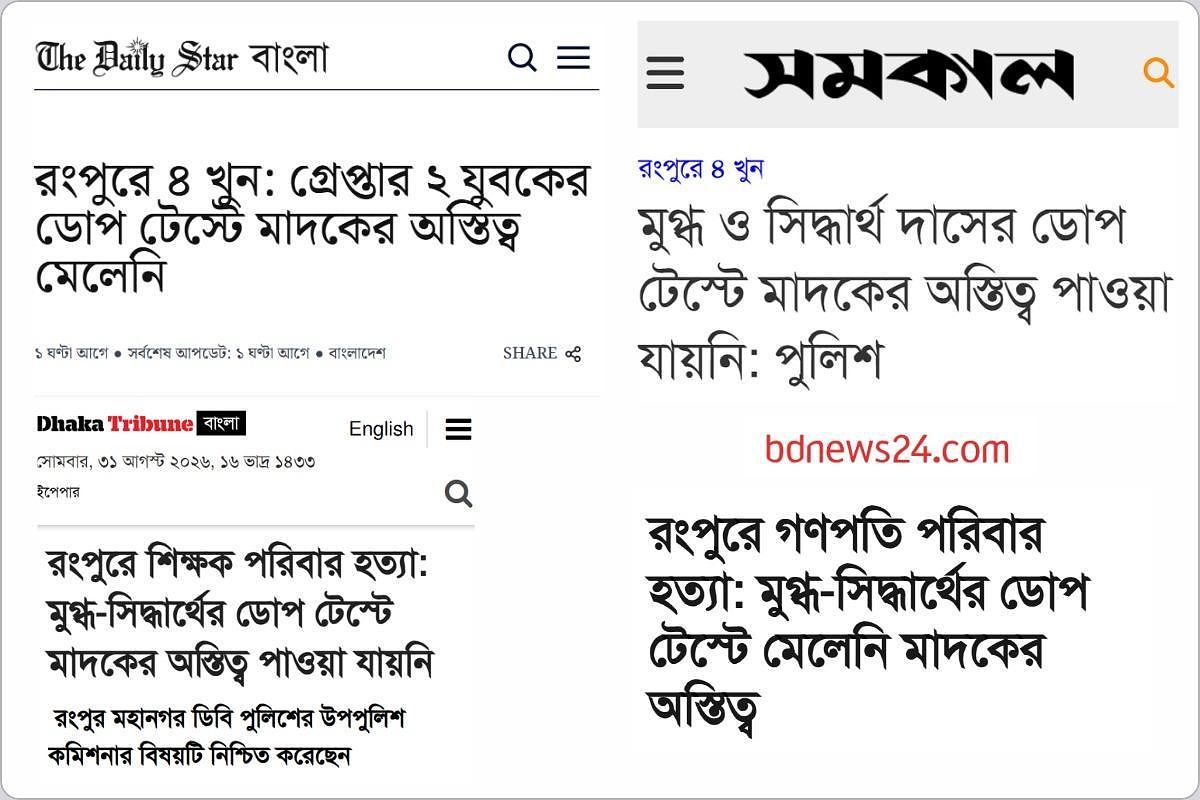
Following the police announcement, several leading Bangladeshi news outlets reported that the drug tests had found no trace of drugs.
But most of those reports did not include the explanation provided by doctors and police about why no drugs were detected in the urine samples.
Some reports also presented the negative results as contradicting the police’s earlier claim that the suspects used drugs.
For example, the Dhaka Tribune wrote: “The negative drug-test results call into question the motive for the killings described by police.”
Ekattor TV published a photo card with the headline: “Sensational Rangpur quadruple murder: No drugs detected in Siddhartha and Mugdha’s drug tests.”
The outlet did not provide further details in either the photo card or the post’s caption.
Several other news organisations published reports with headlines saying that no drugs had been detected in the two suspects linked to the Rangpur killings.
However, their reports did not include the doctors’ explanation for the negative results.
The outlets included The Daily Star Bangla, Kalbela, Kaler Kantho, Manabkantha, Ekattor TV, The Daily Campus, Desh Rupantor, bdnews24.com, The Daily Ittefaq and Dhaka Mail.
The list also included Khulna Gazette, Sylhet View, NewsNow, Bangladesh Journal, Khobor Sangjog, Dhaka Tribune, Samakal, Shomoyer Alo, ATN News, Daily Karatoa and Bhorer Kagoj.
Reports by the Indian news outlets Ei Muhurte and The Wall also did not explain why the test results were negative.
Some news organisations did not include the explanation in their headlines but mentioned it in the body of their reports.
These included Prothom Alo, Bangla Stream, Ajker Patrika, Dhaka Post, Ekhon TV, Amar Desh and Ekushey Television.
Misleading social-media posts follow news reports
Misleading claims began circulating on Facebook after news organisations published incomplete accounts of the drug-test results.
Some posts described the case against the two arrested men as a “staged drama”.
A Facebook user named Aninda Awual wrote: “The drug tests of the accused, Mugdha and Siddhartha Das, have come back negative. So who are the real perpetrators of the four murders in Ganapati Chakraborty Sir’s family?
“Who are the influential land grabbers, powerful figures and owners of black money? The people of the country want to know.
“Justice for this killing is a matter concerning the government’s image. The opposition is waiting for the government to make a mistake. People demand that those responsible for killing Ganapati Chakraborty Sir and his family be arrested and brought to justice.”
A post on a page called Durbar 71 said: “When the drug tests found no trace of drugs, what is the basis of the police’s yaba theory?
“If the account of drug use is not true, what is the justification for keeping Mugdha and Siddhartha in custody?
“Has a story similar to the ‘Joj Mia drama’ been constructed to conceal what really happened? Is blame being placed on someone to protect the real perpetrators?”