Where Fictional Tales Are Presented as ‘Courageous’ Journalism

A commentator narrates a completely fictional story as horror music plays in the background. The story contains allegations against a media outlet and its editor. Although no names are mentioned, the hints are clear. Anyone familiar with the recent news context would understand that someone is being accused.
But the allegations—or the entire story—are fictional. And the fictional story was broadcast by a media outlet in the form of a news report.
The curious part does not end there. Hundreds of viewers have praised the far-fetched story, along with a report incorporating additional statements in similarly imaginative language and some recent information, using terms such as “brave journalism,” “an extraordinary report,” “commendable news report” and “a report that brings satisfaction.”
Some social media users, however, have criticised the presentation of fictional events to audiences in the form of news.
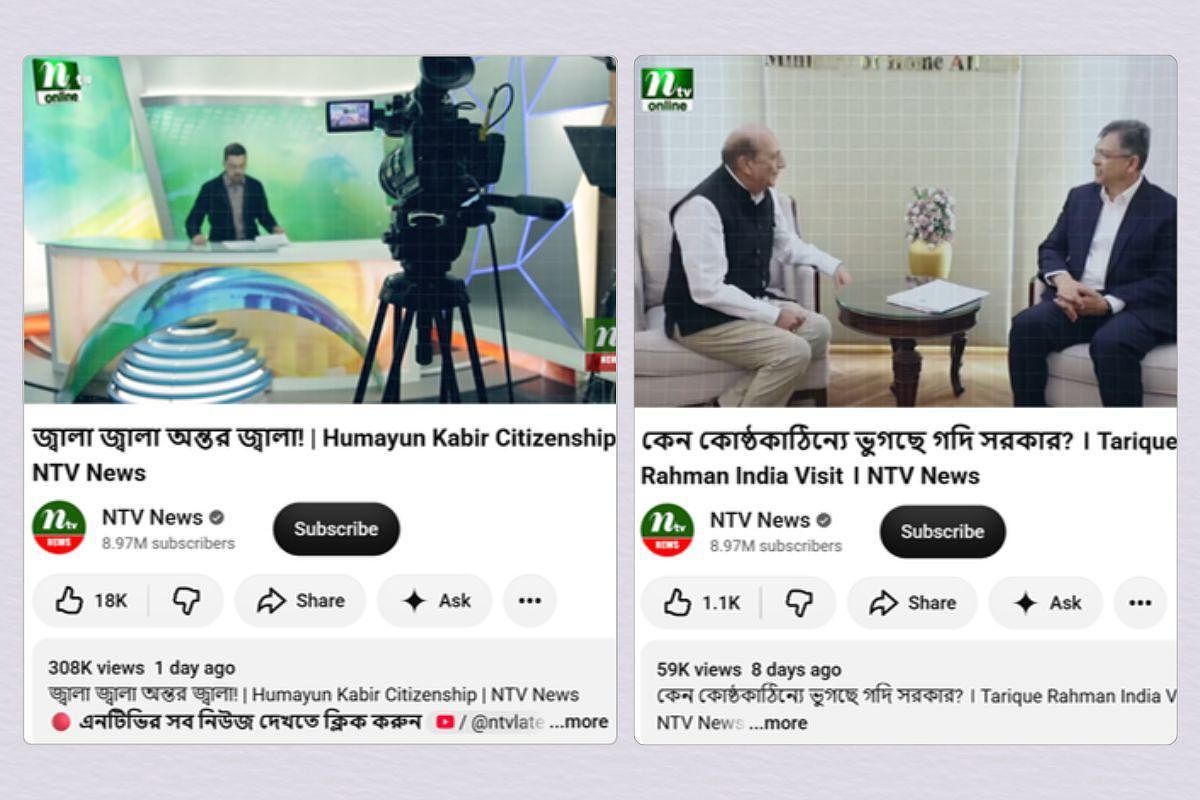
The report featuring the fictional story was published by private television channel NTV yesterday, August 26. It was titled “Jwala Jwala Ontor Jwala!” (“Burning, Burning, Inner Burning!”).
This is not the only such report. The Dissent analysed several recent reports by the television channel on different issues and found that NTV had constructed fictional stories in multiple reports and presented them as news coverage.
A Fictional Story About a Newsroom in Karwan Bazar
In its report titled “Jwala Jwala Ontor Jwala!”, NTV created a story centred on the newsroom of a media outlet in Karwan Bazar in the capital. The story was narrated as follows:
“It's 11 am in the air-conditioned, gleaming newsroom of the country's most neutral, most objective and most civilised media outlet, located in Karwan Bazar, Dhaka. The morning coffee on the editor's desk is getting cold, and deep furrows crease his forehead. There has been no major corruption scandal in the country, no bank has been looted, but his worries lie elsewhere. Perhaps a diplomat at a foreign embassy or a senior official in South Block has delivered a stern reprimand over the phone: ‘What's going on? Your new State Minister for Foreign Affairs, Humayun Kabir, is looking us in the eye when he speaks. He is talking about joining the Makkah Agreement. What are you doing? Find something.’”
The video then claimed that the editor called in his journalists and instructed them to uncover a flaw or scandal involving Humayun Kabir. They eventually settled on his dual citizenship as a potential weapon.
The commentator said, “The editor, deeply distressed, called in the investigative journalists. ‘Find something wrong with Humayun Kabir at any cost.’ The journalists worked day and night. No corruption was found, no scandal emerged. Finally, they discovered a Brahmastra that made them jump with joy: the passport—Humayun Kabir has dual citizenship.”
The report further claimed that after the news was published, senior figures in the newsroom smiled with satisfaction. NTV described the fictional scene as follows:
“The next day, the news was published with a huge headline. A look of self-satisfaction spread across the faces of the newsroom bosses. They thought, ‘Now the man is trapped.’ But they had forgotten that the people of this country are no longer as foolish as they used to be.”
NTV itself noted in the report that whether an unelected individual serving as a technocratic state minister or adviser can hold dual citizenship is a matter of legal debate. However, rather than seeking an objective answer to this legal question, the channel portrayed the entire issue as a politically motivated attack.
It claimed that Delhi, angered by the possibility of Bangladesh joining the Makkah Agreement, had threatened other domestic media outlets and pushed them to launch a campaign against Humayun Kabir.
Yet NTV presented no evidence in support of this claim. Instead, it questioned why other media outlets had remained silent when ministers in the previous government also held dual citizenship.
Through this argument, the channel portrayed a current news investigation involving the state minister for foreign affairs as an act of “servility.”
Many viewers praised the speculation-based report as an example of “brave and objective journalism.” Some of their comments read:
“I don't know how long this video will stay up, but for the first time since 2024, I have seen a news channel report independently in the national interest, looking people straight in the eye. Big respect, NTV.”
“NTV has set the whole place on fire. Salute to journalists like these.”
“NTV is the country's best news channel and produces the bravest news reports. If every news channel did this, nobody would have the power to engage in corruption.”
“An extraordinary news report, presented vividly. Bangladesh is on the right track.”
“An example of extraordinary journalism.”
Some viewers, however, criticised the report for lacking evidence. Their comments included:
“What a news report and presentation! Kazi Anwar Hossain's Masud Rana stories used to begin like this, with a scriptwriter taking inspiration from there and cutting and pasting... Today's audience probably won't understand any of this!”
“Is this news, or is someone being praised? NTV has also started this kind of flattery today.”
“Haha, is this news or bootlicking?”
“Many people are mistaking the script for a news report. This is an example of how the media can respond even to a constitutional issue.”
“The extent to which NTV is flattering [someone] is obvious.”
“How many crores of taka did you receive to upload this video, NTV?”
A Fabricated Story About Dhaka-Delhi Relations
The same jingoistic tendency is also evident in NTV's presentation of diplomatic news. In a report published on August 18 titled “Why Is the Government in Power Suffering from Constipation?”, the channel presented the complex bilateral relationship between India and Bangladesh through a sensational narrative.
The report began by constructing a fictional scenario inside the Indian High Commission in Dhaka. The scene was described as follows:
“A heavily secured, soundproof conference room inside the Indian High Commission in Baridhara, Dhaka. There is no sound inside except the faint hum of the air conditioner. At one end of a large mahogany table sits India's newly appointed High Commissioner, Dinesh Trivedi. In front of him lies a blue folder bearing the words ‘Dhaka-Delhi Relations: The Next Phase’ in large letters. Deep lines of worry are visible on Trivedi's forehead. He repeatedly taps the folder with the pencil in his hand.”
The report cited no eyewitness accounts, interviews, documents or diplomatic sources for these descriptions.
The video claimed that India was desperate to bring Prime Minister Tarique Rahman to Delhi for a visit and was preparing an “unimaginable offer” to entice him.
A statement by India's Minister of State for External Affairs Kirti Vardhan Singh in the Rajya Sabha about expanding cross-border rail and road connectivity was directly portrayed as a “desperate attempt to protect India's interests and lift trade restrictions.”
The report ended with another fictional scene.
“An unusual, tense silence has descended on South Block in New Delhi's Raisina Hills. India's top intelligence officials and policymakers are staring intently at a map. The map of Bangladesh glows at its centre. There was a time when they considered this map a puppet in their hands. But today, it has become an impenetrable wall. They realise that the chess pieces at their disposal are becoming useless one by one.”
Viewers expressed a range of reactions to the video in its YouTube comments section.
Many called for a boycott of India and warned the government against closer ties. Some wrote:
“NTV's extraordinary headlines always seem so strange. They have completely torn India apart.”
“India's friendship means Bangladesh's destruction!”
“This is Delhi's move. Those who fail to understand it will fall into Delhi's trap. Our government must not fall into the trap India has laid.”
“Bangladesh's prime minister should not set foot on Indian soil.”
Some viewers questioned the report's excessive dramatization. Several comments read:
“How did you find out what was discussed in a soundproof room?”
“Just look at that thumbnail. This is what speaking eye to eye means. India must be made to understand that it cannot function without Bangladesh. But presenting news in such poetic language is damaging the quality of journalism. There are many such reports from this outlet that sound like rhymes and seem like dreams. It's obvious that they do this for views. They feed the public whatever it consumes. These media outlets are destroying the country with their flattery. Because of all this flattery, they don't report the real news.”
“It is clear just from listening that this is false news. India will never beg Bangladesh like this. You are making up and dressing up stories. You can get views by saying these things, but provide the accurate information.”
A Fictional Story About Chanakyapuri in Delhi
At the beginning of a video published on August 5, 2025, titled “Are the Dates Being Finalised in Secret? | Sheikh Hasina”, the channel offered a dramatic description of Sheikh Hasina's whereabouts and state of mind.
“The time is 5:30 am. The sky over Dhaka has not yet fully brightened. Delhi is 1,822 kilometres from Dhaka, but the time difference is only half an hour. Dawn is approaching there, too. An elderly person sits by the window of an old house, gazing at the distant sky. Every now and then, she takes a sip from a four-handled cup. Heavy glasses rest on her face, and her lips carry a kind of melancholy satisfaction. This person is the autocratic Sheikh Hasina.”
The report did not verify subjects such as “sleeper cells” or political crises with reliable evidence. Instead, it introduced another fictional scene.
“Chanakyapuri in Delhi is now a silent palace. Inside, Sheikh Hasina sits in a bulletproof room, smiling as she eats bananas with milk from a glass bowl gifted by Modi. She watches the military training taking place in areas bordering Bangladesh on a camera. Sheikh Hasina knows she can no longer return, but her reach is long. Her mind is as cunning as the old Yamuna. And the fire of revenge still burns. ‘I taught this nation corruption, enforced disappearances and crossfire. Now I will teach it destruction,’ she whispers. The Indian intelligence officials standing behind her say nothing.”
Many viewers criticised the report in their comments.
“Can't you produce reports without mentioning Dhaka's sky, air and the darkness of night?”
“Many thanks to NTV for creating such a drama script. NTV could make much more progress by abandoning journalism and writing dramas instead.”
What NTV's Head of Online Said
The Dissent contacted Khandaker Fakhruddin Jewel, head of NTV Online, to ask about the authenticity of these reports and their sources.
Asked whether the narratives in the three reports mentioned above were fictional, Fakhruddin said, “No, definitely not fiction. You could call it somewhat metaphorical.”
He maintained that the reports were not fiction but rather analyses based on various references and sources.
Asked where the specific descriptions of a reprimand from South Block or conversations inside the Indian High Commission had come from, he said, “We have sources for everything. We have all the references, descriptions and everything else.”
However, he could not identify any specific documents.
Rather than discussing the evidence supporting his own reports, he cited a report by Prothom Alo. He asked, “After Sheikh Hasina fled, Prothom Alo published a report saying the SSF and the army had reached a situation of direct gunfire. Can Prothom Alo provide proof of that?”
His argument was that not every news report necessarily has to be supported by direct evidence or footage.
When asked about the description of Sheikh Hasina eating “bananas with milk” in Chanakyapuri, Delhi, he said it was “symbolic” or metaphorical.
“This is described as somewhat symbolic. People know that these things are symbolic,” he said.
Regarding the description of officials from India's intelligence agency, the Research and Analysis Wing (RAW), being present, he said, “Do you think this did not happen? Of course it happened. It is appearing in the media; we know about it.”
During the conversation, he placed greater emphasis on the underlying “message” of the reports than on their factual content.
Identifying himself as a journalism student, he asked the reporter in return, “I am a journalism student. You tell me, what is the basic message of this news? Are the facts being given to you in a completely point-by-point manner?”
When told that a journalism professor had described NTV's content as “fiction,” “a business driven by views” and serving a “political purpose,” he challenged the reporter instead.
He said, “If you also have sufficient evidence that such an incident did not happen, then write about it. Say that the incident did not happen there.”
Asked whether the use of dramatic background music and fictional scenes without supporting evidence complied with journalistic standards, he described the content as “analysis” rather than “hardcore news.”
Fakhruddin Ahmed said, “We are conducting an analysis. We are creating a pattern in it. But the presentation can be a little catchy, a little attractive. That is possible.”
What a Journalism Professor Said
A Rajee, an assistant professor in the Department of Communication and Journalism at the University of Chittagong, said reports of this kind by NTV could not be considered journalism.
He said the reports were built around fictional scenes and stories rather than verifiable evidence or documents. “This is not journalism. This is fiction; this is a story.”
He added that although the reports created the atmosphere of news coverage, they were not backed by evidence or verifiable documents. In particular, descriptions of conversations inside the Indian High Commission or South Block, officials' mental states and scenes from meetings were essentially based on speculation.
A Rajee said such content could be driven by political considerations as well as commercial interests centred on views. “There is politics, there is the business of views—everything is there.”
Noting that “such stories generally do not go against the existing power,” he said this type of reporting could affect the credibility of the media and audience trust in the long term.