


Family of an Accused Disputes Police Account Reported by the Media
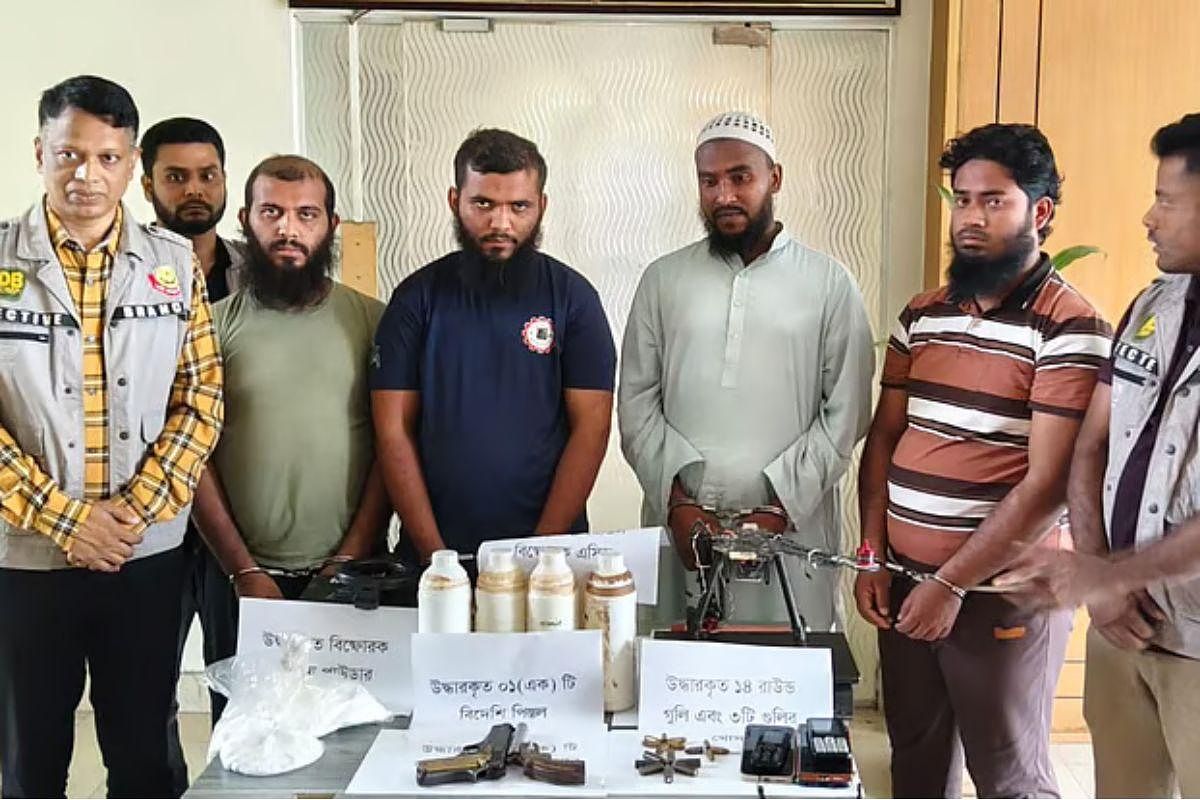
In late April, the Dhaka Metropolitan Police’s Detective Branch (DB) claimed to have arrested four youths in an operation in Kamrangirchar over alleged links to an extremist organisation. Reports published in the media, citing a police case and intelligence sources, said the four had been detained in operations in various areas of Kamrangirchar and Keraniganj in Dhaka.
The four detainees were identified as Md Imran Chowdhury, 29, Md Mostakim Chowdhury, 25, Ripon Hossain Sheikh, 28, and Abu Bakkar, 25. Media reports citing police claimed that the detainees were linked to the militant organisation Tehreek-e-Taliban Pakistan (TTP). However, The Dissent has not independently verified this claim.
Regarding the place and time of Abu Bakkar’s arrest, the first information report (FIR) filed by police states: “Imran was arrested at 3:05am on the night of April 27 from a house in the Koilaghat area adjacent to Tara Mosque in Kamrangirchar. Mostakim was arrested from the Jianagar area of Keraniganj at around 5:45am on April 28, while Ripon and Abu Bakkar were arrested at 8:55am from an area near Rasulpur Shikshan Bridge in Kamrangirchar. Imran and Mostakim are biological brothers.”
However, Abu Bakkar’s family claims that the information in the FIR about the place and time of his arrest, as well as the information published in the media citing the Detective Branch, is incorrect.
The family says Bakkar was arrested not on the morning of April 28 but at noon on April 27. They also claim that he was not arrested near Rasulpur Shikshan Bridge in Kamrangirchar, but was detained at the immigration section of Hazrat Shahjalal International Airport. According to the family, he was detained after clearing immigration while preparing to travel to China, and police showed him as arrested on the third day after his detention.
Mainstream media outlets, including Prothom Alo, Jugantor, The Daily Star, Desh Rupantor, Ittefaq and Dhaka Tribune, reported, citing a DB press briefing, intelligence sources and the FIR, that the four men had been detained in Kamrangirchar and Keraniganj. The reports did not indicate that the locations of the arrests or other details had been verified through statements from the accused men’s families or any other sources. They were based solely on the police case and information provided by the Detective Branch.
Before mainstream media published reports about the arrests of the four men, The Dissent had also received information about Abu Bakkar’s arrest and a copy of his passport from multiple intelligence sources. However, The Dissent follows a policy of independently verifying information through multiple sources and its own methods before publishing any report, particularly those concerning extremism in Bangladesh. This includes obtaining statements from the accused or their representatives, such as family members or lawyers, and verifying evidence of the accused’s extremist activities, such as online activity or other relevant conduct. The Dissent’s policy is not to publish reports on extremism without such verification.
The Dissent refrained from publishing a report on the arrests of the four youths because the available information was insufficient and it had not obtained the family’s account.
Later, multiple senior sources from organisations working to combat extremism and terrorism in Bangladesh told The Dissent that Abu Bakkar had been detained at the airport while travelling to China, not in Kamrangirchar. Although media reports said he had been detained on April 28, the sources said he was detained at noon on April 27.
This means there is a discrepancy of at least one day in the time of Abu Bakkar’s arrest as stated in the FIR and in the information provided by the Detective Branch to the media.
What Abu Bakkar’s Family Says
Abu Bakkar’s sister, Jochhna Begum, told The Dissent: “My brother’s flight was scheduled for 2:20pm on the 27th. He called my mother from the airport and said, ‘Mother, I have cleared immigration. Once I board the plane, I won’t be able to call you again.’ His phone has been switched off ever since. The police came to our house the next day to search it, but they found nothing. When we asked the police, they told us to contact the police station. When I went there, they said he was with RAB. After that, we received no further information. We went here and there, and then to the DB office. There, I identified him and said that RAB had supposedly arrested him. They laughed and said, ‘Is there any such thing as RAB arresting someone and handing them over to the DB?’ They did not acknowledge anything. Later, we learned through the newspapers that a case had been filed against him. Neither the DB, the police nor RAB contacted us or provided any accurate information.”
However, DB chief Shafiqul Islam told The Dissent that the claim that Abu Bakkar had been arrested at the airport a day before the time stated in the case was incorrect.
“If we can show that he was detained in Kamrangirchar, why can’t we show that he was detained at the airport? He was shown as arrested at the place where he was detained,” he said.
Asked whether it was true that RAB had detained him at the airport and handed him over to the DB, he said, “Nothing like that happened. However, he may have been questioned at the airport.”
When asked which agency had questioned him, he said, “He [Abu Bakkar] said he had been questioned and released. I don’t know who did it.”
He said he could not remember details from so long ago.
Arrest Reports Spread on Facebook Before DB Police Briefing
Although the DB police formally informed the media on April 29 that Abu Bakkar and the other three men had been detained, information about Abu Bakkar’s detention had already been circulated by some Facebook groups and pages on April 28.
For example, on April 28, a page called Dinpatra, citing airport sources, claimed that Abu Bakkar had completed immigration formalities at 2:27pm on April 27 to travel to Guangzhou on China Eastern Airlines flight MU-2036. However, the post said that the intelligence agency Directorate General of Forces Intelligence (DGFI), specifically its CTUB unit, had already received information about his alleged militant links. On the basis of that information, he was detained in the INS area of immigration. After his detention, the immigration records showed him as having been “self-offloaded”, and his departure stamp was cancelled under General Diary entry No. 2150. After initial questioning, at 4pm, DGFI Major Ferdous Ahmed escorted the accused, Abu Bakkar, out of the airport area and handed him over to RAB-1 Additional Superintendent of Police Siddiqur Rahman.
Despite repeated attempts by The Dissent, it was not possible to speak to RAB-1 Additional Superintendent of Police Siddiqur Rahman.
The Dinpatra Facebook page is linked to a website called www.dinpatra.in, meaning its domain is Indian. However, the website lists its address as 120 Tejgaon Industrial Area in Dhaka and names Md Shahabuddin Samrat as its editor. No way to contact him could be found.
Of the other three men arrested alongside Abu Bakkar, Imran Chowdhury and Mostakim Chowdhury are biological brothers. The Dissent also spoke to their family, which did not raise any objections to the police account of the two brothers’ arrests.
The Dissent found Facebook accounts belonging to Abu Bakkar, Imran and Mostakim. Mostakim’s account is locked. Abu Bakkar’s bio reads, “I nurture a desire for martyrdom.”
A review of Bakkar’s Facebook posts found that he regularly shared content featuring Osama bin Laden, Mullah Omar and Abu Ammar Jununi, the leader of ARSA. He also repeatedly posted that democracy was “anti-Islamic”.
The FIR filed by police after the arrest of the four men states that the operation yielded a foreign-made pistol, a one-shooter gun, 14 bullets, three spent bullet casings, several smartphones, a laptop, a metal detector, two drones, seven watch straps, military clothing, jihadist books, 900 grams of gunpowder and five bottles of acid. According to the FIR, the accused possessed firearms, ammunition, explosives, jihadist books, drones and military clothing while being involved with various extremist organisations, with the aim of threatening Bangladesh’s sovereignty and destabilising the government and the country.
Human rights activist Rezaur Rahman Lenin said, “Under the amended Section 54, if someone is detained, the reason for the detention and the person’s whereabouts must be communicated to their family. They must be produced before a court within 24 hours. If this does not happen, the detention or arrest is unlawful. Since he was not produced before a court within 24 hours, under human rights law this constitutes enforced disappearance, which is also a crime against humanity. Such crimes are being tried at the ICT tribunal. If these violations continue, however, there will be no benefit. One crime cannot be stopped by committing another. Crimes against humanity occurred during Hasina’s tenure, and they also occurred during Yunus’s tenure, though not through enforced disappearances but through extrajudicial killings. These crimes are continuing even now. If the forces whose officers are facing trial for crimes against humanity continue committing such offences, it shows that they will not stop. The pattern of human rights violations and crimes against humanity in Bangladesh cannot continue, regardless of how heinous the alleged crime is or how dangerous the accused may be.”