No Defined Criteria for ‘Communal Violence’ as Unity Council List Includes Unrelated Incidents
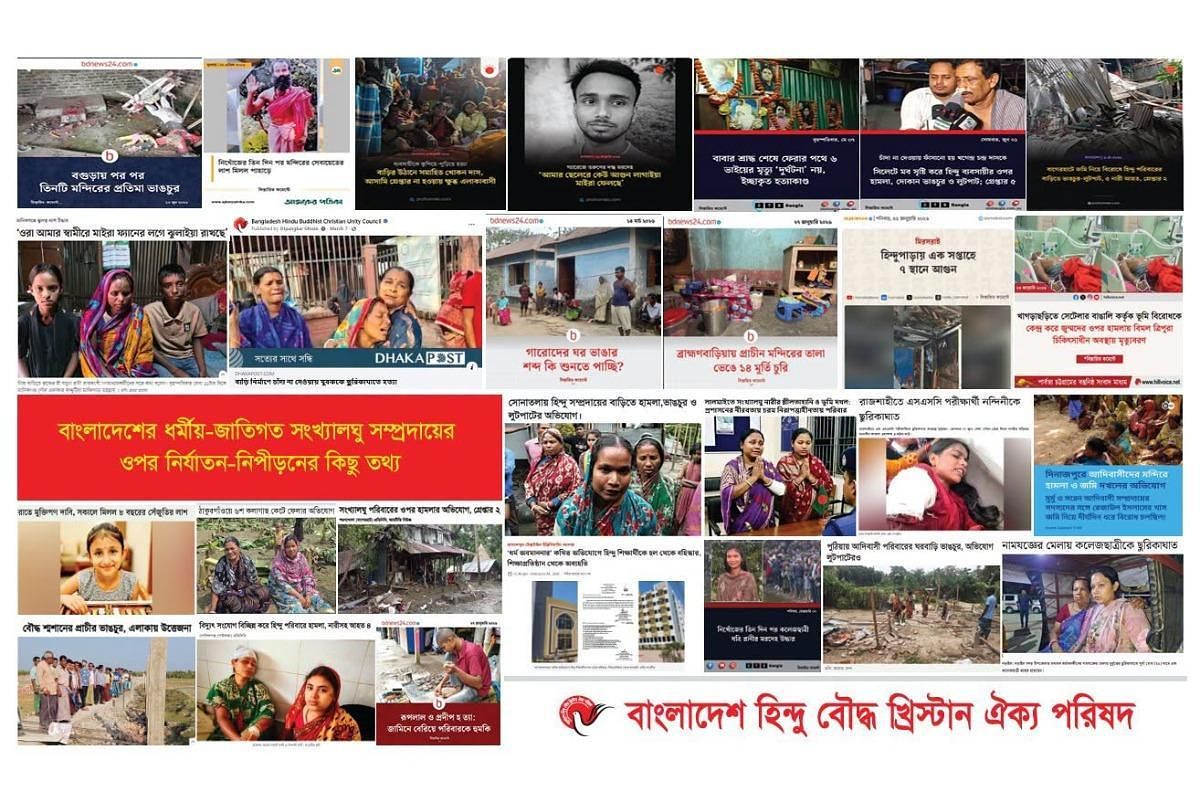

The Bangladesh Hindu Buddhist Christian Unity Council has claimed in a report that 257 incidents of communal violence against religious and ethnic minorities occurred in the first six months of this year. According to the organization, 44 people were killed in 40 of those incidents.
The figures were subsequently cited by multiple news outlets in Bangladesh and India in reports about violence against minorities.
Indian outlets including Kolkata24x7, Egiye Bangla News, Bartaman Bangla, Aaj Tak Bangla, ANI, HinduPost, Tripura India and Asianet News highlighted the figures of 257 attacks and 44 deaths, portraying minorities in Bangladesh as facing “continuous persecution.”
The Indian reports used terms including “communal violence,” “communal attacks,” “atrocities against Hindus,” “persecution of Hindus,” “atrocities against minorities,” “persecution of religious and ethnic minorities,” “persecution of religious minorities” and “hundreds of incidents targeting minorities.”
The Dissent reviewed the details of the 40 incidents involving the deaths of 44 people listed by the Unity Council and compared them with accounts published by mainstream Bangladeshi news organizations.
The review found several cases on the list that could not readily be characterized as either “communal” or, in some instances, as deliberate acts of violence.
The Dissent’s analysis found that several people whose deaths were presented in the Unity Council report as part of “communal violence” had been victims of ordinary robbery or mugging. The list even included the death of a teenage auto-rickshaw driver who was struck by a truck while chasing his stolen vehicle. In several other cases, news reports attributed killings to personal disputes, land conflicts or disagreements over financial transactions.
An ‘Unnatural Death’ Counts as Violence, but There Is No Specific Standard for ‘Communal’
The Dissent asked the Unity Council whether it had a specific definition or set of criteria for classifying the 44 deaths in its six-month report as “communal violence,” and how the organization collected and verified information about the incidents.
Manindra Kumar Nath, the organization’s acting central secretary, told The Dissent that it had no specific definition or criteria for determining whether an incident constituted communal violence.
According to Nath, when news outlets report the unnatural death of a member of a minority community, the organization checks locally whether the incident actually occurred. It then considers that “unnatural death” an act of “violence.”
When The Dissent presented him with details of three specific cases from the list and asked why they had been classified as communal violence, Nath initially described them as acts of “violence.” Later, however, he said they might fall within the category of “normal” incidents and “could be excluded” from the list.
Nath said:“We include the cases that newspapers describe as killings. A person is killed and left somewhere. If someone kills him, surely it is because of some hostility, or because they consider him weak. There is this kind of hostility toward him because he is a minority.”
He added: “These things are happening constantly now. If there were only one or two, we might think otherwise. But one after another, people are entering homes and slitting throats; bodies are being found by roadsides; people are being attacked and killed. We have details of these incidents. We have not fabricated any incident ourselves. Every incident has a source, and they are real incidents.”
Asked whether the organization independently checks the nature and circumstances of an incident after finding it in the news media, Nath said: “Yes, we check whether the incident is true, whether it happened. Newspapers do not publish such baseless reports. The incident happened, and it was not a normal death. We consider an abnormal death to be violence.”
His account suggests that the organization locally verifies whether an incident reported by the news media actually occurred. But he did not identify a specific method or standard for determining whether a victim’s religious identity was a factor in a killing.
Three Deaths Listed as ‘Violence’ Could Be Removed, Unity Council Official Says
The Dissent read Nath the details of three deaths included in the Unity Council’s report.
According to the council and news reports, the three cases were:
On Feb. 26, robbers entered a cowshed in Chandanaish, Chattogram, before dawn and attempted to steal cattle belonging to Chandan Dey. When he tried to stop them, the robbers shot him. He was taken to a hospital, where doctors pronounced him dead.
On the night of March 8, two men posing as passengers pushed Shanto Kumar Saha, a teenage auto-rickshaw driver in Feni, into a roadside ditch and fled with his vehicle. Shanto climbed out and ran after the stolen auto-rickshaw. A speeding truck coming from behind struck him, killing him at the scene.
On the night of April 24, Bullet Bairagi, a customs official, encountered an organized mugging gang while traveling from Chattogram to Cumilla. When he resisted an attempt to take his bag and mobile phone, a struggle followed and he was thrown from a moving auto-rickshaw. He died from severe head injuries and excessive blood loss. His body was recovered from the Kotbari area the following morning.
The Dissent asked how these incidents came to be categorized as communal violence when there was no clear evidence linking them to the victims’ religious identities.
Nath initially responded: “For every incident that happens, is the government investigating it? That is the central question: Was he killed because he was a minority in this country, or was it a normal incident?”
When asked whether the muggers who killed Bairagi, a customs official, even knew his religious identity, Nath replied:
“There was violence. All of them are communal — communal violence.”
The Dissent pointed out that the report as a whole presented these cases under the broader category of communal violence. Nath responded: “I am saying the total report is about violence. This is also an act of violence.”
The Dissent then cited another 15 or 16 cases in the report, including killings linked to land disputes, in which no evidence had been found indicating that the victims were killed because of their religious identity. Asked whether a killing resulting from a longstanding land dispute should be considered communal violence or ordinary violence, Nath said:“It is certainly violence.”
When pressed again about the three cases first raised by The Dissent, however, Nath said: “The three you are talking about may fall within the nature of normal incidents, or you are saying there was nothing violent about them. Those three could perhaps be excluded. Fine, exclude those three. But there is no scope to deny the rest of the 44.”
The Dissent also contacted Advocate Dipankar Ghosh, a member of the Unity Council’s central information collection and monitoring cell.
Asked what criteria the organization used to classify the incidents in the report as “communal violence,” and whether it had a written definition or guidelines for doing so, Ghosh also did not provide a specific definition or explanation.
Other Cases Where Evidence of a Communal Motive Was Not Found
Of the 44 deaths listed by the Bangladesh Hindu Buddhist Christian Unity Council, The Dissent analyzed 16 cases. It compared the council’s descriptions with statements from police, the Rapid Action Battalion, victims’ relatives and local residents as reported by mainstream news organizations. The Dissent did not conduct field investigations into any of the cases.
In these 16 cases, the available descriptions and evidence did not establish that the deaths resulted from planned communal violence. The Dissent has not reached a conclusion about the remaining cases.
Khokon Chandra Das
A claim had previously circulated that Khokon Chandra Das, whose death appears near the beginning of the Unity Council’s list, had been attacked by an “Islamist mob.” According to the council’s report, assailants attacked Das with sharp weapons as he returned home after closing his pharmacy, poured a flammable substance over him and set him on fire. He later died in a hospital.
A fact-check by The Dissent found the claim that an Islamist mob was responsible to be false.
Citing police, Das’s wife, relatives and local residents, the fact-check said the preliminary investigation indicated that robbery was the motive. Police said the attackers assaulted Das and set him on fire after he recognized them during the robbery. His relatives also linked the attack to robbery or mugging. His wife said the family had no dispute with local Muslims.
Ripon Saha
Ripon Saha was killed at a filling station in Goalanda. The Unity Council’s own report said he was run over after demanding payment for fuel.
According to Prothom Alo, a vehicle took fuel worth 5,000 taka and attempted to leave without paying. When Saha demanded payment, he was run over. Police later seized the vehicle and detained its owner, former BNP leader Abul Hashem Sujan, and the driver, Kamal Hossain.
Published accounts contained no indication that Saha was attacked because of his religious identity. Rather, the dispute began over payment for fuel.
Liton Chandra Ghosh
Claims of a communal attack also circulated after Liton Chandra Ghosh was killed in Gazipur.
According to the Unity Council report, an argument over a minor issue broke out at a sweet shop between an employee, Ananta Das, and Masum Mia and later turned into a physical confrontation. Ghosh intervened in an attempt to calm the situation. He was beaten and eventually struck on the head with a crowbar, killing him.
Social media posts later claimed that he had been killed because an image of a Hindu deity was displayed in the shop. But a Rumor Scanner fact-check found that claim to be false. It said Ghosh was killed during a sudden confrontation over the theft of a bunch of bananas.
Gazipur district police similarly said the incident was neither premeditated nor the result of Hindu-Muslim communal tensions, but arose from a fight over a minor dispute.
Madhu Chandra Shil
In the death of Madhu Chandra Shil, reports pointed to a longstanding dispute over a property boundary.
The Unity Council report said Shil was seriously injured after being pushed during an argument with neighbors and later died at a hospital.
According to Jugantor, a scuffle broke out between two sides over the planting of a tree in front of a house. During the confrontation, Shil was pushed and fell onto the concrete base of a tube well, sustaining a serious head injury. Doctors pronounced him dead after he was taken to a hospital. Police arrested the principal accused, Ashraf Ali.
Sunil Banshfor
Reports linked Sunil Banshfor’s killing in Bogura to an extortion demand.
The Unity Council report said someone demanded 500 taka from him and stabbed him after he refused to pay.
According to Ajker Patrika, a drug dealer named Anik demanded 500 taka from Banshfor and stabbed him during an argument. Banshfor died after four days of treatment. His father filed a murder case.
Chandan Dey
Chandan Dey was killed after confronting robbers stealing cattle from his cowshed.
The description in the Unity Council report is consistent with Prothom Alo’s account: A group of robbers raided the area before dawn and began taking cattle from several cowsheds. When Dey tried to stop them from taking his cattle, he was shot. He later died at a hospital.
Police and a local elected representative also described the killing as having occurred during a robbery.
Akash Das
The Unity Council report said that several people assaulted Akash Das’s colleague Michael after an argument near Bitak Bazar intersection. When Das intervened, the attackers struck him with a helmet and stabbed him. He was taken to a hospital, where doctors pronounced him dead.
According to bdnews24.com, the confrontation began over money that was owed. Police said several people were attempting to take Michael away over the unpaid money when Das intervened. A fight followed, during which Das was stabbed, struck with a helmet and beaten. Police arrested four people in connection with the killing.
Chayan Rajbhar
The Unity Council report said Chayan Rajbhar was stabbed by Shahin Fakir and his associates during a land dispute. His brother was also injured while trying to save him. Rajbhar was taken to a hospital, where doctors pronounced him dead.
Jugantor also reported that Rajbhar and Shahin Fakir had been engaged in a longstanding land dispute and that several related cases were pending in court. A confrontation over possession of the disputed property escalated into a clash in which Rajbhar and his brother were stabbed. Rajbhar later died at a hospital.
Ganesh Pal
Reports about the killing of Ganesh Pal in Cox’s Bazar also pointed to extortion.
The Unity Council report said local criminals demanded 100,000 taka from Pal and beat and stabbed him after he refused to pay.
Jugantor also reported a dispute involving an extortion demand. Police later described the case as a planned killing and arrested two alleged masterminds. The report quoted local residents as saying extortion had long been prevalent in the area and that Pal might have been attacked because he refused to pay.
Shanto Kumar Saha
The Unity Council report said two men posing as passengers boarded Shanto Kumar Saha’s auto-rickshaw. When they reached an isolated area, they pushed him into a ditch beside the highway and attempted to escape with the vehicle. Saha climbed out and ran after the stolen auto-rickshaw, but was struck by a speeding truck and died at the scene.
Prothom Alo reported the same sequence of events. Police were investigating the case as an auto-rickshaw robbery.
Ujjal Karmakar
Reports also linked the killing of Ujjal Karmakar to a dispute over land and financial transactions.
The Unity Council report said he was attacked with sharp weapons following a dispute over leasing land for watermelon cultivation and related financial dealings.
A bdnews24.com report likewise described a clash between two groups over land used for watermelon cultivation. Three other people were seriously injured in the same incident.
Bullet Bairagi
The Unity Council report said Assistant Revenue Officer Bullet Bairagi was killed after being attacked by assailants in the Kotbari area of Cumilla while returning home from training in Chattogram. Police recovered his body after his family reported him missing, and the Rapid Action Battalion later detained three suspected muggers for questioning.
According to Prothom Alo, citing RAB, Bairagi was the victim of an organized mugging gang. Gang members posing as a driver and passenger picked him up in a CNG-powered auto-rickshaw, attacked him with a sharp weapon and stole his phone, money and bag. He was then thrown from the moving vehicle and died at the scene.
Krishna Rajbanshi
The Unity Council report said Krishna Rajbanshi was detained in a market association office and beaten by influential local people over allegations that he had stolen fish. His family was asked to pay 40,000 taka. Although the family agreed to pay, he died during the assault. His body was later allegedly hung up in an attempt to make the death appear to have occurred differently.
Reports by Prothom Alo and bdnews24.com similarly said Rajbanshi had been detained and beaten at the market management committee’s office over allegations of fish theft. His family alleged that 40,000 taka was demanded for his release and that he was beaten to death after they were unable to pay. His body was later allegedly hung from a ceiling fan.
Dipali Sikder
The Unity Council report said Dipali Sikder died while receiving treatment at Sher-e-Bangla Medical College Hospital after an employee disconnected her oxygen supply. Her relatives accused hospital staff of negligence, and the employee was later temporarily suspended.
According to The Daily Star, Sikder had been admitted with breathing difficulties and was supposed to receive oxygen while lying on a trolley. Her brother alleged that a trolley attendant disconnected her oxygen so the trolley could be given to another patient. She died minutes later.
Bhabatosh Mridha
The Unity Council report said Bhabatosh Mridha was attacked with sharp weapons at his home by a group led by a local man named Gafur following an earlier land dispute. Mridha later died at a hospital. His wife was also injured.
According to Prothom Alo, assailants broke into the house at night and hacked Mridha to death. His wife, Bibha Mridha, said she recognized a man named Gafur among the attackers and referred to an earlier dispute over land. Police said they were also investigating previous enmity or a personal dispute as possible motives.
Shyamal Chandra Mali
The Unity Council report said Shyamal Chandra Mali got into an argument with Hasan Ali after referring to him as a “kamla,” a term for a day laborer, while discussing the harvesting of paddy. Hasan Ali then struck Mali on the head with a tree branch. He was taken to a hospital, where doctors pronounced him dead.
Prothom Alo reported the same circumstances: Mali used the term while discussing harvesting work, an argument followed and Hasan Ali, angered by the remark, struck him on the head with a tree branch.
How Is Communal Violence Defined Internationally?
The United Nations Office on Drugs and Crime, or UNODC, describes communal violence as conflict or violence involving different religious communities, sects or tribes within a religion, ethnic groups or communities based on national identity. It does not include personal disputes between two individuals or two families within the definition.
Human Rights Watch defines communal violence as violence between groups based on differences in religion, ethnicity, language or race.
A 2020 joint research report by the Folke Bernadotte Academy, the Peace Research Institute Oslo and UN Women describes communal conflict as a form of nonstate armed conflict involving two or more social groups, in which the state is not a party.
A research article published by ACCORD, a South Africa-based peace research organization, and written by peace and conflict researchers at Uppsala University defines communal conflict as violent conflict between two or more nonstate groups organized around communal identities.
Across these definitions, religion, ethnicity, language or another form of collective identity is a central element in defining communal violence or communal conflict.
They do not suggest that personal disputes, land conflicts, robbery, extortion or other ordinary crimes should be classified as communal violence solely because of the victim’s religious identity.
What Experts Say
Shafi Md Mostofa, an associate professor in the Department of World Religions and Culture at the University of Dhaka, told The Dissent that the Unity Council’s approach appeared to focus on the incidents themselves without sufficiently examining their context.
“Looking at the Bangladesh Hindu Buddhist Christian Unity Council’s report, it appears that they conducted content analysis of the news reports, but not discourse or narrative analysis. As a result, the report may show that a Hindu or someone from another minority religion was killed, but it does not address why or how the person died.”
Mostofa has long researched the condition of religious minorities in Bangladesh, the challenges they face during political transitions and religious extremism.
Asked how an attack on a minority should be understood, he said:
“Put simply, any harm — or attempt to cause harm — because of your minority identity, or specifically targeting that identity, is classified as an incident of minority persecution, much as Islamophobia is understood elsewhere.”
That means, he said, an incident cannot be assessed in isolation. The role a person’s religious identity played before, during and after an incident must also be examined; without that context, it is difficult to classify any incident as an attack on a minority.
Mostofa also referred to an earlier investigative report by Netra News that raised questions about a report by the Bangladesh Hindu Buddhist Christian Unity Council, and called for greater methodological transparency in the organization’s reporting.
“If reports like these have substantial methodological limitations, genuine attacks on minorities — even cases involving deaths — may end up being obscured.”
Researcher, writer and human rights activist Rezaur Rahman Lenin told The Dissent that in Bangladesh, distinctions among allegations of “communal violence,” “criminal offenses” and “human rights violations” are not always clearly drawn.
For a killing to be classified as communal violence, he said, it must be specifically established that the crime was motivated by the victim’s religion, ethnicity or communal identity.
“Bangladesh has long had a methodological problem in determining what constitutes communal violence. Incidents motivated by religious hatred, personal disputes, robbery, mugging, land disputes and other criminal offenses are often presented together on the same list. As a result, the distinction between identity-based violence and ordinary crime becomes blurred.”
He added:
“Not every killing of a member of a minority community can be called communal violence. If someone is killed while resisting a robbery, during a mugging, in a road accident, or as a result of a personal or land dispute, those cases are legally treated as criminal offenses. There may be questions about the state’s failure to maintain law and order, but whether those cases can be called communal violence solely because of the victim’s religious identity needs to be assessed separately.”
Lenin said there were also weaknesses in how communal violence is documented and reported in Bangladesh. News organizations and rights groups sometimes list incidents without conducting a full investigation or verification, he said, creating conceptual, factual and practical confusion.
“Before an incident is classified as communal violence, it is necessary to clearly establish that there was hatred, hostility or targeting based on religious identity.”
At the same time, Lenin said identity-based attacks do occur in Bangladesh, including the seizure of minority-owned land and property, intimidation and violence against women during changes in political power. Those allegations, he said, cannot simply be dismissed and require proper investigation and documentation.
But accurately portraying identity-based violence requires examining the cause of each incident individually, he said.
“Just because a Hindu has been killed does not mean it can automatically be called a communal attack. At the same time, we have to make sure genuine incidents of communal violence are not obscured.”
For that reason, he said, the Unity Council’s data and classifications require more detailed scrutiny and explanation. He also called on the government to establish an impartial and independent commission to investigate the incidents and establish the facts.
Lenin said that repeated classification errors could eventually become difficult to regard as simple mistakes.
“The first time such a mistake happens, it may be understandable. If the same mistake occurs a second time, it reflects a decision. And if the same type of mistake happens a third time, it becomes a considered position — one that could even be regarded as a form of wrongdoing.”