


The ‘Rajakar’ Slur Sparked a Revolution in Bangladesh, Where Will the ‘Cockroach’ Remark Lead India?
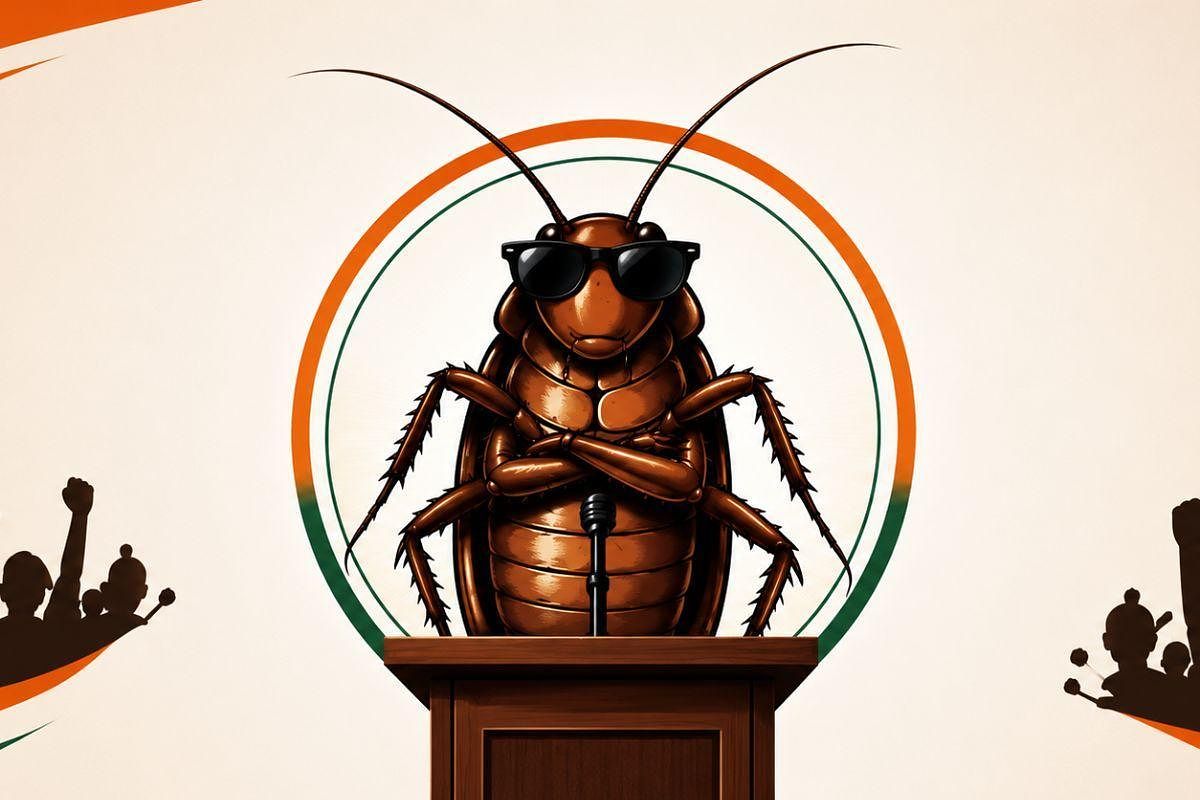

A 30-year-old Indian youth, educated in public relations at Boston University, has suddenly emerged at the center of a swelling wave of political dissent among India’s younger generation. His name is Abhijit Dipke - the founder of a satirical movement called the “Cockroach Janta Party,” born in response to a controversial remark by India’s Chief Justice Surya Kant, who compared unemployed young lawyers to “cockroaches.”
The comparison has ignited debate across India, with commentators asking whether the remark could have consequences similar to those seen in Bangladesh during the 2024 quota reform protests, when then–Prime Minister Sheikh Hasina’s dismissal of demonstrators as the “Razakars” helped intensify a nationwide uprising.
The Birth of the “Cockroach Party”
The controversy began last Friday when Chief Justice Surya Kant, visibly frustrated during a courtroom exchange, likened some unemployed lawyers and online activists to “cockroaches.” He complained that such individuals “go to the media, become RTI activists, and then begin attacking the system.”
The remark spread rapidly across social media, where many young Indians began sarcastically embracing the label, referring to themselves as “cockroaches” in protest.
On Saturday morning, Abhijit Dipke posted on X, formerly Twitter: “What if all cockroaches come together?” The post quickly gained traction. Within hours, he returned with another message proposing a mock political party — the “Cockroach Janta Party,” a pointed parody of the ruling Bharatiya Janata Party, or BJP.
Alongside the announcement, Dipke shared a Google Form inviting people to join the movement. The eligibility criteria were deliberately satirical: applicants had to be unemployed, chronically online, Ability to rant professionally, and lazy.
What began as a joke escalated almost instantly into a viral political phenomenon.
The party’s Instagram account has already amassed roughly 16.4 million followers - nearly double the BJP’s reported 8.8 million followers on the platform. According to Al Jazeera, more than 350,000 people have applied for membership through the online form. Among them are prominent political figures, including Mahua Moitra, an opposition lawmaker from West Bengal, and former Bihar parliamentarian Kirti Azad.
From Satire to Serious Politics
Despite its humorous origins, Dipke now insists the movement is becoming something far more serious.
“This started as satire,” he told Deutsche Welle, “but it is no longer just satire or comedy. It’s becoming very serious.”
He said frustrated young people had found in the movement a platform to voice their anger toward India’s political establishment.
“When you refuse to acknowledge the problem,” he said, “what options are left for young people? Many told me they had nearly given up hope. They believed there was no future within the existing political system. Now they finally have a space to express themselves.”
A similar assessment came from Indian journalist Snigdhendu Bhattacharya, who spoke to The Dissent about the rapid evolution of the movement.
“What started as satire is quickly becoming serious,” Bhattacharya said. “There is now an effort to organize this sentiment.”
He noted that many observers are comparing the moment to youth-led political movements in Bangladesh, Nepal and Sri Lanka — places where younger generations challenged entrenched political establishments amid frustration with weakened opposition parties.
“In India too,” he said, “there is growing discussion about whether a new political force could emerge from this vacuum.”
Bhattacharya compared the current moment to the rise of the Aam Aadmi Party, which emerged from India’s anti-corruption movement more than a decade ago.
“That political space still exists,” he said. “Aam Aadmi Party could not ultimately hold onto it. But someone else may.”
A Manifesto Built on Anger
Beyond social media, the Cockroach Janta Party has launched a website carrying the slogan: “Voice of the Lazy & Unemployed.”
The site describes the movement as “a political party for those the system never counted.” It says the party represents young people repeatedly labeled “lazy,” “chronically online,” and now “cockroaches.”
“This is the core of it,” the statement reads. “Everything else is satire.”
The movement has also published a five-point manifesto, including: Ending post-retirement political appointments for judges; Criminal penalties for deleting or invalidating legitimate votes; A 50 percent quota for women in Parliament and the Cabinet; Revoking the licenses of media outlets owned by billionaires Mukesh Ambani and Gautam Adani in the name of press freedom; and A 20-year electoral ban for lawmakers who defect from one political party to another.
Signs of Government Unease
The movement’s rapid rise has already triggered discomfort within India’s political establishment.
Dipke claimed in a post on X that the Cockroach Janta Party’s account had been blocked inside India. He also alleged that both the party’s Instagram account and his personal social media accounts had faced hacking attempts, accusations the movement has directed at the Indian government.
“A New Political Force Could Emerge”
Snigdhendu Bhattacharya believes the upheaval reflects a deeper political vacuum in India.
“The BJP’s committed vote share is around 37 to 38 percent,” he said. “That means nearly 60 percent of the country does not vote for the BJP. But opposition votes remain fragmented, allowing the ruling party to dominate.”
He argued that growing public frustration — not only with the government but also with the judiciary — has created conditions for an alternative political movement to emerge.
“This sudden trend suggests that within the next one to three years - perhaps even within a year - India could witness the rise of a new political party,” he said. “It may emerge through one unified platform, or through several new platforms across the country. But it is increasingly clear that new political forces are trying to take shape.”