


Cruelty for Clicks: How Animal Abuse Videos Turn Suffering Into Profit


A stray dog lay asleep beside an open drain, undisturbed. Then, without warning, a tiger's roar erupted near its ear. Startled awake, the dog opened its eyes to find what appeared to be a full-sized tiger sitting in front of it. In sheer panic, it bolted blindly and tumbled straight into the drain. At that exact moment, raucous laughter burst across the video's soundtrack.
The clip, posted from a Facebook page called Arif Vai, has now been viewed by more than 21 million people, with nearly 300,000 reactions. In it, a young man — also known as Arif Vai — quietly places a tiger-like puppet and a speaker beside the sleeping dog, steps back, and triggers the roar from his mobile phone. The animal's terror, captured as it falls into the drain, becomes the punchline.
Another video is more brutal still. In a reel uploaded from a Facebook page named Mufazzal Hosen, a young man pins a dog tightly beneath a net. As the animal cries out and struggles desperately to escape, canned laughter plays in the background. The distress of one creature has become, for some, a source of amusement. At one point, the young man lifts the net, and the dog, terrified, runs for its life. Nearly 900,000 people have watched this video too. Among the thousands of comments, some condemn the cruelty; many others appear to relish it.
This form of content — cheap entertainment built on the vulnerability of animals — is not confined to one country. It is already a disturbing trend across multiple nations. Now, this distorted practice has begun in Bangladesh. It is not limited to the pages of Arif Vai or Mufazzal Hosen. Through a digital investigation, The Dissent has identified at least 26 Facebook accounts and pages in Bangladesh that are producing content centred on the abuse of dogs.
The tone of comments on these posts makes clear that many users watch them purely for entertainment. There are, however, negative comments as well. For these content creators, the primary objective is income: monetising these reels and videos on Facebook.
Crime analysts believe this trend is growing, fuelled by social decay, the lure of easy online earnings, and the failure of law to be properly enforced.
What is in these videos?
Most of the 26 Bangladesh-based Facebook pages found online produce nearly identical content. The Dissent analysed more than 300 reels created by abusing dogs, identifying at least ten distinct forms of cruelty: frightening dogs with tiger or lion puppets; tying balloons resembling animals to a dog's tail; trapping dogs under cloth or nets; frightening them by flying drone cameras close to their heads; grabbing a dog by its hind legs, spinning it, and releasing it; blindfolding dogs by tying cloth over their mouths and eyes; blowing flutes near their ears; setting off firecrackers beside them; tickling a sleeping dog's ears; and teasing harmless animals by placing a glass in front of them, provoking extreme irritation.
These acts form the core of the reels and videos they produce.
Some pages also upload similar abuse videos featuring cats alongside dogs. In certain accounts, children and women are used in the creation of this content.
The videos are posted with captions such as:
"New Best Dog Funny Video", "Sleeping Dog Meets Funny Balloons", "Viral Animal Comedy Video", "পাগলের খেলা" (madman's game), "New funny dog", "Viral Trending funny short video", "Sera funny video", "Village Dog vs Drone Camera" — accompanied by various hashtags.
Animal abuse videos are being produced mostly in Mymensingh
The vast majority of the 26 identified Facebook IDs and pages that create video content through animal abuse are based in Mymensingh district. Of the 26 IDs and pages, 19 are operated from Tarakanda, Gauripur and Phulpur in Mymensingh, Bangladesh. Two are run by content creators from Kishoreganj, and two from Sirajganj. Reliable information on the locations of the remaining three IDs could not be obtained.
The Dissent confirmed these details through information on shop signs and structures visible in video backgrounds, location data from the IDs and pages, and conversations with several creators.
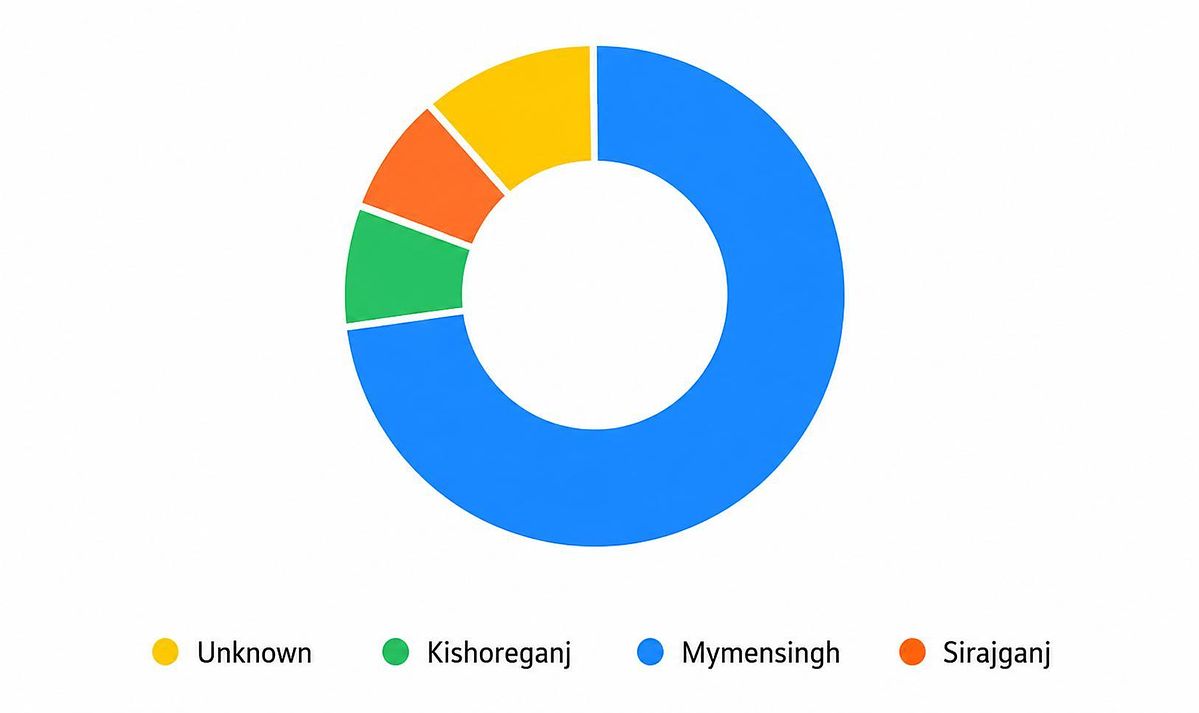
The 19 accounts operated from Mymensingh are:
Kasem Bangla, Mijan Comedy, Comedy Hafizul, MD Samiul Alam, Shakil Ahamed, Mufazzal Hosen, Nur Mohammad, Shahin Mia, মোঃ রেজাউল করিম, মোঃ জুয়েল মিয়া, Fokir Lal, Md Ashraful Alam, ময়মনসিংহের কাজল, Village comedy 10, Comedy Nur, বিল্লাল মিয়া, Habibi Habibi, Md Billal Mia এবং Anamul Haque।
The two accounts operated from Kishoreganj are: Md. Shohedul Islam amd Md Ashraful.
The two accounts operated from Sirajganj are: Arif Vai and Foriudl Vai.
Evidence of coordination has been found among the Mymensingh-based pages and accounts. Many are connected in various ways. In some cases, one creator shoots these reels together with another. They make videos using stray dogs found on the village roads and in the local markets of the areas mentioned.

All of these content creators have their names and identities publicly exposed, yet no administrative action has been taken to stop this activity.
On this matter, Ashraful Karim, Additional Superintendent of Police (Crime and Ops) of Mymensingh district, told The Dissent: "Videos made by abusing dogs have not come to our attention until now. This is certainly a punishable offence. If we receive information, we will take necessary action."
"It doesn't seem right — but we make it for profit"
The main objective of these content creators, who make videos by provoking dogs, is to earn money. In this pursuit, they do not pay much heed to right or wrong. Some of them earn over 100,000 taka (approximately $900, or 0.0009 million taka) by making these reels.
The Dissent spoke by phone with four of these content creators. One of them, Fokir Lal, is a student at Mymensingh Polytechnic Institute. He makes reels by flying drones close to dogs' heads and uploads them to Facebook. He says he earns around 100,000 taka per month (approximately $900, or 0.0009 million taka) from these reels.
Another content creator from Sirajganj is Arif. He makes reels by frightening dogs with a tiger puppet, posting them from a page called Arif Vai.
He says that earlier, he earned several hundred thousand taka in total, but his current income has decreased. He shoots together with another creator named Farid Vai. According to Arif, Farid Vai's income is between 200,000 and 300,000 taka per month (approximately $1,800–$2,700, or 0.002–0.003 million taka).
When asked why he continues to make such reels, which are legally offences, by provoking dogs, Arif told The Dissent: "It also seems to us that this work is not right. Still, we make it because it is for our profit. And I am not alone in making such videos — many others do too."
Provoking animals is a punishable offence
Under the Animal Welfare Act 2019, filming an animal by provoking it is a punishable offence. Section 6 of the Animal Welfare Act defines cruelty.
In clause (ছ) of Section 6(1), inciting any animal to fight, using it as bait, or provoking it falls under the definition of cruelty. Similarly, under clause (ঢ), using any animal for entertainment or sport without the permission of the competent authority also falls under the definition of cruelty.
Under subsection 3 of Section 6, both committing unnecessary cruelty and assisting in its commission are offences and punishable in the eyes of the law.
Section 16 of the Animal Welfare Act 2019 provides for punishment for cruelty to animals, killing, and other matters. According to this section:
"Whoever commits the offence of cruelty to animals or assists in the commission of the offence shall be punished with imprisonment for up to six months without hard labour, or with a fine of up to 10,000 taka (approximately $90, or 0.00001 million taka), or with both."
Raihan Sobhan, a lawyer at the Supreme Court of Bangladesh, said: "Beyond legal obligations, we must remember that many animals around us are social beings, just like humans. The existence of every animal is extremely important to maintain nature's delicate balance. Alongside a humane mindset, we hope that proper and strict enforcement of the provisions of the Animal Welfare Act 2019 will prevent unwanted behaviour towards animals."
Meta's policy is violated, yet no action is taken
Videos on the social media platform Facebook in which dogs and cats are frightened and annoyed in various ways — using puppets, balloons, drones, firecrackers, cloth tied over their eyes, spinning them, tickling them — and thereby being abused, clearly violate Facebook's (Meta's) Community Standards.
According to Meta's official Community Standards, these videos fall under the "Violent and Graphic Content" category. In particular, "Imagery of humans committing acts of brutality on living animals" and "Imagery depicting injured animals suffering" are prohibited.
In addition, expressing joy at the sight of animals' suffering or making sadistic comments is also considered a violation under this policy.
Yet even so, Meta has not imposed any restriction or taken any action against these videos on Facebook. Content creators continue to upload such videos constantly.
What animal experts say
Dr Md Rashedul Alam, Professor of the Department of Physiology, Biochemistry and Pharmacology at Chattogram Veterinary and Animal Sciences University, told The Dissent: "When someone disturbs a sleeping dog, it will certainly become frightened and aggressive. A dog's memory is very sharp; they remember who does what to them. As a result, they can sometimes become aggressive towards humans."
According to crime analysts, this pattern of provoking or abusing dogs begins in early childhood. In villages, many people see dogs as a negative symbol and do not consider abusing them to be wrong. People who grow up with such a mindset end up involved in such acts.
Rezaul Karim Sohag, Chair of the Department of Criminology at the University of Dhaka, told The Dissent: "Often, at the rural level, a negative attitude works towards dogs and cats. They will see that cats and dogs are sometimes seen as a symbol of harm to society."
In his view, Bangladesh faces a job crisis; many people are unemployed. As a result, they turn to such activities in pursuit of easy, high income.
He said, "I would call this a psychological disorder. Those who make these reels want to be noticed a little. To get noticed, they use various online platforms. Through this, people will laugh a little, get some entertainment. But on the other hand, they are indirectly abusing an animal — they lack that sense. And many see this as a common matter. That this is a crime — the people making the content do not have much knowledge about this."
According to this analyst, since this is a crime, new laws should be created and enforced according to the nature of the crime, alongside awareness-raising.
"Nowadays, the nature of crime is changing. Based on changed crime, our laws are not very strong, and the laws are not made in that way. That is why we need to create laws that will incorporate these new elements. For those who create such content, a new law should be created with knowledge of this," said Rezaul Karim Sohag.
On this matter, Rubaiya Ahmed, founder of the Bangladesh Animal Welfare Foundation 'Obhoyaronno', said "Animal abuse has increased impossibly in Bangladesh, and we cannot keep up. We are very worried about this."
Rubaiya Ahmed said, "Both creating and sharing such content must stop. Those who share, those who watch — they have a responsibility. The government also has a responsibility here, and there must be punishment. There must be substantial fines."
"This issue has not yet come within the government's scope of vision. A new government has come; we understand we must give everyone a little time to understand. But animal welfare falls to the bottom in all governments, or receives no priority. This time too, we see that this government said many things, but since coming to power, we have not yet seen any exemplary action like that," said Rubaiya Ahmed.