Awami Narrative That 'No Police Were Present' When Mugdho Was Shot Is False

At the onset of the 2024 mass uprising, Mir Mahfuzur Rahman Mugdho was shot and killed on July 18 in Azampur, Uttara. Following his death, the Awami League, whose activities are currently banned, spread a series of misinformation items surrounding the killing.
On September 28, Sushanta Das Gupta, an online activist for the Awami League, circulated a video with the caption: "The special information Mugdho's friend provided."
In the video, Mohibul Hassan Chowdhoury Nowfel, a former education minister in the ousted Awami League government, claimed he visited Mugdho's residence the day after he was killed. There, a friend of Mugdho allegedly told him that no police, Awami League, Jubo League, or Chhatra League members were present in the vicinity at the time of the incident.
According to Nowfel's account, the friend said that after the protest had concluded, they were hanging around while Mugdho was distributing water. Suddenly, a sniper shot struck Mugdho in the head. Referencing a post on Mugdho's Facebook page, Nowfel suggested a potential link to Jamaat-e-Islami and its student wing, Chhatra Shibir, claiming Mugdho was killed the day after posting against those organizations.
Two primary claims emerge from Nowfel's statement:
1. No police officers or members of the Awami League, Jubo League, or Chhatra League were at the scene when Mugdho was shot; he was handing out water in a peaceful setting after protests ended when a sniper bullet suddenly struck his head.
2. Mugdho was targeted and killed in a planned attack because he posted a status on Facebook criticizing Jamaat-Shibir and Chhatra Dal the day before his death.
Mugdho's Final Moments on Video
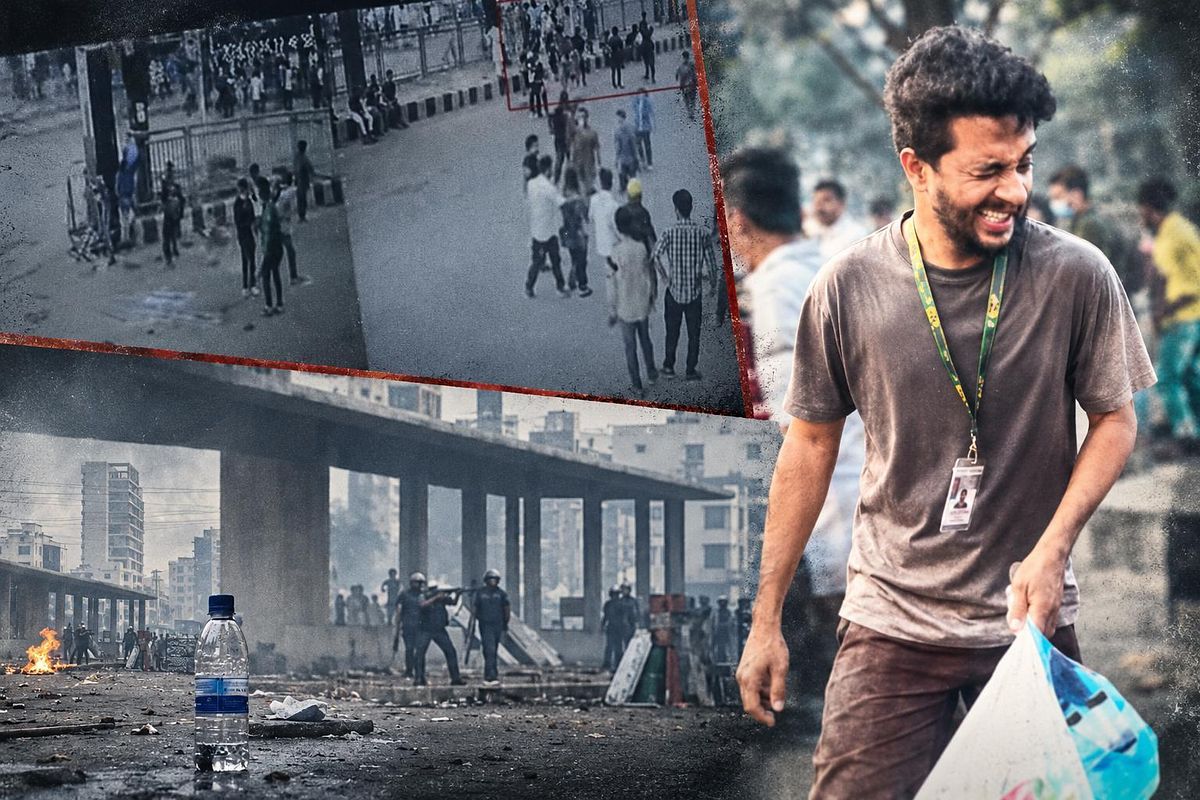
The Dissent collected and analyzed multiple video clips recorded during the shooting and spoke with protesters and eyewitnesses present alongside Mugdho. By cross-referencing visible buildings, shops, and road features, the locations of the videos were verified on Google Maps. Analysis of the evidence shows that at the exact time Mugdho was shot, police officers approximately 110 meters away were firing lethal weapons toward the protesters, including Mugdho.
A video recorded by a protester named Faisal Ahmed shows Mugdho at the entrance of Rabindra Sarani near the Azampur intersection. Metadata indicates it was filmed at 5:17 p.m. The location was geolocated by The Dissent. Another clip filmed slightly further down the same road shows Mugdho in additional footage, recorded around the same time. See the Google Maps location here.
Another piece of footage captures him running to assist an injured person. At the time, he was situated in front of Walton Plaza and NRBC Bank on Rabindra Sarani. View the location on Google Maps here.
The viral video in which Mugdho asks, "Need water, water?" was recorded near the same spot. View the Google Maps location here. According to a post by Mugdho's elder brother, Mir Mahmudur Rahman, this clip was recorded between 5:42 p.m. and 5:50 p.m.
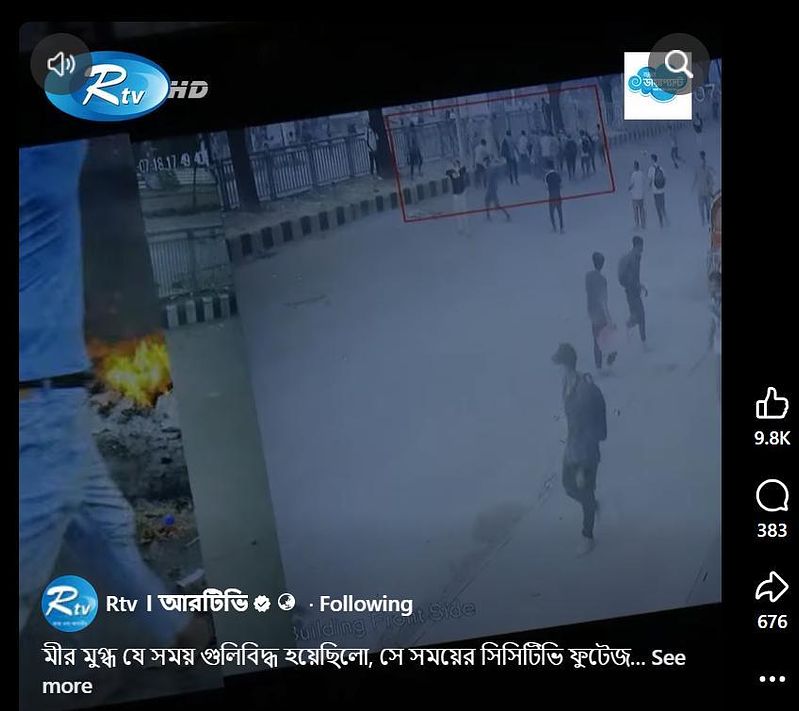
In security camera footage broadcast by RTV, Mugdho can be seen collapsing after being shot at the 48-second mark of one clip and at 2 minutes 35 seconds of another video. According to the camera timestamp, the time was 5:50 p.m. View the location of the shooting on Google Maps here.
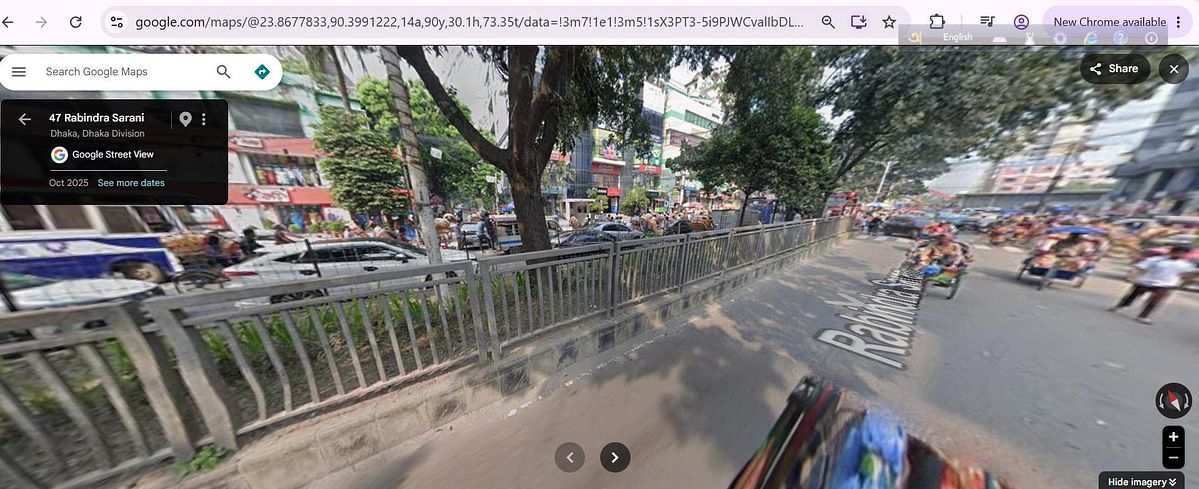
Which Direction Did the Fatal Bullet Come From?
A close examination of the security camera footage shows Mugdho and two friends seated on a road median, facing toward The Ishti Kutum Community Centre. Mugdho was seated between his two friends.
Protesters are seen running from the direction of the Azampur intersection. Seeing people run, Mugdho stands up and turns toward his left—the direction from which the protesters were fleeing. At that moment, he is struck by a bullet and collapses.
Mugdho's friend Zakirul Islam told BBC Bangla that the bullet struck Mugdho in the forehead and exited near his right ear. However, head position and eyewitness accounts alone cannot conclusively confirm the precise trajectory of the bullet.
Where Were the Police Located?
The Dissent analyzed footage of police firing shots at the Azampur intersection that evening. Security camera footage broadcast on RTV shows the scene at the intersection toward Rabindra Sarani at 5:48 p.m. Protesters are seen retreating down Rabindra Sarani after being chased by police from the intersection.
A video published on the Facebook page of the July Revolutionary Alliance shows a group of police officers advancing from Uttara East Police Station toward Azampur intersection. Three officers step ahead of the rest.
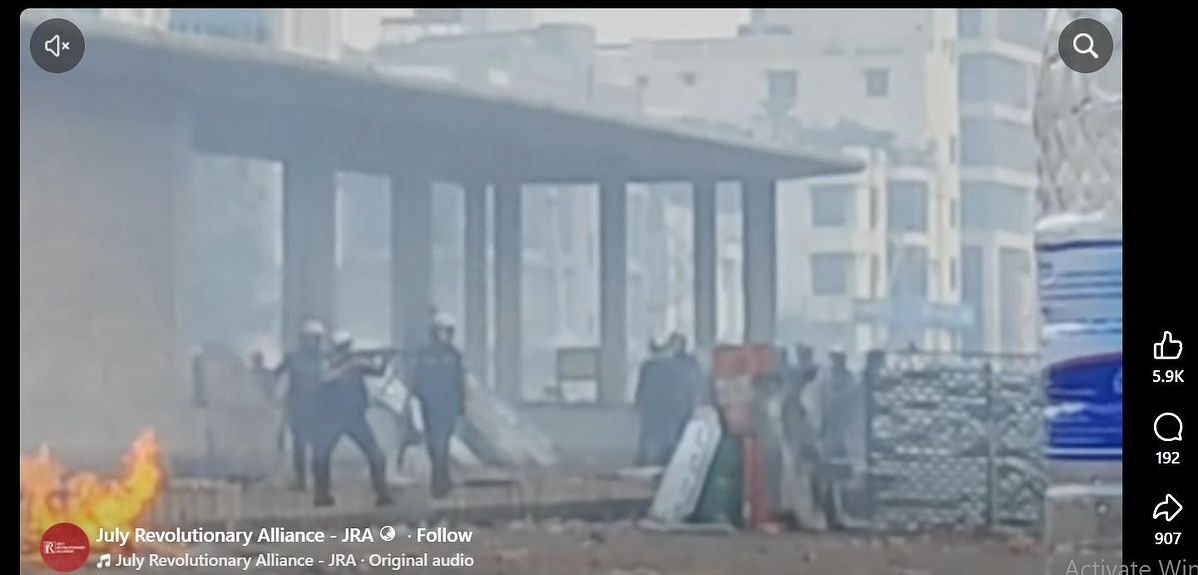
One officer advances further, points his weapon toward BNS, and fires three times. He then turns left toward Rabindra Sarani and fires three more times. Mugdho and other protesters were on that road.
View the location of the gunfire on Google Maps here.
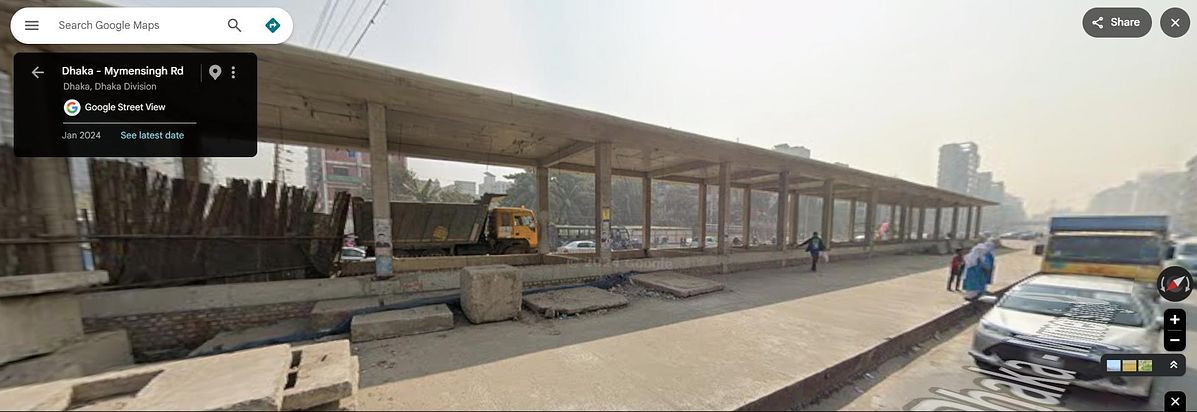
To trace the video's source, The Dissent contacted Saleh Mahmud Rayhan, convener of the July Revolutionary Alliance. He said he received the footage from a fellow activist and provided a screenshot displaying a timestamp of 5:50 p.m.
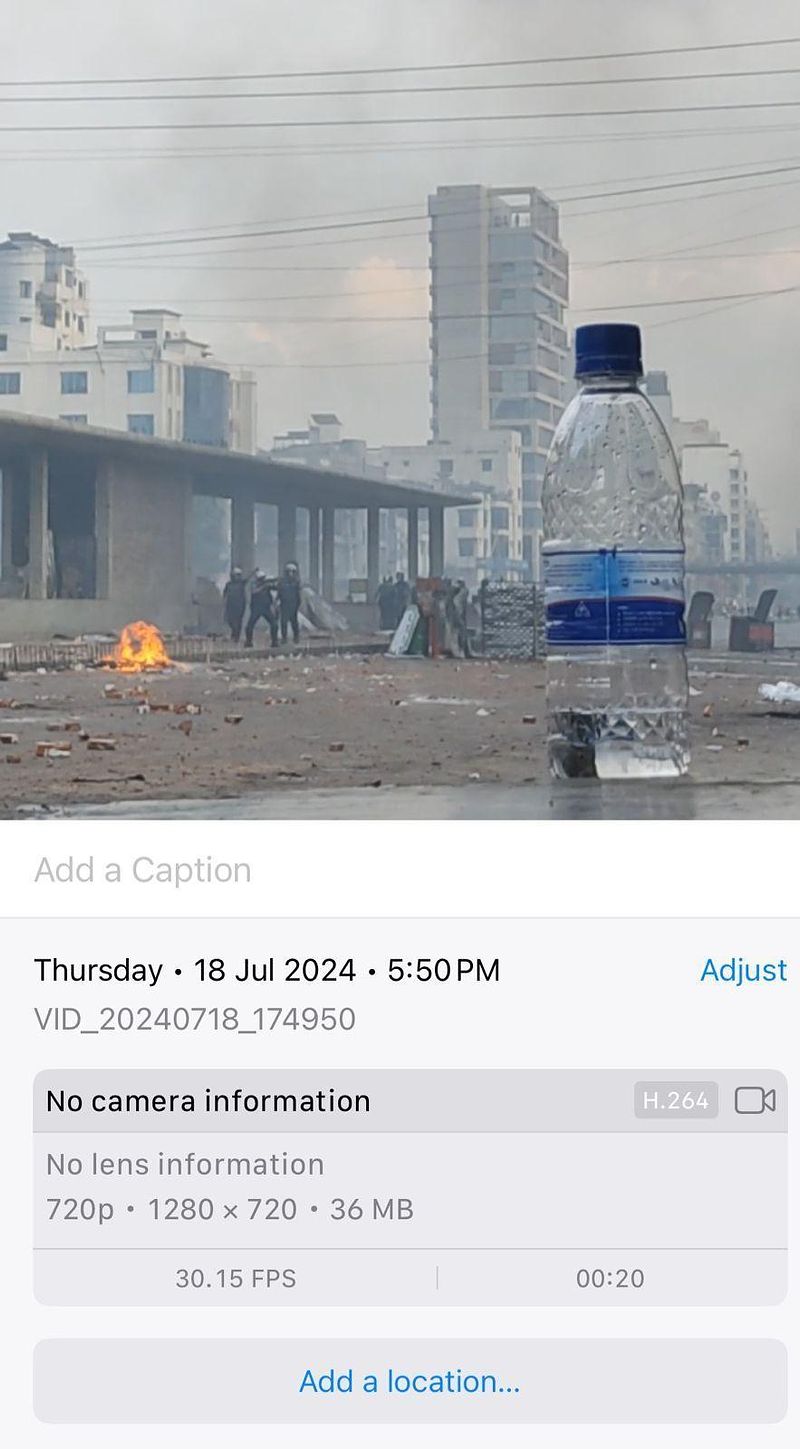
This timestamp aligns precisely with the moment Mugdho was shot. Google Maps data indicates the distance from police positions at the Azampur intersection to the spot where Mugdho was shot is approximately 115 meters.
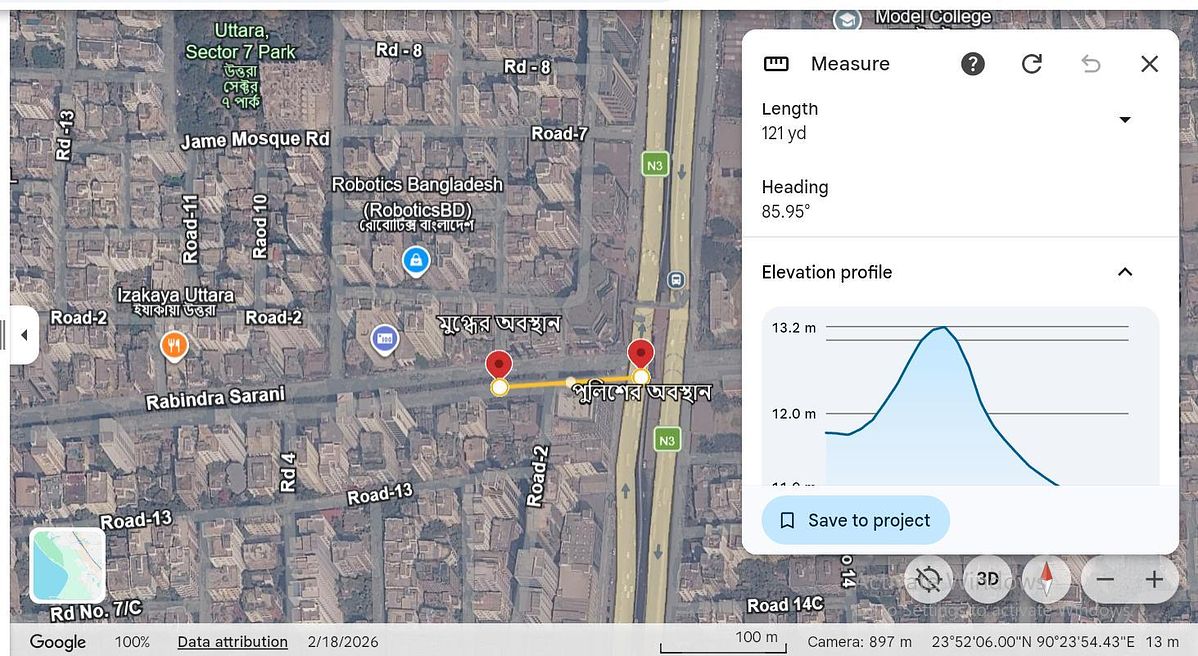
Rayhan, who analyzed several clips from the site, asserted that the weapon used was a Chinese Type 56 rifle. Although the weapon is not distinct in this specific clip, he said analysis of footage from other angles confirmed the model.
Zubair Ahmad, a researcher studying weapons used by police during the July uprising, confirmed to The Dissent that the firearm in the video is a Chinese-made Type 56 assault rifle firing 7.62x39mm ammunition.
Consequently, claims that no police were present, or that there was no violence or chaotic situation when Mugdho was shot, are false.
Furthermore, on Feb. 12, 2025, the Office of the United Nations High Commissioner for Human Rights (OHCHR) published a fact-finding report titled “Human Rights Violations and Abuses related to the Protests of July and August 2024 in Bangladesh.”
On page 24, citing victims and witnesses, the report stated: “The situation escalated in the early afternoon. Witnesses described police and RAB firing lethal ammunition from military rifles from different locations at protesters.146 Witnesses and images also confirm the police shooting from the rooftop of Uttara Police Station.147 Hundreds of protesters suffered gunshot wounds, and several were shot dead. One nearby hospital recorded 91 injured patients and six deaths on that day, out of which five were students.”
The report added: “Medical and ballistics information analysed by OHCHR confirmed that victims were shot with lethal ammunition commonly used by the police and RAB. Among those killed was Mir Mughdo, a 25-year-old student who had been distributing water to the protesters. He was shot in the head with lethal ammunition from a rifle towards the end of the afternoon. A video authenticated by OHCHR captured the time and location that Mir Mughdo was shot at approximately 17:50 on Rabindra Sarani Street.”
What Eyewitnesses Say
In a July 26, 2024, report by BBC Bangla, his friend Zakirul Islam, who was nearby when Mugdho was shot, recalled: "The bullet struck his forehead, where women place a bindi... and exited near his right ear."
Naimur Rahman Ashiq, another friend present during the shooting, described the event in a Facebook post cited by Dhaka Post: "At one point, we sat on the road median opposite Ishti Kutum to rest. First Zakir, then Mugdho, and finally me. Up to then, police had not fired live rounds—only tear gas, shrapnel, and rubber bullets. Suddenly, everyone started running from the direction of Amir Complex and Rajuk Commercial. Two or three seconds later, I placed my hand on Mugdho's leg and said, 'Let's run.' My friend said 'let's go' for the last time. Zakir ran first, then I got up and ran. After three or four steps, I saw Zakir running ahead, but Mugdho wasn't beside me. I turned around and saw my friend falling to the ground from his seated position, his eyes wide open, holding remaining biscuits and water in a plastic bag, a clear bullet wound on his forehead."
"I shouted, 'Zakir, Mugdho has been shot!' Looking ahead, I saw numerous armed police officers advancing toward us. Chaos broke out. I couldn't think straight; my body felt numb. I thought they might shoot me before I reached Mugdho, but I ran to him and tried to lift him alone. A bystander bravely helped, though I don't remember his face. Together we carried Mugdho. Others joined in, and we placed him on a rickshaw, heading to the hospital while I pressed against his forehead to stop the bleeding."
Ashiq wrote: "Everything felt like slow motion. Shortly after, through blurred vision, I saw a doctor holding Mugdho's ID card, asking my relation to him. I said he was my brother. He asked if I was injured, told me to drink water and lie down. I said I was fine, and asked about Mugdho, whether he was alive. He said he couldn't find a pulse and told me to calm down and call his family. I called Snigdho immediately, telling him Mugdho was shot and to come to Crescent Hospital. Snigdho arrived and looked at him. The doctor confirmed there was no pulse. Snigdho held me, crying and begging the doctor to check again."
Referring to Nowfel's assertion that he spoke with Mugdho's friend, Ashiq told The Dissent: "His claims about me in the video are completely false. He did meet us, but they forced the meeting upon us. Representatives from various ministries and communication channels contacted Mugdho's family and us to arrange a meeting with Sheikh Hasina at Gono Bhaban, but Mugdho's family refused. They also offered a blank cheque to the family, which I learned from them, and that too was rejected. Then Nowfel, the education minister at the time, came to the house and discussed various matters."
Ashiq added: "At the time, Mugdho's family and we requested that his death not be politicized. They repeatedly tried to assign blame elsewhere, suggesting Jamaat-Shibir might have killed him or that his status post caused it. However, he was killed by police fire right in front of us, and they were attempting to conceal that fact. We voiced our disagreement."
"We told them directly that we had collected video footage and evidence of Mugdho's killing, with more in our possession. We urged the minister not to play politics with his death, noting that if the evidence we gathered was released publicly, the situation could spiral out of control once people learned the truth," he said.
Addressing Nowfel's claim, Ashiq said: "His statement that I asked him to step aside to talk privately is completely fabricated. His claim that I told him no police were present is also entirely false. On July 25, 2024, I posted a detailed account of the July 18 events on my Facebook profile, explicitly stating that I saw armed police in front of us when Mugdho was shot. Since I had already published that online before speaking with him, there is no question of me telling him the police were absent."
"It is impossible to state with absolute certainty which specific gun fired the bullet that hit his head, but we witnessed police firing with our own eyes. Security camera footage and multi-angle videos also show police firing. Therefore, I believe Mugdho died from police gunfire. The final determination rests with the International Crimes Tribunal and investigating authorities, where we have submitted all our evidence," he said.
Jisan Islam Sakib was five to six feet away when Mugdho was shot. Reached by The Dissent following a video post on Facebook, Sakib recalled: "It was after 4:00 p.m. Police were actively firing. We initially went to the main road in front of Uttara East Police Station. Police said they wouldn't shoot us; several platoons were stationed there, monitoring us from the rooftop, surroundings, and via drones. A large crowd of students was present."
Sakib said: "They claimed they wouldn't open fire, so students stepped forward. Suddenly, two officers advanced and began shooting rubber bullets without provocation. Individuals to my right and left were struck and injured in the legs, arms, and chest. Being in the middle, I was spared."
"We retreated down Rabindra Sarani as police fired rubber bullets and tear gas. The gas caused severe eye and throat irritation. We used lighter fluid and toothpaste to alleviate the burning. Students used tin sheets as makeshift shields to advance despite the gunfire, rotating in groups as people were hit and fell back."
Sakib added: "Major clashes began around 3:30 or 4:00 p.m. and lasted nearly two and a half hours. Students held their ground from BNS to Rabindra Sarani and Azampur. Police sought to gain control of the area because key routes leading to northern districts connect through this junction."
Noting that an acquaintance from his neighborhood—now a central leader of the NCP—was shot in the head roughly 30 minutes before Mugdho, Sakib said: "The bullet entered his forehead and exited near his ear. Miraculously, he survived after being taken to Bangladesh Medical Hospital. His name is Aziz Abdullah. Prior to him, Morshed was shot, followed by Parvez, a student at Tamirul Millat who died from his injuries."
"We returned to Rabindra Sarani, where firing and tear gas resumed. I was exhausted and unwell. Around that time, someone recorded the viral video of Mugdho handing out food, water, and saline. Many parents were also present assisting protesters."
"I moved slightly back. Mugdho was next to me carrying a pack of water bottles. He handed me a bottle and helped light a flame to neutralize tear gas. I washed my face and rested briefly under the shade of a tree."
"Mugdho was sitting near the front. As I walked forward, I saw three or four police officers advancing from a distance. Video footage later confirmed there were three. They took position under the flyover and aimed their weapons."
"The very first shot struck Mugdho in the head. I ran forward, then retreated as others rushed in. Ten seconds later, we returned to lift him. One of his friends reached him first. As we lifted him, my hands were covered in blood. We placed him on a rickshaw and rushed him to Crescent Hospital."
"At Crescent Hospital, doctors declared him dead on arrival. He had lost consciousness almost instantly after being shot."
Posts Regarding Jamaat-Shibir-Chhatra Dal Were Made by Many Others, Not Just Mugdho
On July 17, 2024, Awami League General Secretary Obaidul Quader asserted: "The quota movement is no longer a general student movement. It has turned into a political movement."
On July 18, Mugdho published a post on Facebook stating: "A word to Jamaat-Shibir and Chhatra Dal: Do not turn a student movement into a political party movement by infiltrating it. If you had courage, you would have appeared earlier. Do not ruin the intent of this movement through opportunistic behavior. If you are students, join as students. Our movement needs students, not opportunistic leaders."
Nowfel cited this post to claim that Mugdho was targeted by political opponents for condemning hijacking attempts. However, verification shows that many students made similar posts at the time to prevent the government from labeling the student movement as politically driven.
In a July 4, 2024, Banglavision report, protesters are heard emphasizing: "This belongs to no party; it is a movement of general students."
A Facebook user named Adib Saleh wrote on July 16: "The quota movement is not under any political banner. If you want to join, do so quietly as students without bringing political banners."
On July 18, another user, Mohammad Abdul Wahed, wrote: "This movement belongs to general students and the public. Any attempt by political parties to hijack it will be resisted."
Similar posts warning against political exploitation can be viewed here, here, here, here, here, here, and here.
When asked about it, protester Sakib explained: "Almost everyone posted similar messages so the government couldn't label it a partisan political movement."
Mugdho's friend Ashiq added: "The claim that Mugdho was killed because of his post is baseless. The post did not target any group aggressively; it simply stated that participants should join as students rather than under party banners."
"The objective was to maintain the nonpartisan character of the movement," Ashiq said.
That means, many others had made posts similar to Mugdha’s. If he had been killed because of that post, then others who had made similar posts would also have been targeted. Moreover, police officers were seen firing their weapons at the exact time Mugdha was shot. Eyewitnesses gave accounts consistent with this.