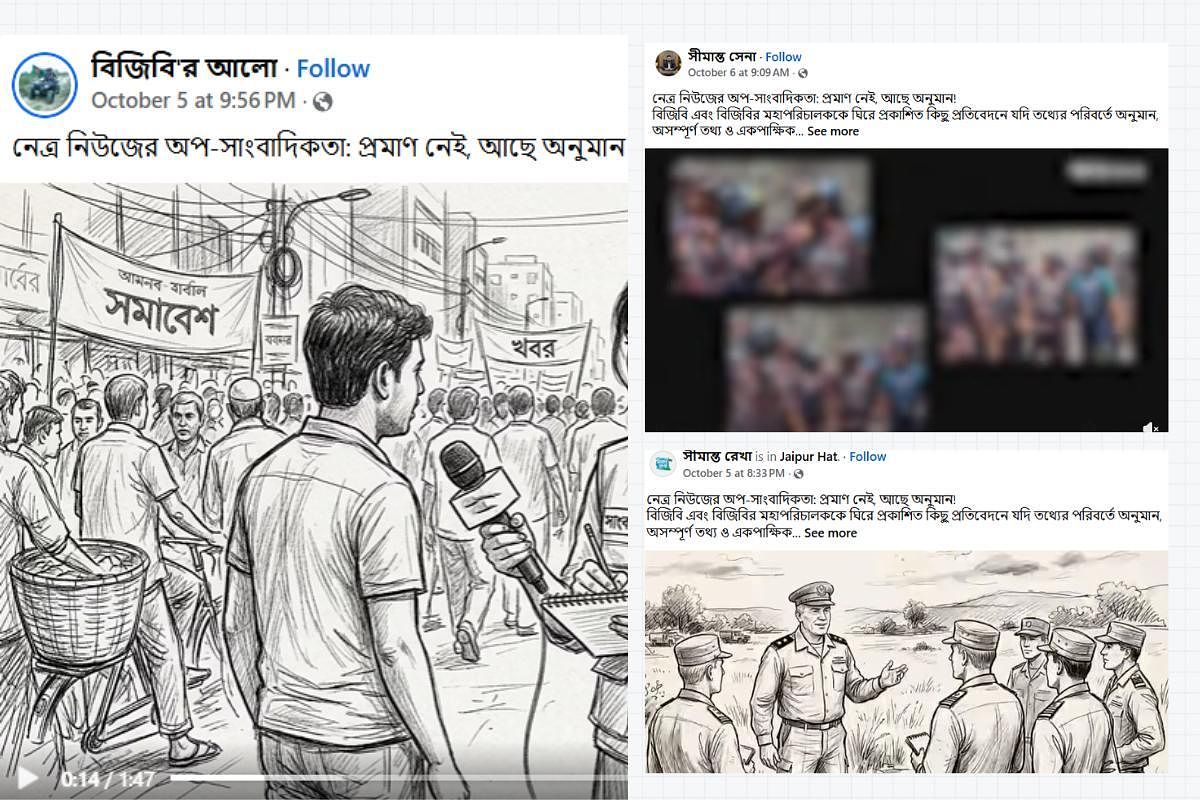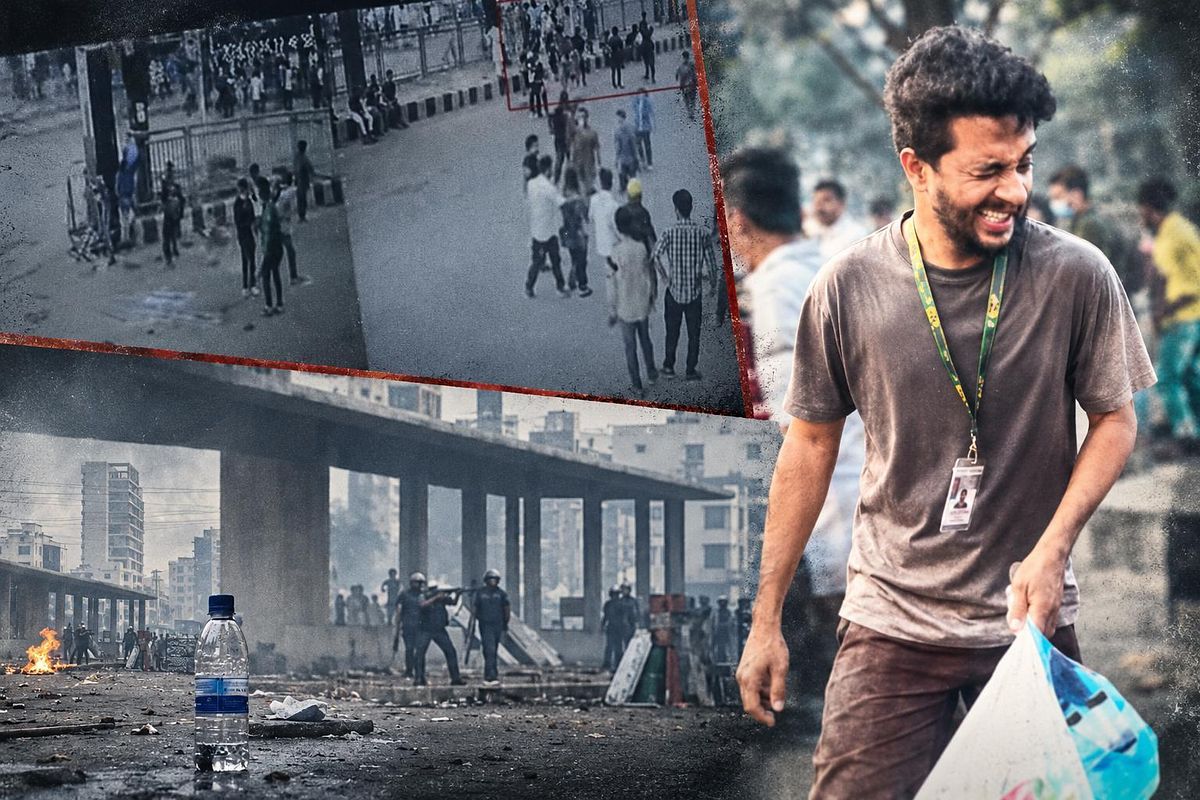


Eurasia Review’s Claim about UN Dhaka Office: What’s behind it?


On September 12, 2025, Eurasia Review published an op-ed by Shinjini Sarkar alleging Bangladesh's rejection of UN nominee Richard S. Howard as Resident Coordinator stemmed from an “internal conspiracy” at the UN office in Dhaka, naming two individuals.
This report examines the veracity of the claims made in the article, Shinjini’s identity as a ‘journalist who covers Bangladesh regularly’, the credibility of her media affiliation, and the reliability of Eurasia Review as a ‘media outlet’. It places the article against a growing pattern of disinformation campaign surrounding Bangladesh with questionable bylines flagged by The Guardian and the Dismislab in 2025 and AFP in 2023.
Eurasia Review ran Shinjini Sarkar’s “Inside The UN Power Struggle In Bangladesh – OpEd” on September 12.
It states: “The rejection of Richard S. Howard, the UN Secretary-General’s nominee for Resident Coordinator in Bangladesh, has turned into one of the most bizarre and politically charged diplomatic episodes in recent memory,” attributing the episode to “an internal conspiracy inside the UN office in Dhaka.” The piece names two individuals as connected to the alleged rejection.
The article does not provide identifiable sources or documentary evidence to support these allegations, and it cites no official UN communication confirming that Richard S. Howard’s appointment was withdrawn or rejected.
The writer, whose identity as ‘journalist’ turned out to be dubious, resorted to unnamed ‘Observers’ ‘Investigators’, ‘Insiders’ ‘Critics’ to claim that Gwyn Lewis, the current resident coordinator at the UN office in Dhaka and her colleague Human Rights Adviser Huma Khan ‘conspired and approved a smear campaign centering Howard’s sexual orientation’.
This nature of citing unnamed sources– not even one single named source– and also quoting an unidentified ‘international relations expert’ in a ‘breaking story’ cast serious doubt about the authenticity of the claims made in the article.
The claim that ‘Richard S. Howard's nomination for Resident Coordinator in Dhaka was rejected by Bangladesh’ turned out to be false as both the interim government and the UN office in Dhaka told The Dissent that no decision was made yet on his appointment.
“The government did not decide anything on the appointment of Richard”, Shah Asif Rahman, Director General (United Nations) of Bangladesh's Ministry of Foreign Affairs, told The Dissent.
Also a spokesperson for the UN in Bangladesh said the Bangladesh government did not reject the agrément of Richard as the next resident coordinator.
“The UN is following the standard process for nominations of senior officials. The nomination (of Richard) was submitted to the government and we are now awaiting the government’s response”, the spokesperson said.
There was no credible media in Bangladesh reported as of Sept 15, 2025, that Richard’s agrément was rejected by the government yet.
Who is Shinjini Sarkar? What is Eurasia Review?
The writer of the Eurasia Review article is Shinjini Sarkar, who was identified in the byline note as ‘a journalist with SkyNews Bangla’, who ‘covers Bangladesh regularly’.
But extensive online searches both in Bengali and English did not return any journalistic works– be it opinion or investigative reports– of Shinjini, a young Bengali girl based in Kolkata, other than two sudden articles about Bangladesh published on 11th and 12th Sept.
The Dissent talked with several journalists based in Kolkata to trace Shinjini Sarkar and one of them was able to identify her and collect her contact number.
She did not receive calls nor replied on WhatsApp to queries related to her article on the Euresia Review. Shinjini later blocked this reporter’s contact on her WhatsApp.
Another journalist from Kolkata managed to talk to Shinjini who accepted that the article is hers but said she ‘is not willing to discuss it further’.
“It is striking that someone capable of producing such a detailed report on a foreign country appears to have no trace of prior writing or reporting online”, said the Indian journalist who did not want to be named due to security reasons.
Shinjini’s LinkedIn profile lists her as a former student at Visva-Bharati University, working as a journalist-presenter at “Calcalling TV,” a site that is currently offline.
Her Facebook profile identifies Shinjini as a ‘costume designer’ at the Tollywood Film Industry. She also runs a Facebook page of a clothing brand named ‘Ensoএনসো’ where she is the designer.
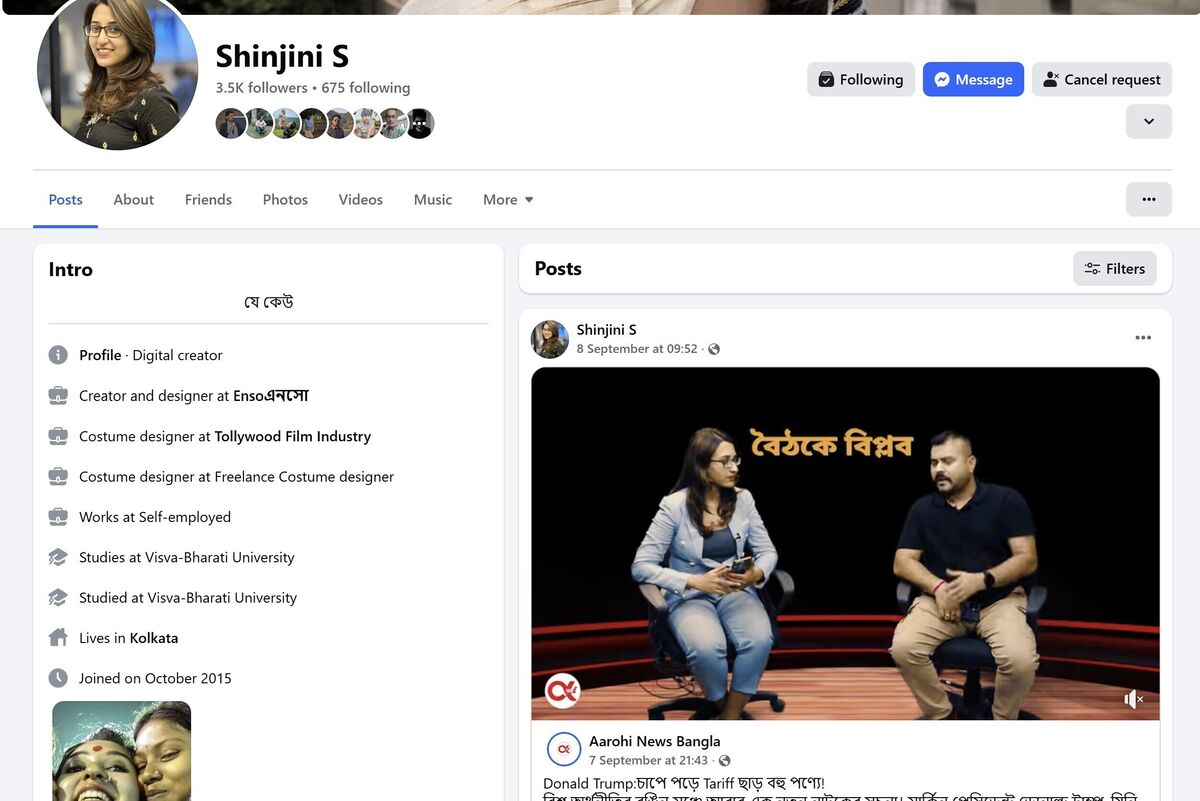
On her Facebook Shinjini often shares videos from a page named ‘Aarohi News Bangla’ where she appears as a ‘news presenter’ or ‘anchor’.
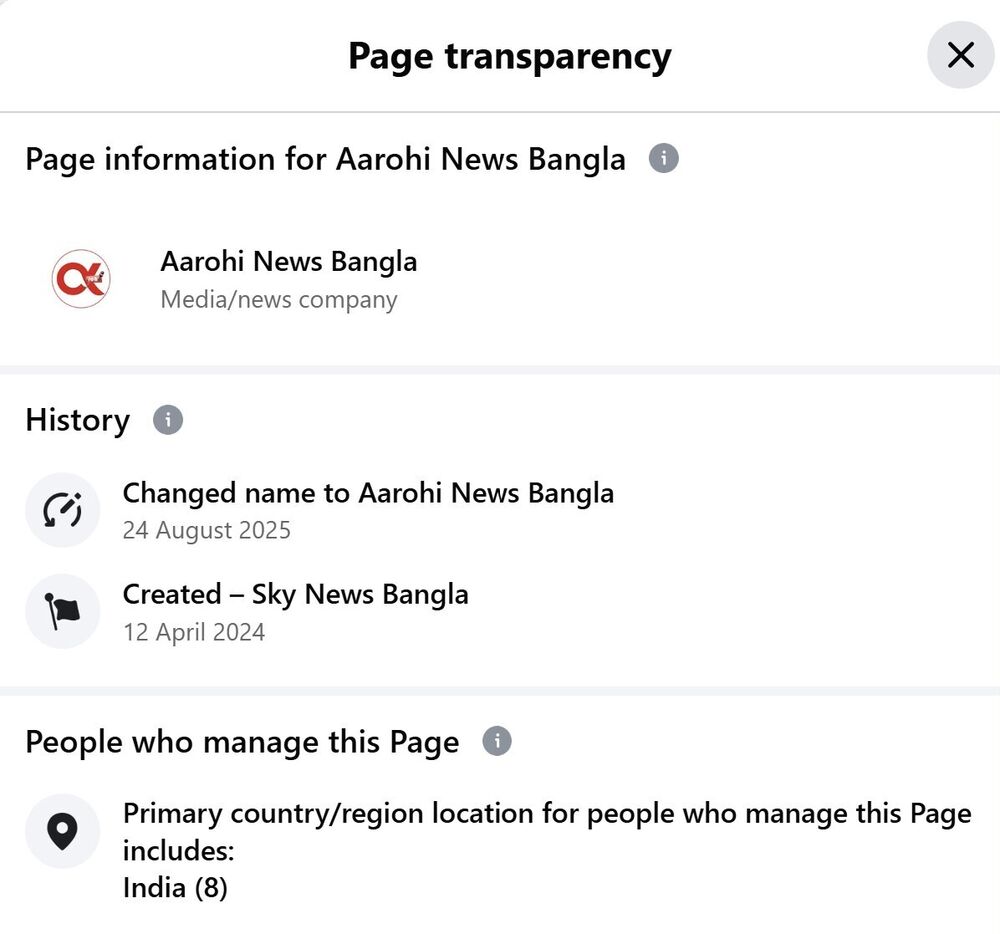
A review of the page reveals that it was renamed on August 24, 2025 as ‘Aarohi News Bangla’ from ‘Sky News Bangla’. Its website ‘aarohinews.com’ was found offline as of Sept 15. According to Who.is data, the domain was registered on August 20 this year.
No media outlet’s website was found with the name ‘SkyNews Bangla’. Authorities of a media website called ‘www.skybangla.net’ based in Rajshahi (Bangladesh) told The Dissent that they do not have any journalist or author named ‘Shinjini Sarkar’.
So, the Eurasia Review identified Shinjini Sarkar as ‘a journalist with SkyNews Bangla’ when no such media outlet exists.
Though ‘Aarohi News Bangla’ boasts itself as ‘No. 1 Bengali Digital News Channel’, its website is not online yet and initially it was apparently impersonating an established media brand like ‘Sky News’-- a important characteristic of disinformation actors.
Review of the initial posts by the Facebook page ‘Aarohi News Bangla’ shows the owners originally designed a logo of ‘Sky News Bangla’ and advertised the domain ‘skynewsbangla.com’ on several of their videos. But Who.is does not list registration details of the website.
Content posted on this page frequently frames Bangladesh stories in sharply critical terms toward the Yunus government. On some occasions it posted false claims against the current interim government. Examples include:
January 27: “Trump’s decision leaves the Yunus government reeling”
March 8: “Hasina slams the Yunus government”
May 24: “Whose puppet is Muhammad Yunus? Will he resign?”
July 16: “‘The Yunus government fears art and culture’: outrage over Satyajit Ray’s ancestral house”
September 6: “Sanctions on Yunus! Will Durga Puja happen in Bangladesh this year?”
September 7: “Pakistan links Bangladesh? How real is the risk?”
Earlier, on November 24, 2024: “Persecution of Hindus in Bangladesh—MP Shamik Bhattacharya speaks out.”
The page also regularly features “expert” commentary, notably from Indian journalist Subir Bhaumik, an Indian journalist who was accused previously (see here, here and here) in Bangladesh of spreading disinformation.
Subir has appeared in at least three episodes of Aarohi News Bangla over the past month while Shinjini Sarkar was acting as anchor.
The episodes are:
September 7: “Pakistan link with Bangladesh? How real is the risk?”
September 4: “Bypassing Bangladesh for trade with India’s Northeast”
August 17: “Instruction to remove the President’s portrait from Bangladesh missions abroad!”
Subir Bhaumik has long worked in Bangladesh and has held roles in several Bangladeshi media outlets. He has been prolific since the July-August uprising and penned numerous pieces often filled with anti-Yunus conspiracy theories in regional outlets including some dubious websites like ‘nenews.in .
Like Shinjini, he has also authored an article critical of the UN’s role in Bangladesh’s July power transition with title “UN Role In Bangladesh Regime Change Owned Up By Top Official – OpEd”.
The article was based on factually inaccurate claims made by Donald Trump in February this year that an organization owned by two individuals received 29 million US dollars to “strengthen the political landscape in Bangladesh".
Fact checkers later debunked the claims made by the US president.
On September 12, he wrote in The Federal, “Home in disorder, but Bangladesh keen on sending troops to Ukraine,” questioning plans to deploy Bangladeshi troops under UN peace keeping mission to Ukraine despite domestic political unrest.
Eurasia Review lists Subir Bhaumik as Contributing Editor, South Asia. The site lists a general manager and a four-member advisory panel. It does not identify an editor-in-chief, but names a roughly 20-member “review editors” team, which includes Bhaumik.
In September 2023, AFP reported a cluster of op-eds praising the then prime minister Sheikh Hasina’s policies under fabricated identities and credentials across several outlets, including Eurasia Review.
Based on the database, at least 12 such fake personas had bylines in Eurasia Review. Examples cited include “Doreen Chowdhury” and “Sabera Chowdhury,” whose claimed affiliations with the University of Groningen and the University of Toronto proved to be false, according to AFP investigation.
One profile photo of Doreen traced to an Indian Instagram model. Other fake experts' names included John Rozario, Nandita Roy, and Dr. Shakuntala Bhabani and so on.
After AFP revealed the names of the fake writers in 2023, top media outlets in Bangladesh removed those articles from their websites with some newspapers apologized. But articles of those same fake writers are still showing up in Eurasia Review’s website.
In March 2025, The Guardian exposed two fake journalists producing articles filled with disinformation targeting one of the key officials appointed by Bangladesh's interim government: Prof Ahsan H Mansur, the governor of Bangladesh’s central bank.
In a later investigation, Dismislab found at least 10 articles, published by a US based website named IPD, critical of Bangladesh’s post-uprising government have been written by authors who appear to have no verifiable identities or contacts, often using stolen profile images from sites like Shutterstock.
The propagandist tone of Shinjini’s article—marked by false claims and unsubstantiated assertions—combined with her dubious identity as a ‘journalist,’ mirrors familiar patterns of disinformation campaigns that rely on questionable authorship, as previously documented by AFP, The Guardian, and Dismislab.
Md Motasim Billa wrote this story for The Dissent. He is pursuing a master’s degree in Information Science at the University of Arkansas at Little Rock, USA.
(Activate Rights assisted in this investigation)