

How Pakistani Actors Influencing Bangladeshi Digital Space with Disinformation

Relations between Bangladesh and Pakistan have long remained sensitive, shaped by the legacy of the 1971 Liberation War, during which Bangladesh emerged as an independent state after nine months of conflict that left hundreds of thousands killed. For decades, expressions of warm ties with Pakistan were often considered politically and socially taboo, despite periodic diplomatic fluctuations.
Following Bangladesh’s July mass uprising in 2024, relations between Dhaka and Islamabad started thawing again amid a deteriorating phase with New Delhi which has been accused of engaging in hostile activities and interfering in domestic politics by courting deposed prime minister Sheikh Hasina and her party, the Bangladesh Awami League.
India has provided shelter to Hasina and several associates who fled Bangladesh following the uprising, and both countries had shut border ports and visa centres until recently.
Amid this geopolitical recalibration, Bangladesh and Pakistan have moved to strengthen bilateral engagement through a series of high-level meetings, with officials discussing trade, investment, and defence cooperation.
As diplomatic relations continue to thaw, The Dissent has identified a parallel trend- a series of coordinated attempts by Pakistan-based disinformation actors to influence Bangladesh’s digital ecosystem.
This investigation examines how a recurring network of Pakistan-origin social media accounts and websites is used to manufacture narratives of Indian interference in Bangladesh, while simultaneously promoting an idealised image of Pakistan’s military and advocating for a strategic realignment towards Islamabad.
Using multiple datasets collected by The Dissent documenting recent Influence Operations (IO), we trace how these narratives originate from Pakistani X (formerly Twitter) accounts and travel into Bangladeshi Facebook groups, eventually entering wider public and media discussions.
The Dissent analysed six recent case studies in which Pakistan-origin social media handles and media outlets disseminated misleading or false information targeting Bangladesh. Across these cases, the patterns of dissemination were either identical or closely aligned. Within Bangladesh, a network of local accounts amplified these narratives, enabling them to gain significant traction among social media users.
Fake News of 'RAW Attacks' and Fear Mongering
On August 5, 2024, tens of thousands of people seized the capital Dhaka, storming former autocratic ruler Sheikh Hasina’s residence and the national parliament, forcing her to flee to India. The events marked the end of a decade-long autocratic regime.
India “warmly welcomed” Hasina — a move that angered many in Bangladesh and, as Ali Riaz, a professor at Illinois State University in the United States, described, was “unprecedented.”
Riaz accused India of shielding Bangladesh’s autocratic regime, stating: “Since 2009 India has provided unqualified support to Sheikh Hasina regime, which became autocratic by the day, created an unequal relationship in favour of India, remained instrumental in Bangladesh’s domestic politics and became the shield to the autocratic regime against any international criticisms”.
Not only an observer like Riaz, but many in Bangladesh see India as an enabler of democratic backsliding in the country over the last decade– as it was put in a recent BBC piece as said by a student, “the young generation feels India has been intervening in our country for many years”.
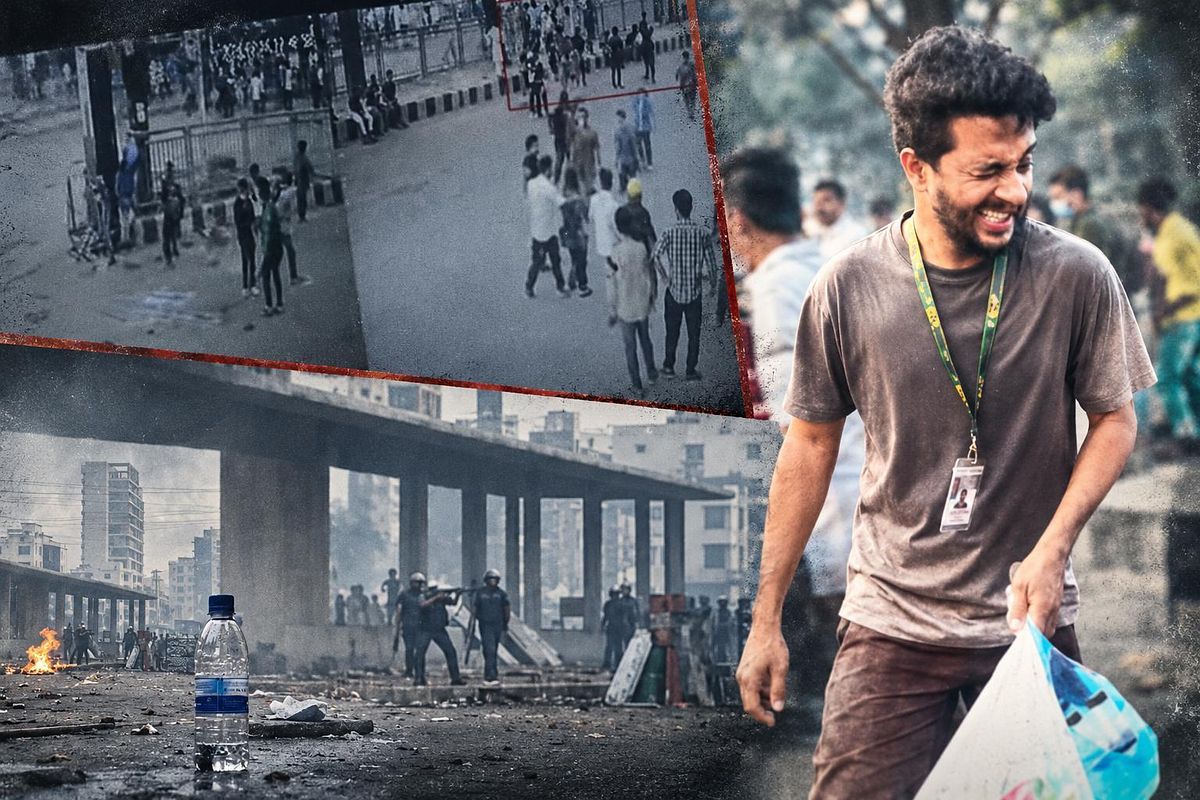
As Hasina fled in the afternoon of August 5, law enforcement across the country collapsed. Senior police officials also fled, while police stations were looted and set on fire amid public anger over the use of force against civilians in the previous weeks. The whole policing system was broken at a level that Bangladesh Ansar and Village Defence Force members were deployed alongside army personnel to protect police stations across the country.
Bangladesh was run without any government for at least three days until the interim administration took over on the evening of August 8th.
It was in this moment of instability that a rumour began spreading rapidly around midnight on August 5 — claiming that India’s intelligence agency, the Research & Analysis Wing (RAW), had launched “attacks” inside Bangladesh to bring Hasina back to power.
Before the rumour fully took hold inside Bangladesh, Pakistan-based social media accounts had already begun circulating claims that Indian RAW agents were being detained by the Bangladesh Army.
A Pakistan-based X account, The Intel Consortium (@IntelPk_), posted a video at 01:23 PM on August 6 claiming: “30 Indian Intelligence Agency RAW Officers Arrested in Bangladesh Army Uniform Attempting to Flee, Search for More Continues.”
Fact-checkers later found the claim to be false. The footage was unrelated to any Indian intelligence activity, and there were no public records indicating that the army or any authority had detained RAW officials at that time.
The post received more than 1,000 reposts. Another Pakistan-based account, Tactical Tribune (@TacticalTribun), amplified the claim, writing: “RAW INVOLVEMENT IN BANGLADESH: Reportedly 30 India's undercover personnel, who were involved in inciting pro-Hasina goons to kill Bangladeshi students, have been arrested.”
Other Pakistan-based amplifier accounts included @hnn, MIA-BKK, @MiamiBkk, @NazishIMalik_, @intelsource0, @HHalmazo33524, @BarbaraPac89305, @SHAKIR_BALBIN, @nas7658, @5chstereoAI, among others.
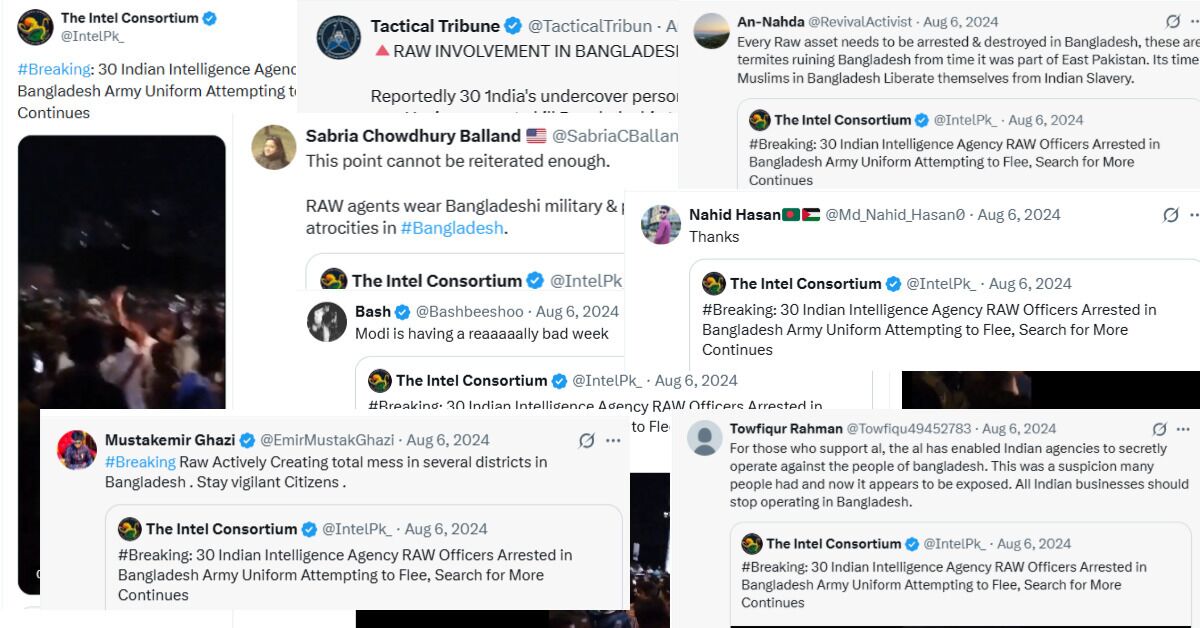
Amplification.
The claim quickly entered Bangladesh’s digital space. For example, Sabria Chowdhury— Co-founder of The Coalition for Human Rights & Democracy in Bangladesh and Editor of Aequitas Review — reposted it, adding:
“RAW agents wear Bangladeshi military & police uniforms & commit atrocities in #Bangladesh.”
At the same time, signs of coordinated behaviour began to emerge. The Dissent identified identical, copy-paste posts carrying the same claim across multiple accounts in both Bangladesh and Pakistan.
See some posts, here, here, here,here, here, and here.
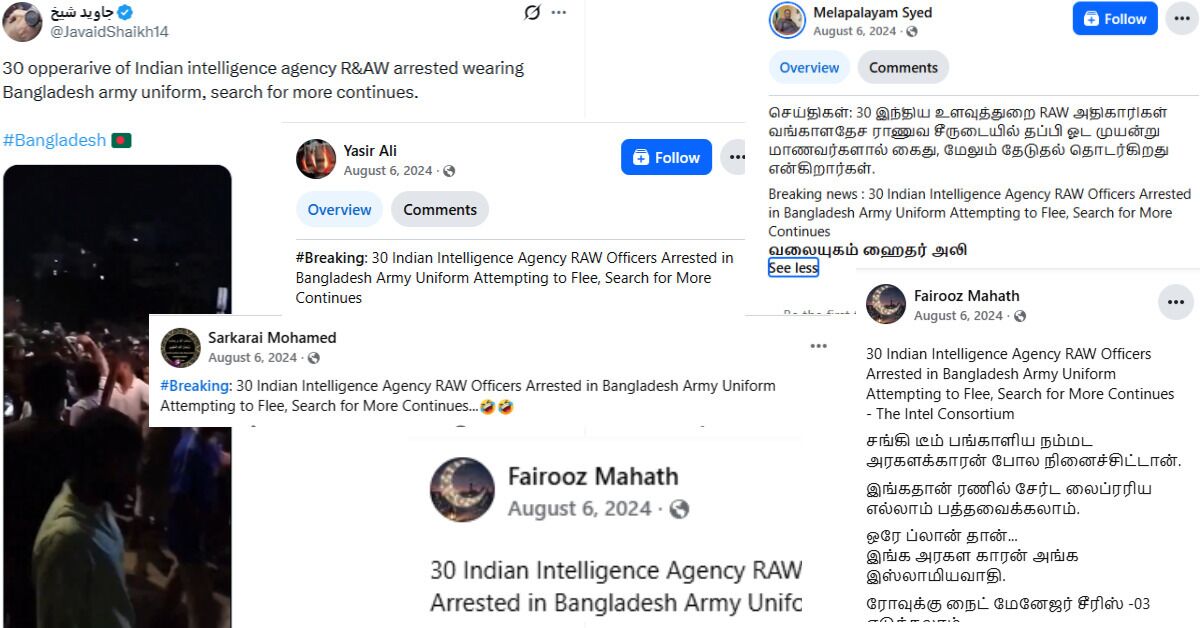
All posts were identical and appeared within a close timeframe, often using hashtags such as #Bangladesh, #Indian_RAW_attack_Dhaka, and #RAW.
Pakistan-based media platform “Sindh Today Ai” also amplified the narrative, claiming:
“30 officers of the Indian intelligence agency 'RAW' arrested in Bangladesh in military uniform. Ousted Foreign Minister Hussain Mahmud and Communications Minister Junaid Ahmed also apprehended while fleeing to India.” (translated from Urdu)
A second rumour centering RAW soon followed — that claimed “Indian spy agency RAW's station chief has been arrested by Bangladeshi army from Dhaka.”
This claim also originated from Pakistan. A verified account, Ironclad (@NavCom24), posted it at 11:47 AM on August 6, 2024, where it received nearly 2,000 reposts.
Many of the accounts amplifying this claim appeared automated or coordinated, including Daniel Morales @0530Daniel, figureitout @psychiatrip_, L C @PrinsesseLola, Ali Ch @AsadAliCh300, Hitman @theagent47_, Ali Athar 🇵🇰🇵🇸 @Athar_Joya, 2090bot @2090bot183360, HαɱɱαD 💧 @XxxEngineer_, manolo639 @manolo63921, bgc689, Human987, @Justme2443, ĞÓHăř Ali(ŠãHêř Příñćě) @HAli90917197, Kthv_18 LAYO( ꪜ )ER @samaira1196, wizop ☭ @Jodaman1617419, Muriithi @_1Muriithi, and @Chris_Nkeonye.
Pakistani film director and news anchor Mubasher Lucman, host of Khara Sach, also shared the same false claim.
No verified reports supported the claim. According to a fact-check report, the image used alongside it was old and unrelated.
Copy-paste Networks and Narrative Recycling
The same message appeared across dozens of accounts in both Pakistan and Bangladesh, often with identical wording and near-simultaneous posting patterns — a common indicator of coordinated amplification.
See some post here, here, here, here, here, here, here, here, here, here, here, here, here, here, here, and here.
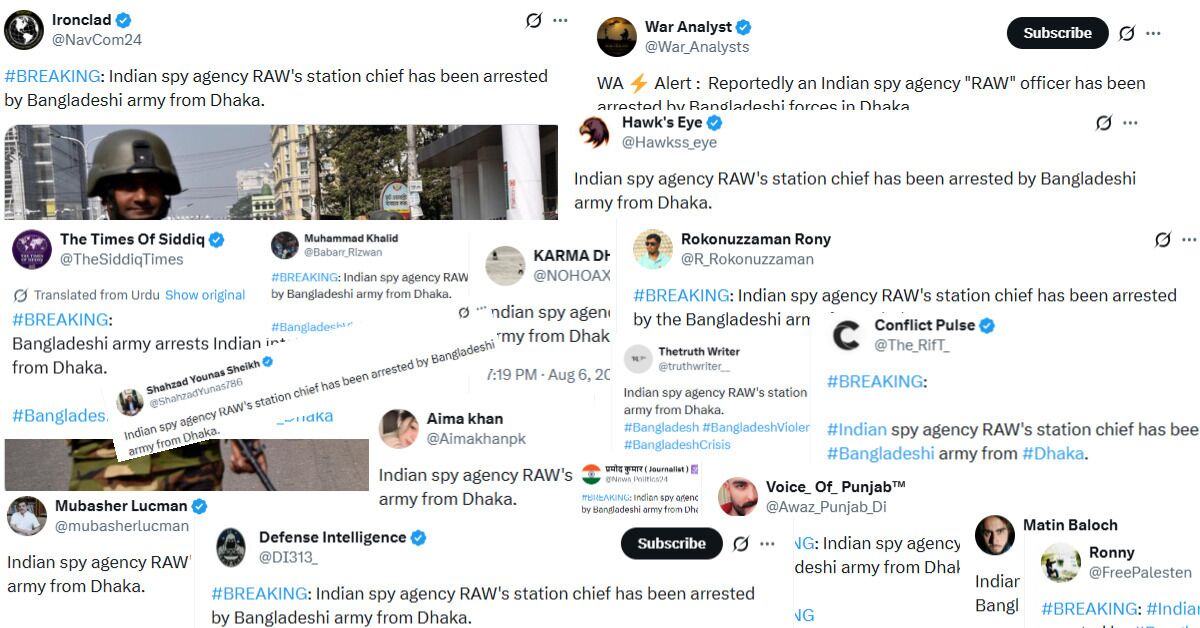
Copy-Paste pattern.
Pakistan-based outlet South Asia Times also shared the same claim.
The narrative spread into Bangladesh as well. A Bangladeshi user praised the supposed “arrest of RAW station officer”:
As the claim gained traction, fear-based posts multiplied. Hundreds of Bangladeshi users began claiming that RAW was carrying out attacks across the country — describing dead bodies, gunfire, and alleged clashes between RAW operatives and Bangladeshi forces, without any verifiable evidence.
See some posts here, here, here, here, here, here, here, here, here, and here.
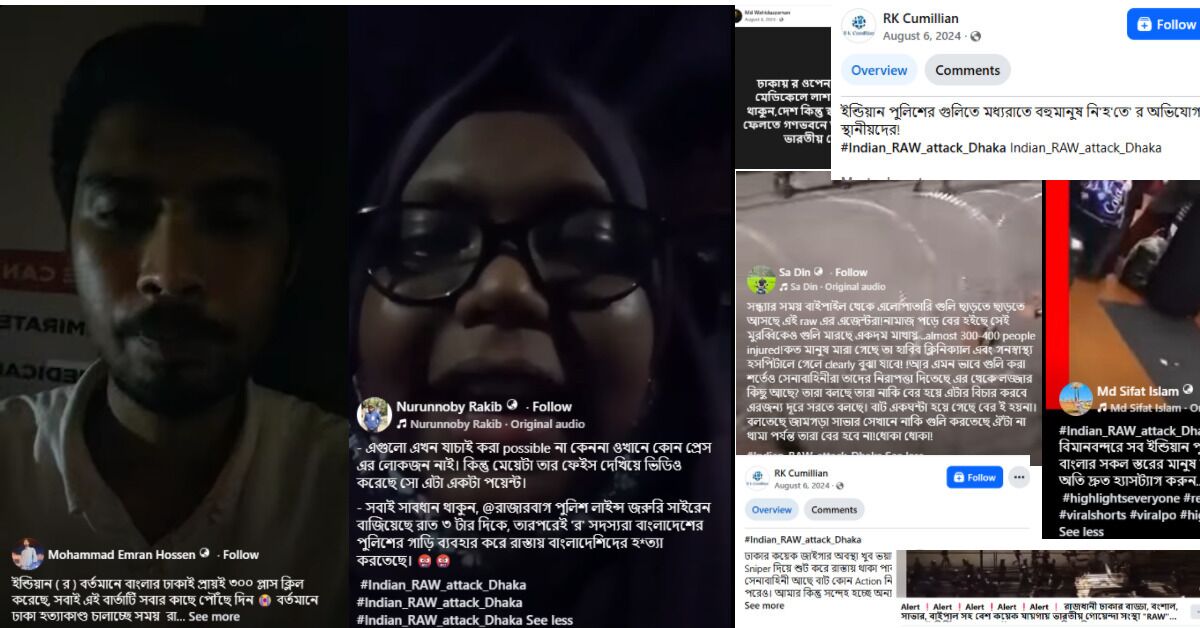
The narrative did not stop there. Nearly a year later, on August 4, 2025, the same verified Pakistan-based account, Ironclad (@NavCom24), claimed: “#BREAKING: Just in, Bangladesh has successfully eliminated a massive Indian spy cell, with intel help from Pakistan.”
This claim was also false. There were no verified reports that any Indian spy cell had been dismantled in Bangladesh, nor that Pakistan had provided such assistance.
It is to be mentioned here that RAW’s presence and activities in Bangladesh has long been a topic of discussion in the political and diplomatic circles of Dhaka. Books like ‘RAW in Bangladesh’ and ‘RAW: A History of India's Covert Operations’ detailed how the Indian agency worked in its neighboring countries.
Top BNP Leaders Targeted
In late January 2026, a cross-platform disinformation narrative began circulating, alleging that senior BNP leaders had secretly met India’s intelligence agency, R&AW, in New Delhi. The claim originated from a Pakistan-linked X account, Indus Sentinel Grid, which posted a video featuring AI-generated images presented as leaked photographs of a covert meeting involving BNP figures Amir Khasru Mahmud Chowdhury and Abdul Awal Mintoo. The content suggested a secret political deal and was widely shared during the peak campaign period.
The Dissent and other fact-checking organisations later identified the images as AI-generated.
Despite this, the content quickly went viral across social media. Dozens of Pakistan-based accounts amplified the claim, alleging that the Bangladesh Nationalist Party (BNP)—now the ruling party—had negotiated with India’s RAW.
Notable Pakistan-based accounts including Eagle Eye, The Intel Consortium, IC (Intellectually Confused),SHAFAAT SHAH shaed identical or near-identical posts.
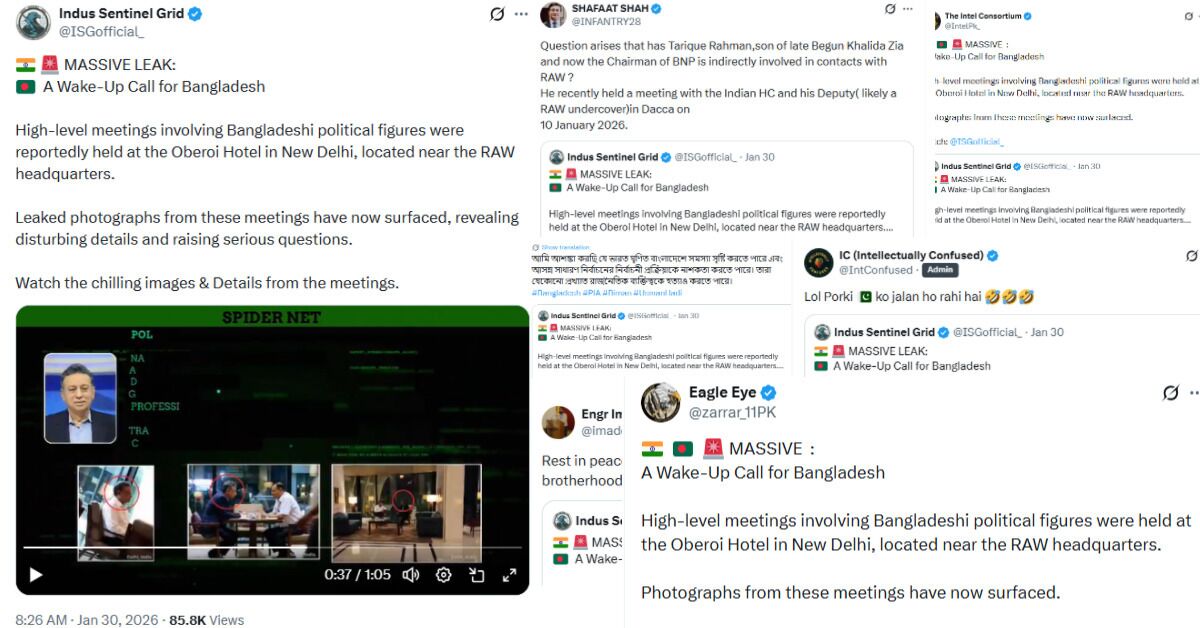
The false narrative soon crossed into Bangladesh’s information space. Social media activist Shafin Rahman shared the same claim, asserting that he had personally verified the images through metadata analysis and that they were confirmed by “OSINT platforms.”
The same claim was then replicated across dozens of Bangladeshi accounts, often using identical or near-identical copy-paste posts.
See some posts here, here, here, here, here, here, here, here, here, here, here, here, here, here, here, here, here , here, here, and here.
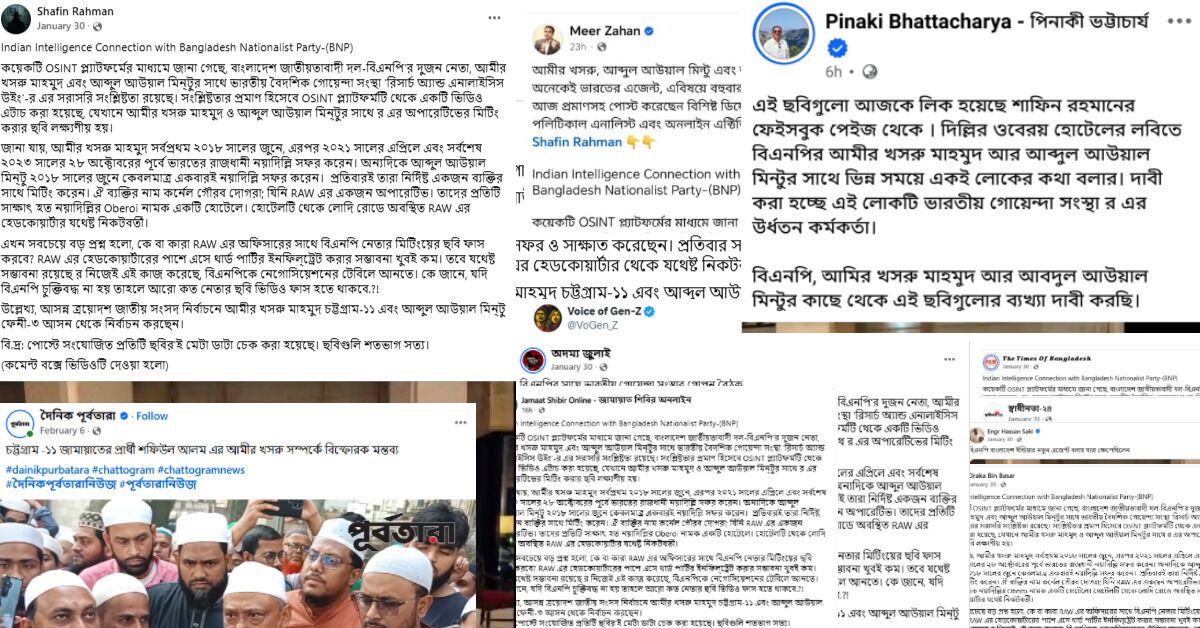
The claim was further amplified by prominent Bangladeshi online figures, including Pinaki Bhattacharya, Elias Hossain, and Meer Zahan, generating millions of views.
The narrative evolved further. During an election campaign, a Jamaat Islami candidate for Chattogram 11 constituency Shafiul Alam claimed that he had seen footage of BNP leaders meeting RAW agents in a “secret meeting.”
Another online page, Bangla News TV, claimed that BNP leader Amir Khosru Mahmud Chowdhury was a “tested RAW agent.”
Deepfake Videos Ahead of the Election
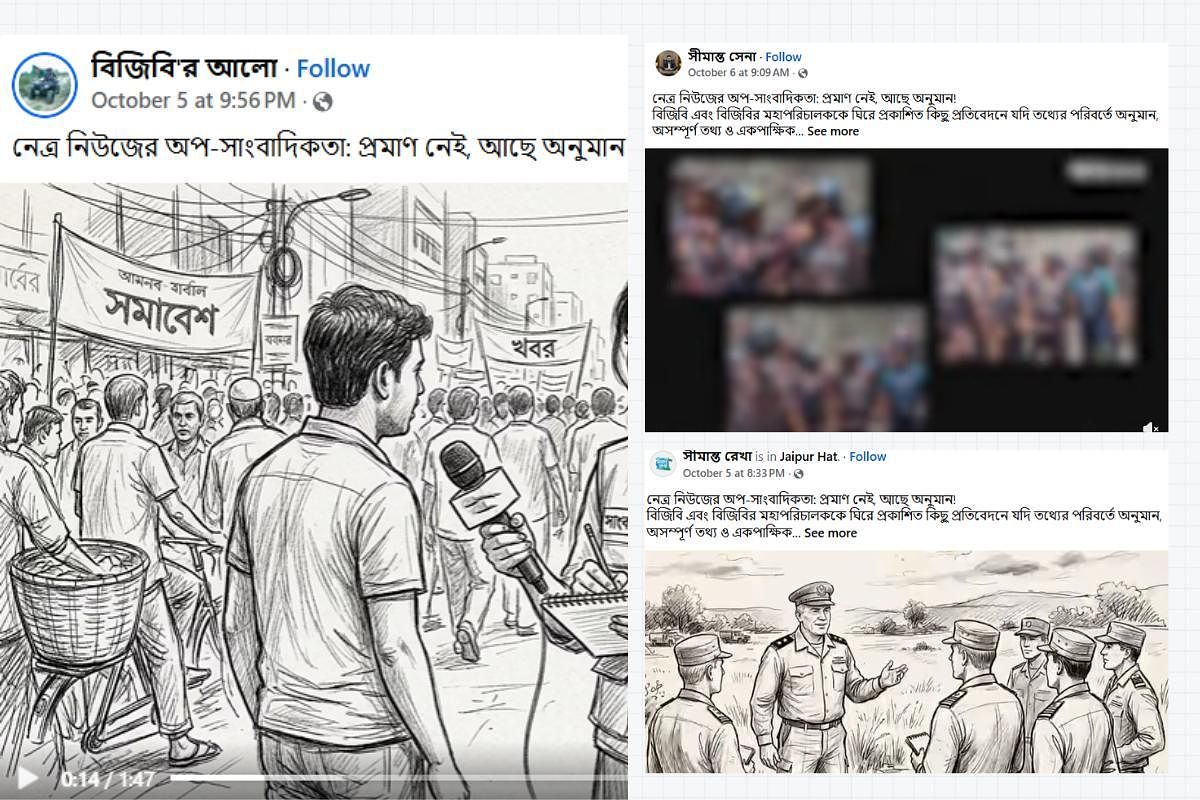
The Dissent also identified a Facebook page named Waiting for Death run by admins based in both Pakistan and Bangladesh, producing deepfake videos styled as top global media outlets like BBC, Al Jazeera and DW featuring top BNP leaders in negative light.
In such a deepfake video it was claimed that “Amir Khasru Chowdhury is a controversial Bangladeshi politician facing multiple allegations, including criminal cases, money laundering, and security-related matters. Reports also highlight unauthorized visits to India and alleged meetings with RAW officials, keeping him under constant public and legal scrutiny.”
Ahead of the February 12 national election, the page had produced at least 24 deepfake videos against 24 BNP leaders– including Mirza Fakhrul Islam Alamgir, Salahuddin Ahmed, Zahiruddin Swapan, Habibur Rahman among others– depicting them as ‘corrupt’ and ‘pro-Indian’.
See related videos here, here, here, here, here, here, here, here, here, here, here, here, and here.
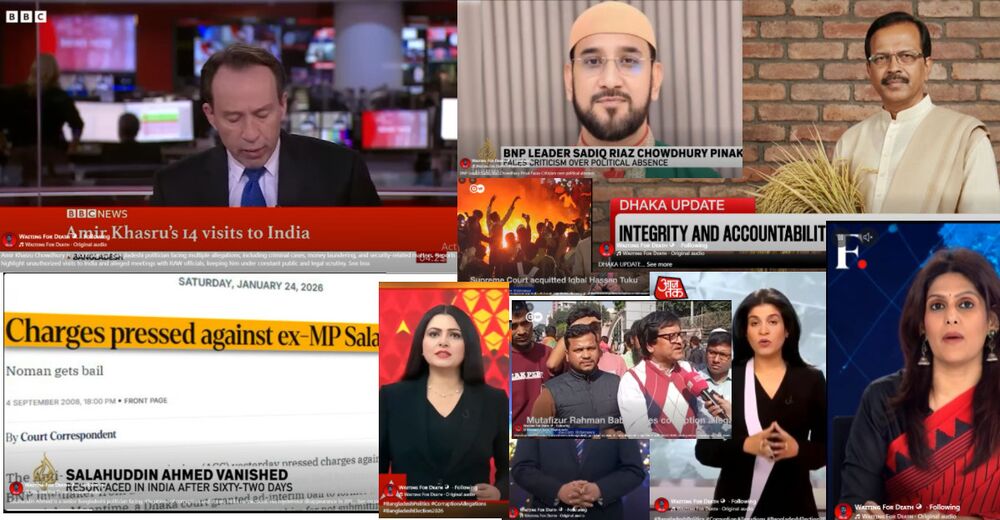
The repeated use of AI-generated images, deepfake videos, and impersonation of trusted international media outlets suggests a more deliberate attempt to lend credibility to otherwise unverified claims, particularly during politically sensitive periods.
Assassination of Osman Hadi and Competing 'RAW' Narratives
On December 12, 2025, Sharif Osman Hadi, an activist and spokesperson for Inqilab Mancha, was shot while campaigning in Dhaka — one day after the Election Commission announced the February 12, 2026 election and referendum. Hadi, an independent candidate in Dhaka-8, was taken to Singapore for treatment on December 15 and died on December 18.
Shortly after the attack, The Dissent identified two suspected shooters — Faisal Karim Masud and his associate Alamgir Hossain — using OSINT techniques.
The suspects later fled to India and were detained on March 8 from the Bangaon area near the Bangladesh–India border by West Bengal Police's Special Task Force (STF).
The shooting of Hadi quickly turned into a cross-border information flashpoint, with Indian and Pakistan-linked actors pushing competing narratives.
The Dissent’s analysis shows that India-linked narratives repeatedly pointed to a Facebook post made from Hadi’s account hours before the attack, which allegedly featured a “Greater Bangladesh” map including Indian territories. Indian social media handles also celebrated the murder attempt and hailed the shooters.
This framing was widely circulated, with claims suggesting that Hadi was shot shortly after sharing a “distorted map of India,” implying his death was linked to challenging India’s territorial integrity.
The narrative followed a hybrid pattern. Indian news outlets and web portals, including The Hindu and HT Bangla, presented Hadi’s alleged “radical” views as context, while high-impact influencers on X amplified and sharpened the messaging through mockery and derogatory framing around his hospitalization.
Multiple X accounts also posted near-identical captions targeting Hadi for his territorial claims, suggesting patterned amplification rather than isolated commentary.
In contrast, Pakistan-linked narratives — largely circulating on Facebook — framed the attack through themes of “Muslim Unity” and direct accusations against Indian intelligence. Pages such as Pakistan Bangladesh Unity and Muslim Unity & Brotherhood portrayed Hadi as a political victim and repeatedly claimed the attack was carried out by an “Indian R&AW agent.”
These posts framed Hadi as a “revolutionary” figure, linking the incident to broader anti-India narratives and appealing to shared identity across Bangladeshi audiences and the wider Islamic diaspora.
Pakistan’s outlet Times of Islamabad also claimed on December 22 that India’s RAW role in the assassination had been “confirmed.”
Pakistani journalist and editor Ammar Masood similarly claimed that India was involved in the killing.
Another Pakistan-based platform, White News Bangla, published multiple posts directly blaming India and RAW for the assassination.
Analysis shows that the page is operated by Muhammad Kamran Saeed Usmani, who holds multiple political and organisational roles in Pakistan, including President of Pakistan Youth PML and Convener of the Pakistan Bangladesh Friendship Forum.
Pakistan-based X accounts such as Tactical Tribune and Pakistan Defence also promoted the same claim.
See some post here, here, and here.
Another post from Pakistan Bangladesh Unity claimed that Hadi was shot dead by Indian RAW, which was then amplified by dozens of Pakistan-based accounts.
Accounts including Muslim Unity & Brotherhood, Nazar Muhammad, Khyber Mushwani, سیدہ سمیرا الجیلانی, Casper Love Casper, Farhan Sahab Muhtaram, and Miraz Naik shared similar claims.
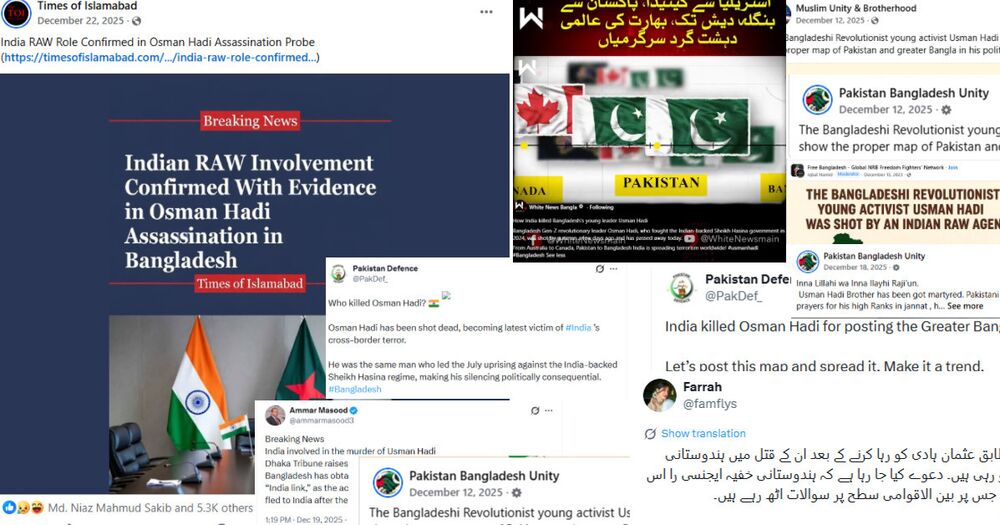
Dozens of Bangladesh-based accounts also reposted the same narrative, including Saiful Islam Shuvo, Rudro Hasan, S. T. Zobair, Rezaul Karim, Viral Mania, Md Kazi Toslim, Tanvir Khan, Zafar Tanveer, Sayham Ahmad, Abidur Rahman Abir, Golam Sarowar Ripon, and Ruhul Amin Sarkar.
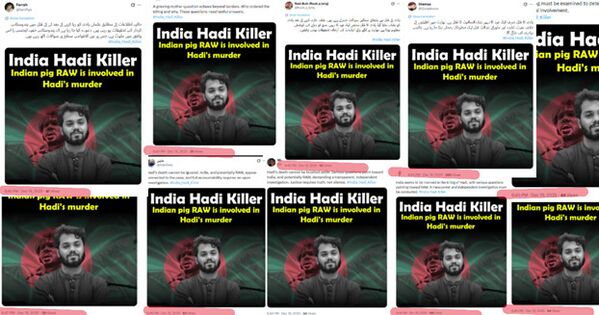
A series of near-identical posters in almost same time (06:45-06:50pm) circulated across X, including messages such as “Indian p*g RAW is involved in Hadi's murder,” indicating coordinated messaging.
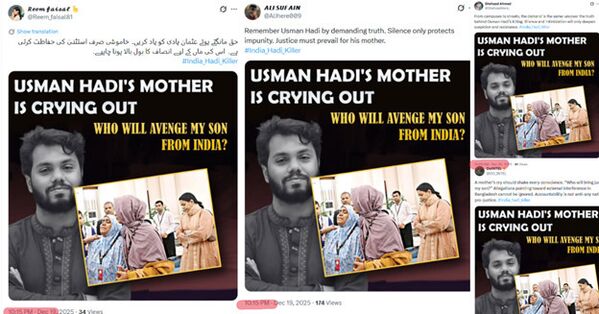
Similar waves of posts framed the killing as “Indian involvement,” or called for retaliation, including emotionally charged messages such as appeals from Hadi’s “mother” and calls for revenge.
Other posts escalated the narrative further, suggesting that Bangladeshi youth would retaliate against India.
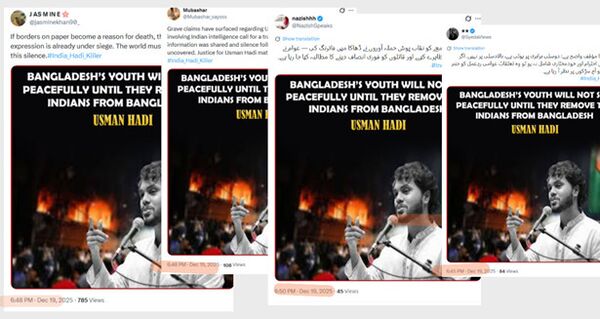
The hashtag #India_Hadi_Killer also gained traction. According to an NDTV investigation, it appeared in more than 1,700 posts on X between December 19 and December 23, with 385 posts published within a single hour.
The Dissent also identified fabricated videos styled as reports from Al Jazeera and France 24, falsely claiming Indian involvement.
A Pakistan-based account, Zardan Sangzi, shared a fabricated France 24 video claiming: “India is responsible for the killing of Bangladeshi Gen-Z figure Osman Hadi. France24 reports that India’s intelligence agency, RAW, hired agents to assassinate him. - India continues to sponsor terrorism globally.”
The video was later amplified by multiple Pakistan-based accounts, including Defense Watch and @EngnXulfiPTI, as well as Bangladesh-based accounts such as @BDMILITARY.
Another fabricated video, styled as an Al Jazeera report, was circulated by Pakistan Defence and widely amplified across a large network of accounts before being picked up by Bangladeshi users.
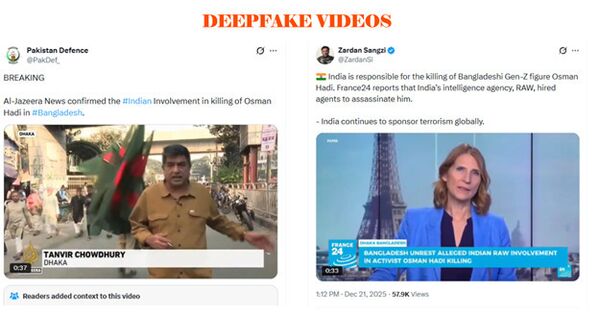
Fact-checkers later confirmed that these videos were deepfakes.
A closer examination of these Pakistan-based accounts shows consistent behavioural patterns. Many appear to function as coordinated amplification nodes — frequently promoting narratives aligned with Pakistan’s government and military positions, including support for Pakistan Army Chief Asim Munir and Prime Minister Shehbaz Sharif, while attacking opposing political actors.
They often post identical or near-identical content within short timeframes, suggesting organised amplification rather than organic engagement.
‘Islamic NATO’ Narratives
In early January 2026, a series of legitimate diplomatic and defence developments — including Bangladesh Air Chief Marshal Hasan Mahmood Khan’s visit to Islamabad, reported discussions on JF-17 procurement, and Türkiye’s potential entry into the Pakistan–Saudi Strategic Mutual Defence Agreement — were reframed into a broader claim that Bangladesh was preparing to join a Pakistan–Türkiye–Saudi military bloc, described by some outlets as an “Islamic NATO.”
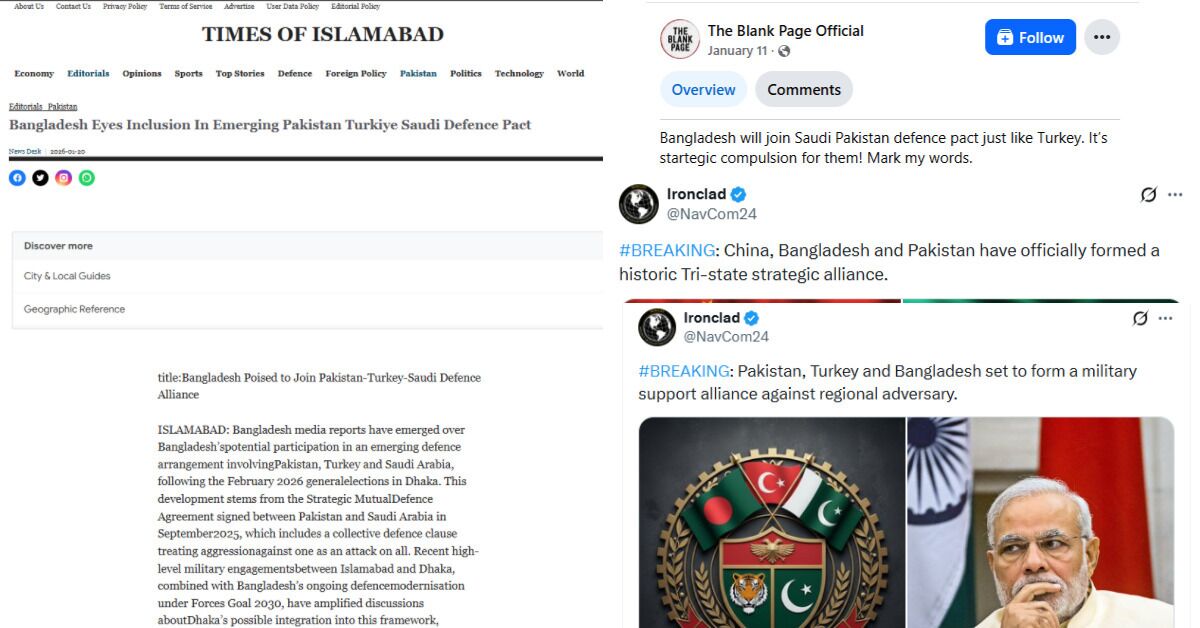
On January 12, the Pakistan-based media outlet Times of Islamabad brought these developments together in an article titled “Bangladesh Eyes Inclusion in Emerging Pakistan Turkiye Saudi Defence Pact”, suggesting that Bangladesh could become the fourth member of the alliance after the February election. The report framed the move as being under consideration by the interim government and linked it to post-election policy direction.
Bangladesh’s Foreign Adviser later clarified that the country had neither joined nor was planning to join any such alliance.
The Dissent observed that the defence-bloc narrative spread through a structured cross-border amplification chain. Following publication by Times of Islamabad, similar claims began appearing across Pakistan-based social media accounts and defence-focused aggregators.
Pakistan-based verified account Ironclad (@NavCom24) had already pushed similar narratives earlier. On November 3, 2025, it claimed that Pakistan, Turkey, and Bangladesh were set to form a military support alliance against a regional adversary.
In another post, the same account claimed that China, Bangladesh, and Pakistan had “officially formed” a historic tri-state strategic alliance.
Pakistan-based Facebook page The Blank Page Official also claimed that Bangladesh would join the Saudi–Pakistan defence pact “just like Turkey,” calling it a “strategic compulsion.”
These narratives were then picked up by Bangladeshi users. In one example, a Facebook user claimed: “Bangladesh joins Muslim NATO. BRAVO!”
Bangladesh-based X account BDMilitary (@BDMILITARY) also advocated for the idea, stating that Bangladesh should view such a bloc favourably, as Türkiye, Pakistan, and Saudi Arabia are integral to Bangladesh’s strategic interests.
In an explainer video, YouTube channel BDViews claimed that Bangladesh was considering joining a defence bloc consisting of Pakistan, Turkey, and Saudi Arabia. The video framed the idea as part of a broader strategic shift: Bangladesh is reportedly modeling its defence draft on the Saudi–Pakistan framework, seeking “strategic depth” with Muslim-majority nations, and positioning itself under a wider “security umbrella”
The narrative did not remain confined to social media. It was picked up by several Bangladeshi media outlets, including Centrist Nation, Daily Ittefaq, Manab Zamin, Dhaka Mail, and RTV Online. Within days, the claim spread across Facebook, X, and YouTube, generating hundreds of posts, reels, and commentary videos.
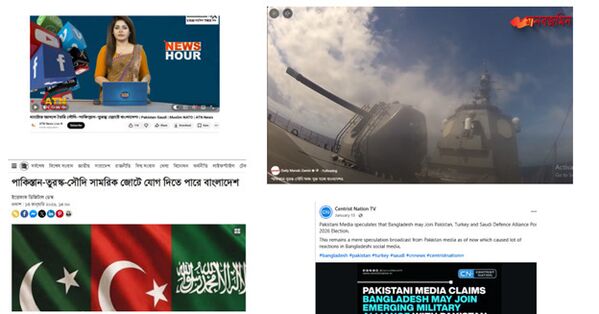
As mainstream outlets reported on the claim — often citing Pakistani media speculation — the narrative gained further visibility and began circulating more widely in public discourse. In many cases, it was reframed in nationalist or religious terms, reinforcing the idea of a unified “Muslim defence bloc” before prompting official clarification from the government.
The JF-17 Push
The Dissent investigation shows a sustained effort by Pakistan-linked disinformation actors to push claims that Bangladesh has either signed or is preparing to sign an agreement to purchase Pakistan–China jointly produced JF-17 fighter jets. Alongside this, parallel narratives suggest that Bangladesh and Pakistan are moving towards a broader defence alignment aimed at countering what these actors describe as “Indian aggression.”
These narratives emerged alongside real diplomatic engagement. In January, Bangladesh Air Force Chief Air Marshal Hasan Mahmood Khan visited Islamabad and met Pakistan Air Force Chief Air Marshal Zaheer Ahmed Babar Sidhu. According to Pakistan’s Inter Services Public Relations Directorate, the two sides discussed the “potential procurement” of JF-17 Thunder aircraft.
At the same time, broader geopolitical narratives were being shaped. Pakistan and China both claimed that their aircraft (JF-10 and JF-17) had downed a Rafale jet during Operation Sindoor. French intelligence reports later pointed to a joint Pak-China disinformation campaign aimed at discrediting the Rafale and promoting Chinese-origin defence products, particularly in Southeast Asia.
Despite this, there has been no official confirmation from the Bangladesh government or Air Force regarding any JF-17 procurement decision.
The Dissent’s analysis shows that the JF-17 narrative follows a recurring pattern seen across earlier cases — where limited or tentative developments are amplified into definitive claims through coordinated messaging.
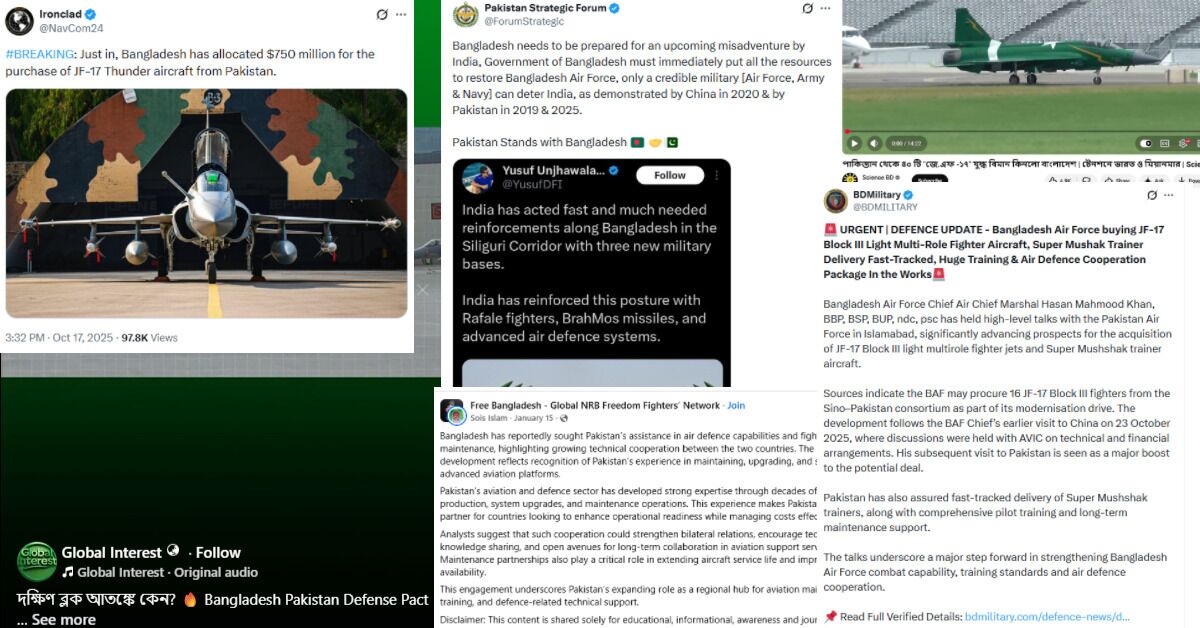
Pakistan-based account Ironclad (@NavCom24) claimed as early as October 17, 2025, that Bangladesh had allocated $750 million for the purchase of JF-17 aircraft.
This was followed by another Pakistan-based account, ENTEI (@ZEUS_PSF), which claimed that Bangladesh had “officially requested” procurement of JF-17 Block-III aircraft and that both sides had entered detailed discussions.
However, no verified reports support these claims.
The narrative was then amplified within Bangladesh. Bangladesh-based account BDMilitary (@BDMILITARY) claimed that the Bangladesh Air Force was purchasing JF-17 Block III aircraft alongside a broader training and air defence package.
A Facebook page, Defense Technology of Bangladesh-DTB, claimed — citing alleged documents from the former chief advisor’s office — that Bangladesh had initiated the purchase of 12 JF-17 jets with a budget of $720 million.
However, The Dissent found no publicly available evidence of such documents.
Another group, Free Bangladesh - Global NRB Freedom Fighters’ Network, framed the reported purchase positively, presenting Pakistan as a “reliable partner” for defence cooperation.
At the same time, narratives escalated beyond procurement into security framing. In another post, Ironclad (@NavCom24) warned that Bangladesh must prepare for an “upcoming misadventure by India,” urging rapid military strengthening and positioning Pakistan as a strategic ally.
The Dissent also identified AI-generated videos circulating within Bangladesh that reinforced the procurement narrative.
A Facebook page named Global Interest published a video with AI-generated voiceover claiming that Pakistan had begun special training for Bangladeshi pilots on JF-17 operations, framing the aircraft as a deterrent against India.
Another page, Trending News, claimed that Pakistan’s modern JF-17 jets were being added to the Bangladesh Air Force despite “India’s conspiracy.”
A Bangladesh-based YouTube channel, Science BD, with 3.69 million subscribers, further amplified the claim, stating that Bangladesh had signed an agreement to purchase 40 JF-17 jets from Pakistan.
The narrative also entered mainstream Bangladeshi media. While some outlets reported on the possibility of procurement in speculative terms, others presented unverified claims more definitively.
For example, Kaler Kantha reported on October 15, 2025, that Bangladesh had signed a deal to purchase 16 JF-17 fighter jets, citing unnamed “responsible sources” without providing evidence.
Television channel Boishakhi TV reported that Pakistan’s fighter jets and air defence systems would soon be added to the Bangladesh Air Force.
Somoy TV framed the issue as a potential strategic shift, suggesting that such a purchase could alter the regional balance of power in South Asia.
Defence Agreement Propaganda
The Dissent monitored a sustained stream of narratives promoting the idea that Bangladesh has signed — or should sign — a defence agreement with Pakistan to counter what is repeatedly framed as “Indian aggression.”
A Pakistan-based Facebook page, Pakistan Bangladesh Unity, framed the issue in explicitly ideological terms, claiming that the Pakistan Army was working with a broader “Muslim Army” to defend the Muslim Ummah, and that Bangladesh should enter into a defence treaty with Pakistan to protect itself from a perceived “eternal enemy.”
A similar message was echoed by Pakistan-based account @SanaYousafzai9.
These narratives were not confined to Pakistan-based sources. They were quickly amplified by Bangladesh-based accounts, suggesting a cross-border feedback loop.
For example, Bangladesh-based account @revolt_71 reposted and expanded the claim, writing that stronger ties with Pakistan would help Bangladesh counter “Indian dirty politics.”
The same account repeatedly advocated for deeper defence cooperation, including posts stating: “To counter India, we need Pakistan…”, “A top class Defence deal between Bangladesh and Pakistan is a must”
Pakistan-based account @Defence_Index further intensified the narrative by introducing religious and civilisational framing, portraying the issue as a shared struggle between Muslim nations and India.
Bangladesh-based users also adopted similar language. For instance, @shanto_shamsu framed the issue in terms of shared Muslim identity, while @_freexyfraaxer linked the narrative to historical grievances and anti-India sentiment.
The narrative was further reinforced through content designed to resemble news reporting.
A Pakistan-based page, 9L, published a video claiming that Bangladesh and Pakistan were set to sign a defence agreement within a week.
The Dissent also identified a Pakistan-based propaganda platform, White News Bangla, which operates in a news-style format with multiple presenters. In its content, defence cooperation with Pakistan is framed as essential for Bangladesh’s security.
In a podcast published by the same platform, Muhammad Kamran Saeed Usmani — President of Pakistan Youth PML and Convener of the Pakistan Bangladesh Friendship Forum — discusses Indian influence in Bangladesh and advocates closer ties with Pakistan.
In another video, Usmani appeals directly to religious identity, urging Bangladeshis to “reunite” with Pakistan despite the historical context of the 1971 war.
The platform also organised and promoted events such as a “Pak-Bangla friendship conference,” reinforcing the same messaging.
Parallel to this, AI-generated videos circulated from Bangladesh-based pages such as Trending News, further amplifying the narrative.
These videos claimed: Pakistan’s Prime Minister and Army Chief were visiting Dhaka to finalise a defence pact and weapons procurement, Pakistan would intervene militarily if Bangladesh were attacked by India, India would be unable to defeat Bangladesh due to Pakistan’s support.
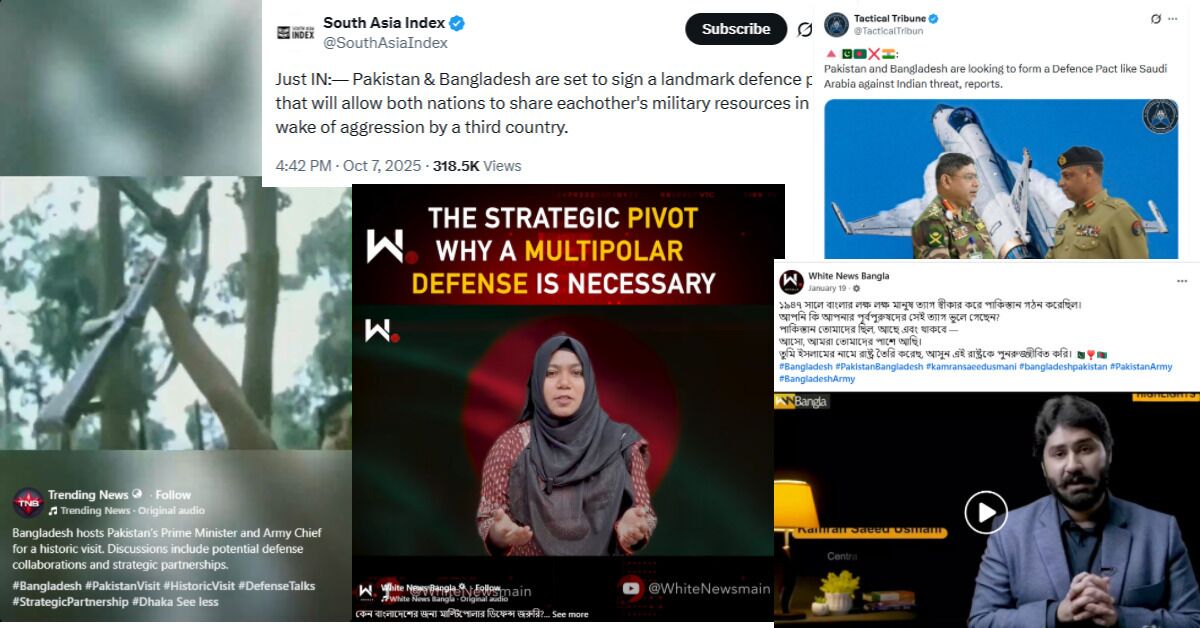
Pakistan-based accounts such as @TacticalTribun and @SouthAsiaIndex played a central role in sustaining and escalating the narrative. @TacticalTribun claimed that Pakistan and Bangladesh were moving towards a Saudi-style defence pact and increased military cooperation.
@SouthAsiaIndex claimed that the two countries had already established defence ties and were preparing to sign a “landmark” agreement involving shared military resources.
Bangladesh-based account @BDMILITARY further localised the narrative, advocating specific military cooperation — including acquisition of missile systems and joint defence technologies — and framing Pakistan as a key strategic partner.
Post-election Narrative Recycling
Following the election, the same narrative resurfaced in a new form. A fresh wave of posts claimed that the newly elected government in Bangladesh was preparing to “fast-track” defence agreements with Pakistan.
These posts used “breaking news” framing and confident language — such as “set to fast track” and “moving fast” — without citing any official confirmation, creating the impression of insider knowledge.
Pakistan-based account @TacticalTribun claimed that the new government was accelerating multiple defence deals.
Similarly, @ZardSi claimed that the newly elected BNP government was prioritising defence ties with Pakistan and China.
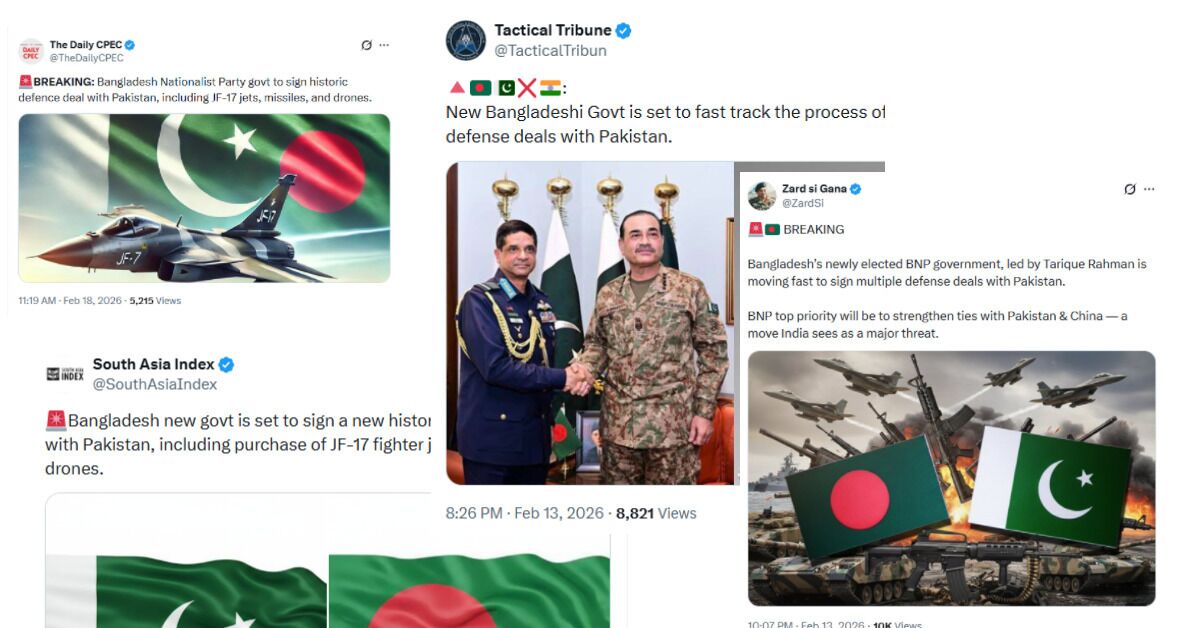
These claims were further amplified by accounts such as @SouthAsiaIndex and @TheDailyCPEC, which framed the alleged agreement as “historic” and linked it to procurement of JF-17 jets, missile systems, and drones.
Key Actors in Cross-Border Disinformation Campaigns
The Dissent analysis shows that cross-national disinformation campaigns are not random but driven by a loosely coordinated network of actors operating across platforms—primarily X and Facebook. These actors can be grouped into three functional tiers: originators, amplifiers, and local legitimisers.
At the top are the actors based in Pakistan and they are the originators of the particular pieces of disinformation. These actors include Pakistani media outlet ‘Time of Islamabad’ and social media handles such as The Intel Consortium (@IntelPk_), Ironclad (@NavCom24), Tactical Tribune, Indus Sentinel Grid (@ISGofficial_), White News Bangla, Pakistan Defence, Pakistan Bangladesh Unity, and South Asia Index.
These accounts were found to consistently act as early injectors of those narratives, often posting unverified claims framed as “breaking” intelligence. In multiple cases— such as the alleged ‘RAW arrests’, ‘BNP–RAW meetings’, or ‘defence alliance’ claims— these accounts published the first wave of content, frequently accompanied by misleading visuals or AI-generated material.
A second tier consists of amplifier networks, largely Pakistan-based but including globally dispersed accounts. These include dozens of handles that repost identical or near-identical content within minutes, often using the same hashtags (e.g., #RAW, #Bangladesh, #India_Hadi_Killer). The repetition of identical phrasing, synchronized timing, and high repost volumes indicates copy-paste amplification behaviour, a common signal of coordinated influence operations rather than organic engagement.
The third tier involves Bangladesh-based amplifiers and legitimisers, including social media influencers, political commentators, and hyper-partisan pages. Accounts such as BDMilitary, Trending News, @revolt_71 play a critical role in localising these foreign-origin narratives. Once picked up by these actors, the narratives are reframed in domestic political or emotional terms— transforming external claims into seemingly credible “internal discourse.”
A notable subset of actors includes hybrid or cross-admin platforms, such as Facebook pages operated jointly from Pakistan and Bangladesh including Facebook Page Waiting for Death, Trending News.
In several cases, the narratives go further, entering mainstream media coverage or broader public debate. Even when reported cautiously, this visibility contributes to legitimising the underlying claims. The “Islamic NATO” narrative and JF-17 procurement claims illustrate how speculative reporting, when amplified across platforms, can evolve into widely discussed public assumptions.
Across cases, posting behaviour follows a repeatable dissemination pattern:
Narrative seeding from Pakistan-based X accounts
Rapid coordinated amplification via bot-like or aligned networks
Cross-platform migration into Facebook and YouTube ecosystems
Local uptake in Bangladesh, often by partisan or influencer accounts
Mainstream spillover, where some narratives enter media reporting or public debate
Content characteristics remain consistent: fear-based framing (RAW attacks), identity narratives (Muslim unity), geopolitical alignment (anti-India positioning), and increasing use of AI-generated visuals and deepfake videos to enhance credibility.