


Militant-Linked Accounts Amplify ‘Apostate’ Rhetoric Against Bangladesh Military

On Dec. 13 of last year, six Bangladeshi peacekeepers were killed and nine others wounded when a separatist armed group carried out a drone attack on the Kadugli logistics base of the United Nations peacekeeping mission in the Abyei region of Sudan. The attack cast a pall of grief across Bangladesh. On social media, countless people expressed sorrow for the slain soldiers.
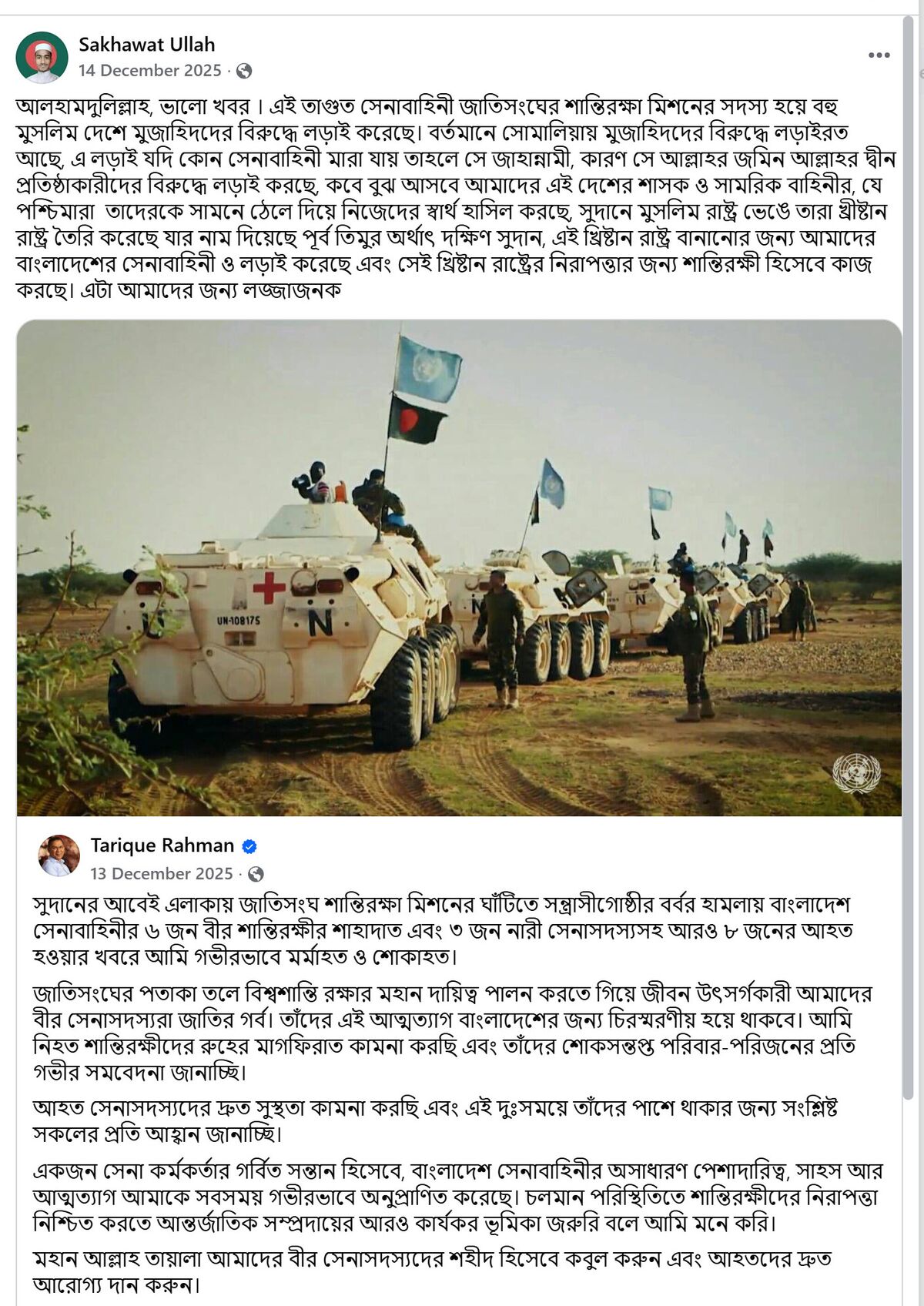
The armed forces, the government and major political parties issued formal statements of condolence. On Dec. 13, the current prime minister and the then acting chairman of the Bangladesh Nationalist Party, Tarique Rahman, also posted a message of mourning from his verified Facebook account.
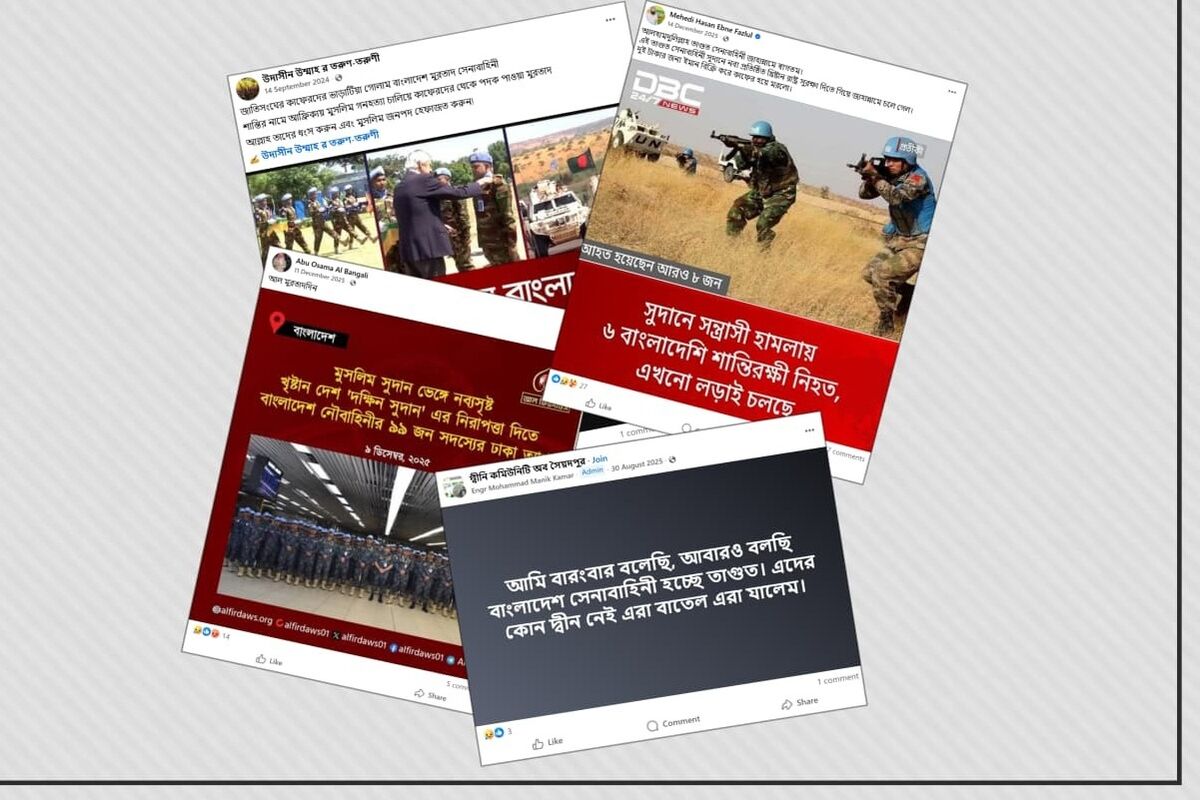
Yet even as the nation grieved, across party lines, for members of its armed forces who died while serving abroad, a different picture emerged online.
‘Members of a Taghut Force Have Died’
Sharing Mr. Rahman’s condolence post, a Facebook account under the name Shakhawat Ullah described the fallen soldiers as members of a “Taghut army.”
In a post from that account, it was written: “Alhamdulillah, good news. This Taghut army, as part of the United Nations peacekeeping mission, has fought against the mujahideen in many Muslim countries. Currently it is fighting against the mujahideen in Somalia. If any soldier dies in such fighting, then he is destined for hell, because he is fighting against those who establish Allah’s religion on Allah’s land. When will our country’s rulers and military understand that the Westerners are pushing them forward to serve their own interests? In Sudan, they broke a Muslim state and created a Christian state named East Timor, that is, South Sudan. Our Bangladesh Army also fought to establish that Christian state and is now working as a peacekeeper to secure it. This is shameful for us.”
On Dec. 14, the official page of Bangladesh Jamaat-e-Islami also shared a condolence message from its amir, Dr. Shafiqur Rahman.
A Facebook account under the name Muhammad Anis Uddin shared that post and wrote in the caption: “They die as apostates and are being made martyrs.”
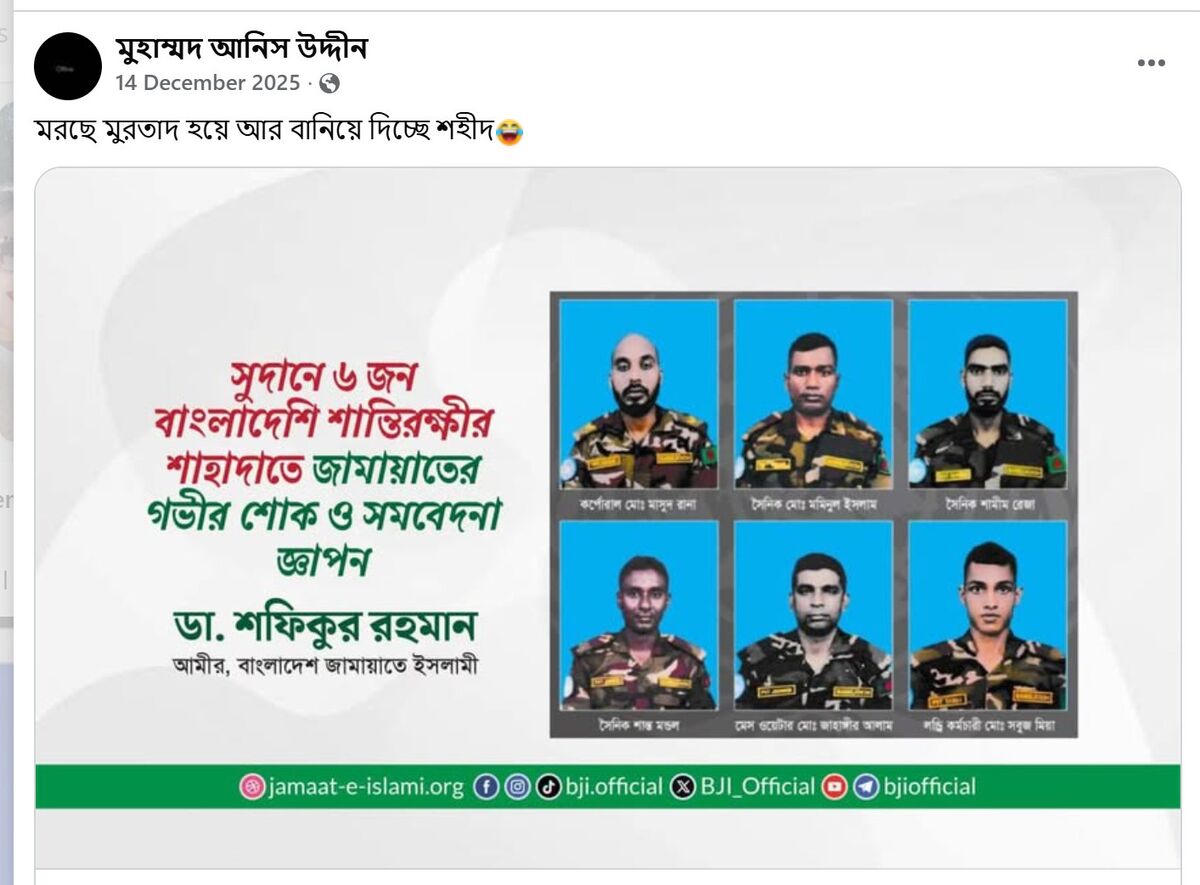
The Jamaat page’s post received 97 comments. At least 28 of them labeled the slain soldiers as “apostates,” expressed jubilation at their deaths, or mocked Jamaat-e-Islami for referring to their deaths as martyrdom.
Labeling Bangladesh’s armed forces as “Taghut,” “apostate” or “impure” is not new. For several years, such characterizations have circulated on social media.
The Dissent analyzed content from about 60 Facebook accounts that have, at various times since 2015, spread similar narratives against the armed forces.
While isolated efforts to label the forces “apostate” had occurred before, The Dissent found a marked increase in such propaganda during 2024, 2025 and 2026, often tied to specific events.
Other Recent Incidents That Prompted Similar Campaigns
On April 22 of last year, a Hindu official at the Kohinoor Chemical factory was accused of insulting the Prophet Muhammad. A group of outsiders blocked the road in front of the factory, demanding punishment for the accused. At one point, law enforcement used batons to disperse them. In the aftermath, various accounts on social media described the Army as “apostate.”
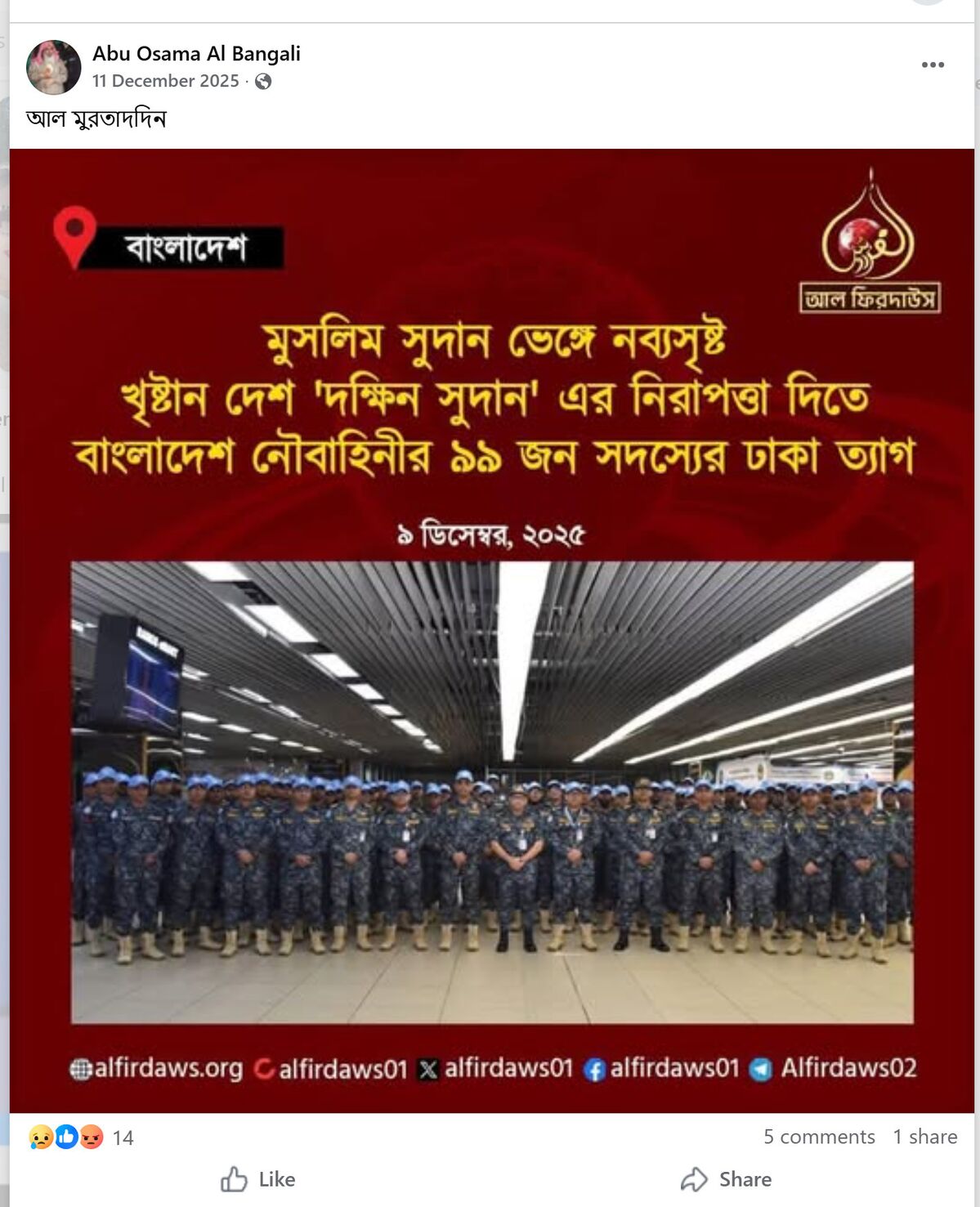
On Dec. 9 of last year, 99 members of the Bangladesh Navy left Dhaka to join a United Nations peacekeeping mission in South Sudan.
A page called “Al Firdaws” posted a photo card of the departing personnel under the headline: “99 Members of the Bangladesh Navy Depart Dhaka to Provide Security to the Newly Created Christian Country ‘South Sudan,’ Formed by Breaking Muslim Sudan.”
The post drew 170 comments. Most labeled the sailors “apostates” and wished for their deaths on the battlefield. The post was shared 150 times, many with captions similarly branding the naval personnel as apostates and expressing hopes of their deaths.
The Al Firdaws photo card was reposted by numerous other accounts, repeating the same accusation.
The page Al Firdaws regularly shares reports of attacks by Al Qaeda, the Tehrik-i-Taliban Pakistan (T.T.P.) and other militant organizations, along with material promoting their ideology.
In September 2024, Bangladeshi peacekeeping engineers received United Nations medals. After various Bangladeshi news outlets published the story, many users in the comment sections labeled the armed forces “apostates.” Others shared the news while repeating the same claim.
On Dec. 16, 2024, Victory Day, delegations from the Bangladesh and Indian armies met at the zero line of the Akhaura border in Brahmanbaria for a courtesy exchange. Photographs of the meeting were used on social media to describe the Army as an “apostate force.”
On March 21 of last year, Hefazat-e-Islam Bangladesh called a protest march at Baitul Mukarram against Israeli attacks. When a black flag was found in the possession of one participant, the Army detained him. Video of the incident circulated on Facebook, with captions portraying the Army as an apostate force.
On Nov. 17 of last year, a group of protesters announced a program to demolish Dhanmondi 32 with excavators. Law enforcement dispersed them. In anger, a young man named Saiful Islam referred to the Army as “our pet dog.” He later alleged that soldiers came to his home and beat him. After his claim surfaced, posts labeling the Army as “apostate” and “Taghut” proliferated on Facebook.
On Dec. 18 of last year, after Sharif Osman Hadi died while undergoing medical treatment, claims circulated on Facebook that the Army was involved in his death, branding it a “Taghut force.”
In January of this year, when discussions arose about Bangladesh’s possible participation in a proposed international force aimed at restoring peace in Gaza, social media again saw a wave of posts calling the Army apostate.
Who Is Driving the Campaign?
The Dissent selected 60 social media accounts that, since 2015, have participated in describing the armed forces as “apostate,” “impure” or “Taghut” for closer analysis.
Of those accounts, 22 promoted Al Qaeda ideology, 11 supported T.T.P., 7 supported Jamaat-ul-Mujahideen Bangladesh (J.M.B.), and 4 expressed support for ISIS. Analysis showed that 18 used real names and photos; the remaining 42 used pseudonyms and fake images.
Accounts supporting J.M.B. shared images of the group’s founding leader, Shaykh Abdur Rahman, portraying his death as glorified. Several labeled former Prime Minister Begum Khaleda Zia a “killer” and “Taghut,” holding her responsible for his execution.
Accounts supportive of Al Qaeda posted images of its flag; described Osama bin Laden as a great mujahid; shared his speeches; celebrated the attack on the Twin Towers; provided updates on Al Qaeda attacks in various countries; and discussed the group’s strategies. Many of the accounts The Dissent identified as pro–Al Qaeda also promoted T.T.P.
Accounts aligned with ISIS ideology referenced Dawlatul Islam, posted about its principles and activities in various countries, celebrated the Twin Towers attack, shared ISIS flags and issued religious rulings justifying the killing of civilians in war zones.
T.T.P.-supporting accounts celebrated the group’s attacks on the Pakistani military, labeled the Pakistani Army “infidel” and “impure,” and called for the establishment of Sharia law in Pakistan.
The Collective ‘Apostate’ Fatwa Against the Army
In 2015, a Bengali-language website affiliated with Al Qaeda in the Indian Subcontinent (AQIS), called “Dawah Ilallah,” published a fatwa collectively declaring the Bangladesh Army apostate.
It stated: “The Bangladesh Army is collectively an apostate force, although within it there may be sinful Muslims, even believers. However, this does not alter the ruling of ‘comprehensive jihad against this apostate force.’”
The explanation continued: “The sole purpose of any country’s army in the present world is to protect the interests of the enemies of Muslims. This is among the most despicable chapters in Muslim history. Through this army two objectives are realized:
First, to protect the king or president and his associates — that is, the protectors of Taghut.
Second, to protect the interests of this Ummah’s enemies — namely the Jews and the aggressive American power.
— This army protects apostate rulers in Muslim countries.
— They are fighting against Islamic Sharia.
— They are killing those who seek to establish this Sharia.
— They are fighting against the mujahideen in Pakistan, Somalia and the Western world to protect America’s interests.”