Paid Anonymous Facebook Campaign Targets Army Officers’ Trial

Trials have begun at Bangladesh’s International Crimes Tribunal against 25 current and former army officers — including several former chiefs of the Directorate General of Forces Intelligence (DGFI) — in three separate cases involving enforced disappearances and crimes against humanity.
In two of the cases, arrest warrants were issued on October 9 for 24 serving and former officers. On October 22, the Tribunal ordered that 15 currently serving officers be produced in court and sent to prison. Amnesty International, in a statement, welcomed the decision to bring the accused army officers under trial through the International Crimes Tribunal (ICT).
After the fallen autocrat Sheikh Hasina fled and took refuge in India on 5 August 2024, demands surfaced to bring to justice those responsible within the security forces and intelligence agencies for enforced disappearances and killings during her last 15 years in power. Various human rights organizations and individuals have consistently demanded the trial of responsible members of the security forces and intelligence agencies.
Earlier, in June this year, the Commission on Enforced Disappearances submitted a report to the government detailing extrajudicial killings, disappearances, torture, and other human rights violations committed by various units of the security forces. Titled “Unfolding the Truth: A Structural Diagnosis of Enforced Disappearances of Bangladesh”, this report was submitted to Chief Adviser Dr. Muhammad Yunus.
A synchronized, anonymous ad blitz
When the Commission’s report on the role of security forces in disappearances and killings was submitted in June and the demand for justice began to intensify, and in October when the trial process of army officers started at the Tribunal, a massive coordinated anonymous campaign unfolded online in parallel.
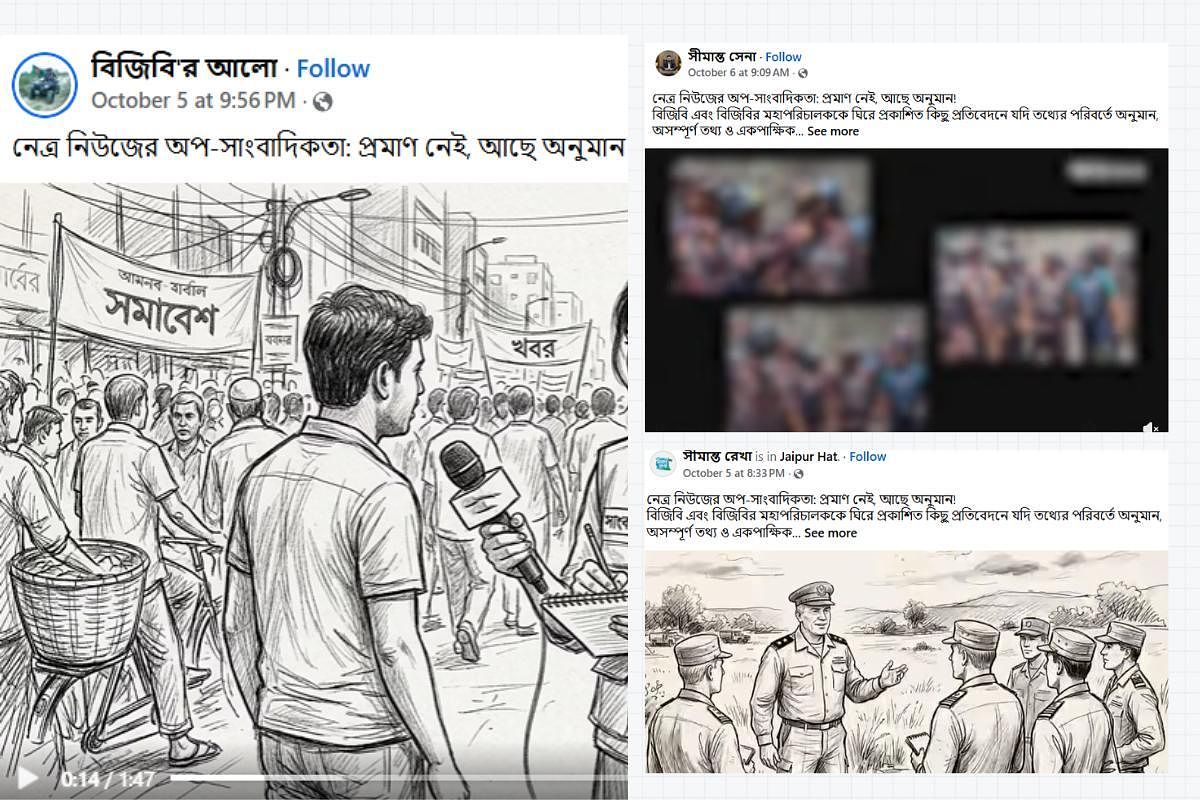
Dozens of Facebook pages have begun publishing propaganda content-- hundreds of them are paid advertisements-- to negatively portray the trial as “staged” and "scripted" while depicting the accused officers as “innocent". The advertisements also targeted several individuals who have long been vocal in demanding trail of the responsible officers.
The Dissent has identified at least 67 Facebook pages taking part in this campaign. Some of these pages were born in the last one to two months, while some are older; investigations show that these older pages occasionally post positive content on issues related to the Bangladesh Army. From these pages, The Dissent found 547 advertisements between June and 26 October of this year; these ads cast several persons—who have been vocal for trials of responsible members of the security and intelligence agencies for disappearances and killings—in a negative light. The time window of the examined ads or posts runs from the beginning of June this year to 26 October. That is, the ads and posts referenced in this report were posted on those pages between 3 June and 26 October.
Although a small number of earlier ads on the same issue were found, the number increased from 3 June; therefore June is taken as the “starting month” of this investigation. Beyond paid ads, these pages posted daily content—texts, images, reels, documentaries—framing the Tribunal’s trial process as “questionable,” “politically motivated,” and “biased.” The investigation found several features indicating that this campaign is coordinated. For example, the same caption/photo-card was posted across many pages within a short time, and both new and old posts/photo-cards were boosted as ads across many pages at about the same time to increase reach. Specific hashtags were repeatedly used across pages (#ICT, #army, #গুম, #DGFI, #mediatrail, #fakenews, etc.).
The timing of boosting posts as ads often matched exactly. For instance, consider one ad about Pinaki Bhattacharya.
The caption read: “Pinaki Bhattacharya’s life seems like a chameleon-like drama. From leftist to Islamist, from businessman to exiled vlogger. Though he keeps himself in discussion through historical distortion, fake medicine scandals and inciting propaganda, he remains a symbol of evading moral responsibility and irresponsibility.”
This Facebook post was simultaneously boosted as an ad at exactly 7:00 a.m. on 4 October 2025 by the pages BanglaZ, গণ টকশোতন্ত্র, Wikileaks V.2, বাংলার বাণী, Flash Feed, and সময়ের অসঙ্গতি.
Another example: at 7:00 a.m. on 3 October the following captioned post was boosted as an ad on four pages at exactly the same time: “Vandalism at House 32 in Dhanmondi was a suicidal step. The fascist government did not fall; rather, sympathy towards them increased. Such destructive acts only undermine the country’s dignity and bring disgrace on the international stage. #PinakiBhattacharya #fblifestyle #foryouシpage”.
Out of the 547 ads across 67 pages, 541 were boosted at exactly 7:00 a.m. Only 4 ads were boosted at 8:00 a.m. Visual materials—photo-cards, memes—sometimes used edited/deepfake videos. Many ad texts used emotionally charged language; in some cases crude negative adjectives were used or targeted individuals’ names were distorted. In addition to the 547 ads, these pages hosted many more pieces of content (text, images, videos) pushing similar messages and claims; the total number of such posts could not be determined. The top 10 ad-purchasing pages together ran 325 ads.
The 10 pages that ran the most ads
গণ টকশোতন্ত্র — 41 ads — https://www.facebook.com/RepublicTalkshow/
বাংলার বাণী — 39 ads — https://www.facebook.com/news.livecht/
Bengali Emotion — 37 ads — https://www.facebook.com/bengaliemotion/
Wikileaks V.2 — 35 ads — https://www.facebook.com/61578410524868/
সময়ের অসঙ্গতি — 34 ads — https://www.facebook.com/pahariponno/
Flash Feed — 33 ads — https://www.facebook.com/flashfeed.newsbd/
BanglaZ — 31 ads — https://www.facebook.com/BanglaZ0/
Xpress News — 26 ads — https://www.facebook.com/xpressnewscht/
Voice of Rights — 26 ads — https://www.facebook.com/bd.voiceofrights/
আওয়াজ উঠাও বাংলাদেশ — 23 ads — https://www.facebook.com/AwajUthaoBD0/
The Dissent investigated and analyzed this coordinated campaign to outline its nature and features. It should be noted that The Dissent did not fact-check the truthfulness of the information and statements used by these pages. Rather, the investigation examined the dynamics and characteristics of an anonymous, coordinated campaign on a specific topic.
Key claims pushed in the ads
What exactly do the ads in this coordinated online campaign promote? The main subjects are several individuals—at least seven. They are: writer and YouTuber Pinaki Bhattacharya, Brigadier General (Retd.) Hasan Nasir, Colonel (Retd.) Hasinur Rahman, Lieutenant Colonel (Retd.) Mostafizur Rahman, member of Bangladesh’s Commission on Enforced Disappearances Dr. Nabila Idris, journalist and YouTuber Ilias Hossain, and journalist and YouTuber Kanak Sarwar.
Among these, the highest number—416 ads—were found against blogger Pinaki Bhattacharya. Next comes journalist Ilias Hossain with 129 ads. There were 57 ads about journalist Kanak Sarwar. There were 100 ads against Lt. Col. (Retd.) Mostafizur Rahman and 65 against Col. (Retd.) Hasinur Rahman. There were 24 ads against Brigadier General (Retd.) Hasan Nasir and 10 ads about Commission member Nabila Idris. In many ads, multiple names appeared together—for example, some ads about Pinaki also mentioned Ilias Hossain, Kanak Sarwar, or Lt. Col. (Retd.) Mostafizur Rahman. These individuals were labeled in the ads as “rumor-mongers,” “anti-state,” or “foreign-influenced”; some ads called for their arrest.
From June to the time of writing, the estimated total money spent on these 547 ads targeting the above individuals is at least 70 thousand taka to several lakhs. Alongside negative portrayals of these individuals, certain other themes appear: the army and the army chief are presented as “professional, disciplined, the pride of the nation”; the army is called the “symbol of stability and security” in Bangladesh; the DGFI is described in many ads as “indispensable for national security.” A recurring argument is “crime is individual, not institutional.”
Campaigns against those vocal for justice
The Dissent’s analysis shows a commonality among the seven highlighted individuals: all have long been vocal about bringing to trial members of the security forces and intelligence agencies implicated in disappearances and killings. Several of these seven have recently written on social media against the current army chief or other serving/former officers; in some cases the language was aggressive, and in some cases The Dissent’s review noted they cited unreliable sources.
Of the two cases in which the International Crimes Tribunal issued arrest warrants on 9 October, one was filed by Lt. Col. (Retd.) Hasinur Rahman. According to a 2022 report by Netra News, he was disappeared by DGFI in 2018 and held in a secret prison until he was released in 2020. On 9 October 2024, he filed a complaint before the ICT naming 11 individuals.
Since then, negative campaigns about him began on Facebook. At least six pages have been running serial campaigns about him, calling him, in places, “a former army officer who himself abducted people,” “a crossfire specialist,” and in almost all the ads claiming “he seeks revenge, not justice.” The six pages spending money to run ads against him are: কাগজের গল্প, Xpress News, রঙিন চশমা, Viral Fact, Power of People, and গণ টকশোতন্ত্র. Three of these pages were created this September, while the others were opened two to three years earlier. Across various pages, at least 65 ads targeting Hasinur Rahman were found.
From these pages, ads were also run against two other former members of the army: Lt. Col. (Retd.) Mostafizur Rahman and Brigadier General (Retd.) Hasan Nasir. Ads described Lt. Col. (Retd.) Mostafizur Rahman as someone who “regularly spreads rumors about the army chief and the army,” linked him to the eviction of Khaleda Zia’s house and to “the disappearance of Colonel Hasinur,” and later labeled him as an “agenda-driven propagandist running anti-army rumor-trade from abroad,” allegedly aiming to “break the morale of the army and weaken the state.” Some pages also called for his arrest. Searching the Meta Ad Library with the keywords “কর্নেল মস্তুফিজ” and “মোস্তাফিজ” found at least 100 negative ads about him running since May this year; negative ads about him are also found prior to 5 August 2024. On at least 5 of the 6 pages campaigning against Colonel Hasinur, negative ads about Lt. Col. Mostafiz are also present.
There were at least 24 ads about former Brigadier General Hasan Nasir. These portrayed his statements/behavior as “violating the army’s confidentiality, undermining morale and impartial image, and dragging it into political controversy.” After 5 August, Hasan Nasir was declared unwelcome at the cantonment; several ads framed that declaration as “preventive and logical.” At least 14 pages ran ads about Hasan Nasir and Lt. Col. Mostafiz: Single Squad, Nispapツ, BanglaZ, জনগণের কণ্ঠস্বর, Bengali Emotion, আমাদের ব্রহ্মপুত্র-By Seba Hot News, Chetonar Bangladesh, সেনাবাহিনী আমার অহংকার, গণ টকশোতন্ত্র, আওয়াজ উঠাও বাংলাদেশ, Mail Dhaka 24.com, দেশে বিদেশে, Voice of Rights, Trending Bangladesh, ইনসাইড স্টোরি, Viral Fact. Notably, both Lt. Col. (Retd.) Mostafizur Rahman and Brig. Gen. (Retd.) Hasan Nasir have long used their social media accounts to allege army involvement in human rights violations and to demand justice, and they have been vocal critics of Army Chief Waker-uz-Zaman.
On 23 October, Lt. Col. Mostafizur Rahman wrote on his verified Facebook ID: “Giving criminal officers unfettered privileges in front of the people is actually a display of General Waker’s muscle power. Same on the Home Affairs Adviser, same on IGP Rizwan Brigadier General Motahar, same on Professor Yunus.” Similarly, since 5 August, Brig. Gen. (Retd.) Hasan Nasir has proposed forming an independent military reform commission regarding the Bangladesh Army and has campaigned for the release of detainees held at DGFI-run ‘Aynaghar’.
Among the 14 pages listed above, at least 6 ran negative ads about Dr. Nabila Idris, a member of the Commission on Enforced Disappearances and someone working on human rights violations by different army officers. These six pages are Single Squad, Nispapツ, আওয়াজ উঠাও বাংলাদেশ, Mail Dhaka 24.com, Trending Bangladesh, and Viral Fact. Outside that list, at least four more pages ran 10 negative ads about Nabila Idris between 14–25 October 2025: সমকালীন বাংলাদেশ, Power of People, নতুন দিগন্ত, BD News. The main narrative in these ads: Dr. Nabila Idris is turning the Commission into a “tool to implement a political agenda” and running a “media trial” against the army and army officers, thereby “damaging the army’s institutional reputation.” The exact “media trial/institutional reputation” framing was posted in identical language by Mail Dhaka 24.com, Power of People, আওয়াজ উঠাও বাংলাদেশ, Nispapツ, সমকালীন বাংলাদেশ, and several others. In places, potential harms to UN peacekeeping missions were also mentioned. On Viral Fact and Single Squad, Dr. Nabila was coupled with ICT Chief Prosecutor Tazlul Islam, alleging that together they were using pressure tactics on the army before the election rather than ensuring justice at the ICT.
Pinaki Bhattacharya is the top target
Across the whole campaign, the highest number of ads targeted writer and YouTuber Pinaki Bhattacharya. From October 2024 to 27 October of this year, more than fifty pages criticized various activities of his through roughly 416 ads; the vast majority ran between June and October, peaking in September–October. Some ads criticized him alone; others linked him with journalist Ilias Hossain and Kanak Sarwar; some tied Colonel (Retd.) Mostafizur Rahman to him.
For example, on 21 September a page named বাংলার বানী posted about Pinaki. The caption: “The name of Pinaki Bhattacharya is still uttered in connection with the terrible fake medicine scandal of 2008. About 289 patients died and thousands suffered severe complications because the kala-azar medicine supplied by his company had no effective ingredient. This proves how people’s safety and trust were sacrificed for profit, causing deaths. Yet justice has not been done; instead, he continues abroad spreading false information and propaganda.” A photo-card titled “In Pinaki’s fake medicine scandal, 289 patients died” accompanied the post at 4:59 p.m. on 21 September.
Searching with the same caption shows that the identical photo-card and caption were posted on at least seven other pages—গণ টকশোতন্ত্র, Wikileaks V.2, স্বদেশ, সংস্কার, সময়ের অসঙ্গতি, Flash Feed, বিবর্তন—between 4–5 p.m. on 21 September. That is, within an hour and a half, the same caption and photo-card appeared in different designs on those pages.
Searching the keywords “পিনাকী এবং কালাজ্বর” shows a report on this topic was published in Prothom Alo on 8 October 2008 and republished on the website ebanglahealth.com. It stated: “The Directorate General of Health Services began feeding patients miltefos (miltefosine) capsules last May to eradicate kala-azar, but questions have arisen about its effectiveness. On 11 September, the DGHS stopped treatment with the capsule. The Drug Administration also ordered the manufacturer Popular Pharmaceuticals Ltd. to temporarily suspend production, storage, and marketing of the capsule.”
The report quoted Dr. Pinaki Bhattacharya, then the company’s COO. Pinaki also posted his own statement on his personal website in 2019.
However, no credible news could be found that 289 people in Bangladesh died due to miltefos/miltefosine. In fact, the claim that 289 died from a Popular Pharmaceuticals drug first appeared in February this year on journalist Masud Kamal’s YouTube channel “Kotha,” made by Dr. Manzur Ahmed Chowdhury, former chairman of the National River Protection Commission. Although he said “such a death toll has come in one account,” he cited no source; the claim was later picked up by several media outlets and then by the coordinated Facebook campaign.
Clustered networks of the promoter pages
The investigation shows the ad-running pages are not all alike nor operated from the same place. Some share behaviors and operators; others share different sets of similarities—thus forming multiple clusters. The eight pages that began posting/boosting several Pinaki-related posts together in late September can be identified as one “cluster.”
They largely copy-pasted each other’s Pinaki posts within a short time, but those exact posts do not appear on other pages running Pinaki ads. The admins’ locations are also common: each page shows 3 or 4 admins; on every page one admin is in Canada (per page transparency), and except for one page, the remaining admins are in Bangladesh.
Another roughly ten pages form another cluster, sharing page-creation timings, copy-paste tendencies, other post topics, and admin locations. Several of the 67 identified pages were created years ago and repeatedly changed names over time.
For example, Xpress News began in 2016 as “সাংবাদিক সাইফুল ইসলাম,” later “সিএইচটি জার্নাল,” then “Bechelor Point All Season,” then “Bechelor Point Season 4,” and later “Khagrachhari Express/খাগড়াছড়ি এক্সপ্রেস.”
The page বাংলার বাণী started in 2017 as “CHT photography,” then “CHT Tour,” then “Organic Products Of CHT,” then “Dream Aviary.”
Voice of Rights started in December 2024 as “Alhamdulillah.”
DGFI framed favorably in narratives
The ads widely used personal attacks against targeted individuals, while portraying the army positively. For example, Pinaki Bhattacharya is described as “rumor-monger,” “fraud,” “anti-state,” and “agent of India’s intelligence agency ‘R’.” Ilias Hossain is depicted as a “yellow journalist” in several ads; Kanak Sarwar is presented as one of the “three monkeys.” A post on গণ টকশোতন্ত্র said, “History-distorters like Pinaki Bhattacharya want to confuse the nation by carrying out foreign agendas. To safeguard the pride of independence, now is the time to unmask this disinformation.” GenZ Nation wrote, “As a journalist or social media personality, Ilias Hossain is controversial. The reason is his coarse language, where journalistic objectivity is absent.” Xpress News posted, “Sensing the heavy defeat of their favorite candidate, the Pinaki–Ilias group is spreading false rumors about the DUCSU election. The intent is clear—to incite clashes and then blame the army… Resist the rumor-mongers of the Pinaki–Ilias group.”
Alongside praise for the army and army chief, many ads also positively presented the DGFI—or condemned the seven targeted individuals for negatively portraying DGFI.
For example, Chetonar Bangladesh wrote: “Who knew there would be a killing? From which angle to record the video?… Then why are Pinaki–Ilias blaming the army–DGFI to save the BNP?”
Bengali Emotion wrote: “If there were no intelligence agencies in Bangladesh, India would benefit—could operate here unhindered… Pinaki’s agenda is actually India’s agenda.”
Voice of Rights writes: “Pinaki’s incitement to dissolve DGFI: the nation faces a terrifying future!”
Ads on Nispapツ and Bangladesh Military Insider stated, “On the tumultuous day of 5 August he went very quietly to Sheikh Hasina… that silence was an indomitable declaration. Army Chief Waker-uz-Zaman Sir—such a name that is now a symbol of trust and stability for many.”
অপ্রতিরোধ্য বাংলাদেশ write: “After 5 August, the country faced three big tasks—justice for the July killings, necessary reforms, and elections… but a group at home and abroad—the Elias–Pinaki—have been busy every day targeting the army for disinformation.”
Power of People writes: “Their biggest failure is rumors about a coup. Because people know the army chief is doing his utmost to protect the democratic process.” Voice of Rights: “Army: a symbol of trust—it has been proven repeatedly in Bangladesh’s history that when the army is on the ground, the people are reassured… Demanding to send the army back to barracks means breaking that trust.”
A possible Deepfake-style ‘analyst’ fronting content
Within the list of ads about Pinaki Bhattacharya, a page named Jahid Hasan Jewel drew The Dissent’s attention. The page ran at least six ads against Pinaki. The core message: Pinaki is political, not justice-oriented; the ads also criticize calls to “dissolve DGFI.” One ad claims some of Pinaki’s statements are false and urges verification. Another ad on the assault by soldiers on Nurul Haque Nur in front of the Jatiya Party office last August alleges a planned conspiracy jointly by “Ilias’s threats and Pinaki’s instigation.”
Analyzing the page shows it started on 24 October last year, initially as Gen-Z Fact Check, then 1 Minute’s Fact Check, and finally Jahid Hasan Jewel. Early posts carried so-called “fact-check reports,” but from August this year it shifted to video “analysis.” Multiple times the page described “Jahid Hasan Jewel” as a “political analyst,” but online searches found no writings, images, or videos of any such analyst beyond the Facebook page.
Examination of its videos (and the YouTube channel of the same name) suggests AI may have been used to modify the speaker’s face. Several inconsistencies appear: a 2 September video titled “Attack on Nur—Undoubtedly Planned,” where he appears older; a video two days later where he looks younger and different; in almost every video, the watch hands on his wrist show the same time—hinting at an edited template. Ironically, despite relentlessly criticizing Pinaki, the page’s initial promotional ad to gather followers used Pinaki’s photo with the caption, “Those who love Pinaki Dada, please follow on the right.”
That indicates the admin’s attempt to mislead readers to gain followers—something a professional political analyst would not do.
(Investigation enabled by Activator Rights; information collection by Jobair Ahmad)